Guides
How Long Does the Solar Permit Process Take in Canada?
Solar permit process in Canada takes 2 to 8 weeks for approvals and 1 to 2 weeks for final inspection. Provincial authorities add variability.
What to take away
- Most residential solar permits in Canada take 2 to 8 weeks from application to approval, with another 1 to 2 weeks for final inspection after installation.
- Municipal building permits and provincial electrical authority reviews run in parallel after the first completeness check.
- The biggest blocker is often the utility interconnection confirmation, which cannot proceed until the local building permit is approved.
- Winter weather and BC's coastal inspections can add 2 to 4 weeks; a heritage property in Toronto is a named worst case at 10 to 12 weeks.
The short version
A Canadian solar permit process rarely follows one timeline. The schedule depends on the municipality, the provincial electrical authority, and the local utility. In Ontario, the Electrical Safety Authority (ESA) handles wiring permits and inspections. In British Columbia, Technical Safety BC (formerly BC Safety Authority) plays a similar role. Most homeowners can expect 2 to 8 weeks for paper approvals and 1 to 2 weeks for the post-install inspection.
Municipal building permits cover roof load, zoning, and fire setbacks, while electrical permits cover the Canadian Electrical Code, inverter disconnects, and labelling. The two reviews often overlap, but some provinces require electrical authorization only after the building permit is issued.
For broader context on how permit regimes vary, see the Wikipedia entry on building code. For an overview of provincial solar programs that affect permit volumes, see Solar power in Canada. This sequence means the longest phase usually dictates the total wait.
In smaller municipalities, the building permit may be issued in 2 to 3 weeks. In larger cities such as Toronto or Vancouver, 4 to 6 weeks is common. The utility interconnection step adds another 1 to 4 weeks in areas with feeder constraints.
Phase by phase
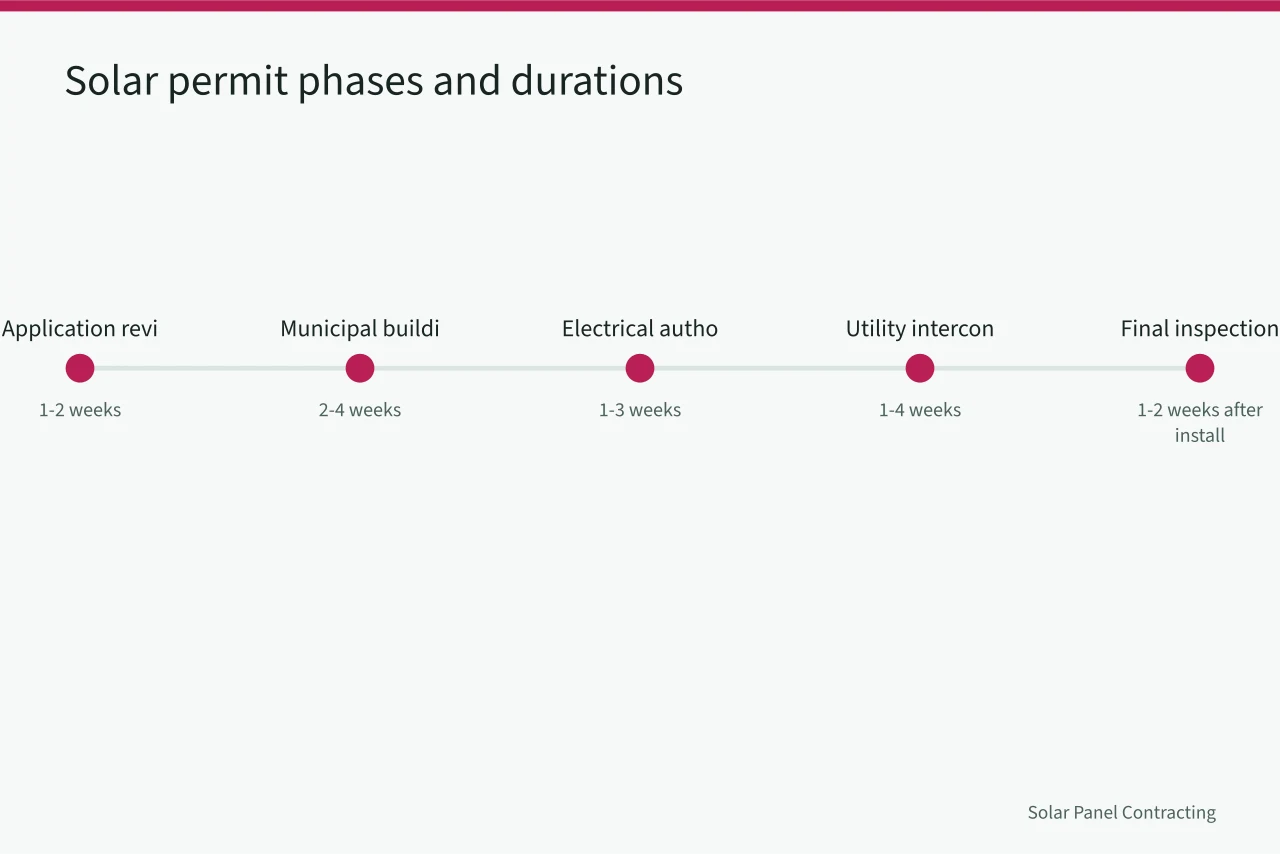
| Phase | Typical duration | What can slow it |
|---|---|---|
| Application completeness review | 1 to 2 weeks | Missing roof plans, inaccurate panel layout, missing engineer stamp |
| Municipal building and zoning review | 2 to 4 weeks | Heritage district rules, setback appeals, site-specific structural questions |
| Electrical authority review | 1 to 3 weeks | Canadian Electrical Code load calculations, service panel capacity |
| Utility interconnection confirmation | 1 to 4 weeks | Transformer capacity, feeder congestion, time-of-use studies |
| Final inspection and reconnection | 1 to 2 weeks after install | Reinspection queue, snow on panels, scheduling conflicts |
The table shows the median range for a standard rooftop system. Ground-mount systems add 1 to 2 weeks to the municipal review because of trenching and property line checks. Off-grid systems may skip the utility phase entirely, but still need the electrical authority approval.
Here is a related read on how local utility territory shapes approvals: solar service-area map. In Canada, provinces often have one dominant utility, but municipal boundaries still matter.
What has to finish before what
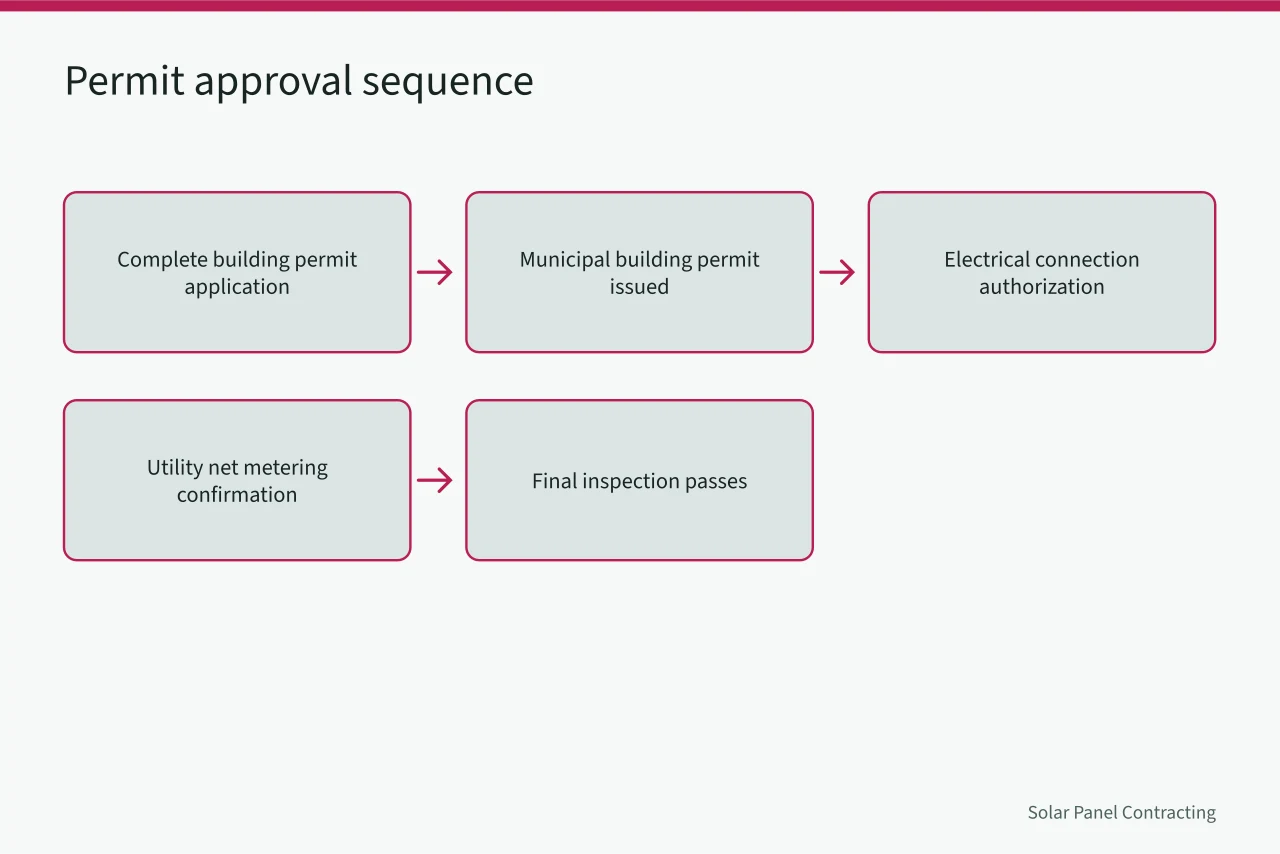
- The building permit application must be complete before any review starts.
- The municipal building permit must be issued before the electrical authority will schedule its connection authorization.
- The electrical authority's connection authorization must be issued before the utility will confirm net metering or bi-directional meter installation.
- The utility interconnection confirmation must be in hand before the final inspection can close the permit file.
- The final inspection must pass before the system may legally export power to the grid.
Step 2 is the most common blocker. In Ontario, an installer cannot request the ESA connection authorization until the local building permit number is active. In BC, Technical Safety BC applies a similar sequence.
If you operate across borders, you will recognize how licensing boards change in similar ways. For a U.S. comparison, see that article.
Where schedules slip
Toronto's heritage review can add four to six weeks because the city's Heritage Preservation Services must approve roof changes before the building permit.
Most slippage comes from incomplete applications, not slow clerks. Missing structural engineer stamps cause a third of municipal resubmissions in Ontario, based on installer experience. The figure is illustrative, but it matches inspector reports.
Utility transformer upgrades are the second largest cause. When the local feeder is full, they can move an approval from 2 weeks to 10 weeks.
In rural areas, a single electrical inspector covering a large territory adds 1 to 2 weeks to the final inspection. In Quebec, the two-week construction holiday in July pauses many permit reviews because municipal and provincial offices close.
Seasonal and weather constraints
Cold weather does not stop a permit, but it slows site inspections. Roof snow can hide flashings and panel mounts, forcing a reinspection 2 to 3 weeks later. Frozen ground delays ground-mount trench inspection by 2 to 4 weeks in the Prairies. The spring melt in BC's Lower Mainland can create a short backlog because many homeowners request permits at the same time.
A referral habit matters after the inspection passes. See solar installer business referral habit for how owners convert happy clients.
Example
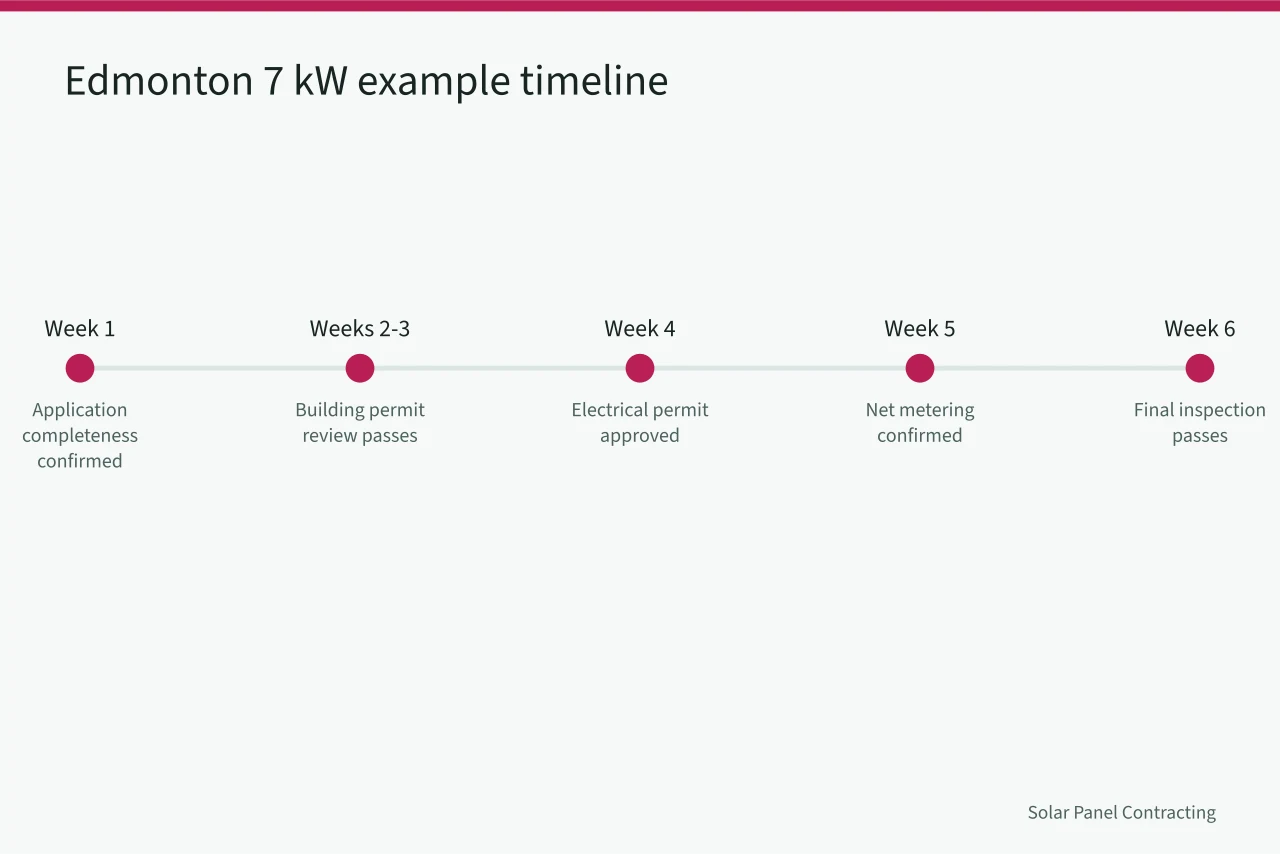
A 7 kW rooftop system in Edmonton often takes 6 weeks total. Week 1: municipality confirms the application is complete. Week 2 and 3: building permit review passes. Week 4: Alberta's Safety Codes officer approves the electrical permit. Week 5: EPCOR confirms net metering on the existing transformer. Week 6: final inspection after installation passes. That assumes no heritage review, no feeder upgrade, and no snow delay. The worst case in the same city is 11 weeks when the transformer needs a larger service.
Before starting, check that your installer's quote includes the same permit assumptions. The solar installer quotes article shows where timelines hide in a contract.
Common questions
How long does the solar permit process take in Canada overall? Most homeowners wait 2 to 8 weeks for municipal and electrical approvals, plus 1 to 2 weeks for the final inspection after installation.
Can I install the panels before the permit is approved? No. Installing before the municipal building permit is issued violates local bylaws and can void the electrical authority's connection authorization.
What is the single longest phase in the solar permit process? Utility interconnection confirmation is often the longest, because transformer and feeder studies may take 4 to 10 weeks.
Does winter slow down a solar permit in Canada? Yes, but less for paperwork. Snow and cold can delay final inspections by 2 to 3 weeks, especially for ground mounts.