Guides
Building a solar installer business referral habit in 2027
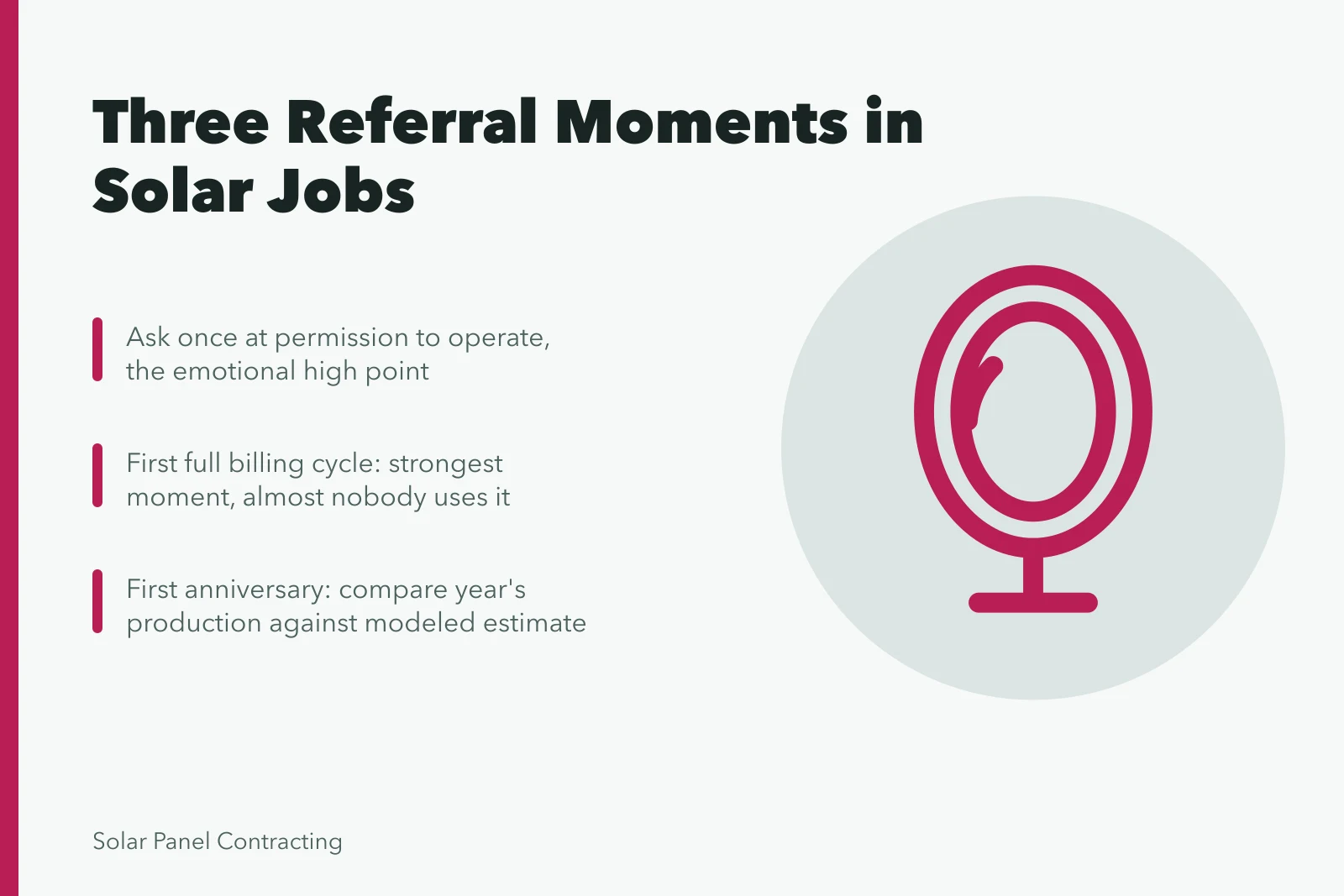
Solar referrals come from three moments in a job, not from a rewards scheme. Here is what to do at each, and why the second one matters most.
What to take away
- A residential solar job produces three natural referral moments: permission to operate, the first full billing cycle, and the first anniversary. Almost nobody uses the second two.
- The strongest referral generator is the thing nobody thinks of as marketing: contacting the customer during the weeks when nothing is happening.
- A cash incentive scheme is legal in most contexts and it changes what you must disclose. Understand that before offering one.
- Trade referrals from roofers and electricians are a separate and often better channel, because those people have already been on the roof.
Why timing matters more than mechanism
Most referral programs fail because they ask at the wrong moment. The classic mistake is asking on install day, when the customer is pleased about a job whose quality nobody can yet judge and whose outcome they have not experienced.
A residential solar customer's actual experience unfolds over months. They sign, they wait, they see one day of work, they wait again, the system is finally switched on, and then they find out what it does. The moments where they know something worth telling a neighbor are later than most contractors think.
Moment one: permission to operate
The day the utility gives permission and the system starts running is the emotional high point of the whole process. It is the day the thing they bought becomes real.
What to do. Tell them, rather than letting them discover it. Walk them through the monitoring so they can see production. Hand over the documentation package and explain what each warranty covers and who honors it. Then ask, once, whether they know anyone considering the same thing.
Ask for a review here too, on the same terms you use for everyone. The Federal Trade Commission's guidance on soliciting and paying for online reviews says requests should go to genuine customers, not just those likely to respond well.
Any incentive or connection must be disclosed, not left to create a false impression. Asking everyone at the same point satisfies that and gives you honest signal.
Moment two: the first full billing cycle
The most valuable moment and the one almost nobody uses.
After a complete billing period with the system running, the customer has something concrete: a bill they can compare. That is when they tell people, and it is when they have a question they would otherwise ask a search engine.
What to do. Contact them, ask whether the bill made sense to them, and offer to look at the production data alongside it. Answer honestly, including where the answer is that the utility's rate structure explains more of the change than the array does.
Two things happen. You catch a misunderstanding before it becomes a complaint. And you are present at the exact moment they are talking to neighbors about it.
Moment three: the first anniversary
A full year of production is the first point at which the system can be compared against the estimate honestly, since a partial year proves nothing.
What to do. Send the year's production against the modeled estimate, with the assumptions the estimate rested on. Explain any gap plainly, whether it is shading, soiling, weather, or equipment. Offer a service visit if the data suggests one.
A contractor who volunteers this comparison, including when it is unflattering, is doing something almost no one in the trade does. It is also the moment to ask again, because a year of satisfaction is a stronger recommendation than a good install day.
| Moment | What the customer knows by then | What to do | Why it is usually missed |
|---|---|---|---|
| Permission to operate | That the system is real and running | Walk the monitoring, hand over documents, ask once | Contractors ask on install day instead |
| First full billing cycle | What it actually does to a bill | Ask whether the bill made sense, read it with them | Nobody makes the call |
| First anniversary | A full year against the estimate | Send the comparison, explain any gap | It risks an unflattering conversation |
The thing that makes all three work
The weeks of silence between installation and energization are where satisfaction is lost. A customer who spent six weeks wondering whether they had been forgotten does not refer anyone, however good the installation was.
Contact them on a fixed schedule during that period even when there is nothing to report. Tell them inspection passed. Tell them the utility package went in. It costs minutes and it is the highest-return activity in this list.
The four dates you are reporting on are the same ones you should already be tracking to run the operation: install complete, inspection passed, utility package submitted, permission to operate. Operations and referrals turn out to be the same subject.
The anniversary conversation is the one owners avoid, because a year of data can show a shortfall. That is precisely why it works. A contractor who volunteers an unflattering number and explains it is doing something the customer has never seen a contractor do, and it is remembered.
Trade referrals, a different channel
Roofers, electricians, real estate agents, and home inspectors all encounter the customer earlier than you do, and the first two have already been on the roof.
A roofer who has just replaced a covering knows the deck is sound and the remaining life is long, which are two of your survey questions already answered. An electrician who has just upgraded a service panel knows there is capacity.
Build these relationships by being useful first: refer work to them, tell them plainly what you can and cannot do, and never compete with them on their own work. Then make it easy for them to hand a customer over.
Be careful with any arrangement that involves payment. Depending on how it is structured it may need disclosure to the customer, and some states regulate referral arrangements between licensed contractors. The state contractor board is the authority on what is permitted where you work; ask before you agree anything.
If you offer an incentive
A reward for a referral is common and it carries obligations.
The link between the person recommending you and your company is a material connection. It must be disclosed, not left implicit. The Federal Trade Commission's guidance on reviews and endorsements is the frame for that.
Practically: if you pay for referrals, say so publicly, and tell the referring customer that they should disclose the arrangement when they recommend you. That instruction is part of running the program honestly, not an optional courtesy.
Also consider whether you want one at all. Referrals that arrive because someone is genuinely satisfied behave differently from referrals that arrive because someone wants a payment, and the survey survival rate of the two groups is usually not the same.
What kills referrals
Four things, in order of frequency.
Silence during the waiting period. Already covered, and the most common by a wide margin.
A leak. Nothing undoes goodwill faster, which is why the attachment method and the photographic record described in the equipment and setup guide for solar crews matter to marketing as much as to quality.
A production shortfall the customer was not prepared for. Prevented at proposal time by stating what the estimate assumes, and handled at moment three by volunteering the comparison.
An incentive that did not arrive as expected. Federal residential credits are administered by the Internal Revenue Service and depend on the customer's own tax position; state and utility programs come from the state energy office and the utility. Say that in the proposal, in writing, and the disappointment lands somewhere other than on you.
Measuring it
Tag every lead with its source, and tag referrals with the customer who made them and the moment at which they were asked. After a season you will know which moment produces the most, which is worth knowing because it is probably not the one you expected.
Compare referral leads against other channels on survey survival rate, not volume. Referrals usually win by a wide margin, which is the argument for spending owner time here rather than on paid channels, as the marketing and growth guide for solar owners sets out.
Being findable matters too, because a neighbor who hears your name will search for it. Google's own guidance on improving your local ranking describes what its systems take into account, in Google's words, and the practical steps sit in the local search checklist for solar contractors.
Capacity first
Referrals arrive in clusters, because neighborhoods talk. A run of them into a company that cannot install them produces long waits, which produces exactly the silence problem that stops the next round of referrals.
Before working this list hard, check that the crew can absorb the result. That staffing question is in the hiring and training guide for solar contractors.
How to ask that a customer becomes a customer at all is the sequence in winning more solar customers.
Common questions
How many times should I ask one customer?
Once at each of the three moments, and never again if the answer is no. Repeated asking converts a satisfied customer into an irritated one.
Should I ask a customer whose job went badly?
Ask for the review, yes, on the same terms as everyone. Do not ask for a referral. The distinction is that one is honest feedback and the other is a favor you have not earned.
Do referral cards and yard signs work?
Sometimes, and they are cheap. They are not a substitute for the three moments, which is where the actual conversation happens.
What if most of my work is already referrals?
That is a good position and a fragile one, because referral volume cannot be increased on demand. Keep one other channel working even when you do not need it.