Guides
The bookkeeping routine that keeps a solar installer business solvent in 2027
Solar installer bookkeeping around the deposit-to-energization cash curve: what leaves the account, when, and why a growing company runs short.
What to take away
- A residential solar job has a cash curve with a deep trough. Money goes out for material and labor weeks before the final payment arrives, and the final payment usually waits for the utility.
- That trough is why growing companies in this trade run out of cash while showing a profit. Every additional job in flight opens another one.
- Job costing is not optional bookkeeping. Without cost attached to each job you cannot tell which work funds the company and which drains it.
- Deposits held for work not yet done are not earnings. Treat them as an obligation until the work is delivered.
The cash curve of one job
Follow the money for a single residential installation, in order.
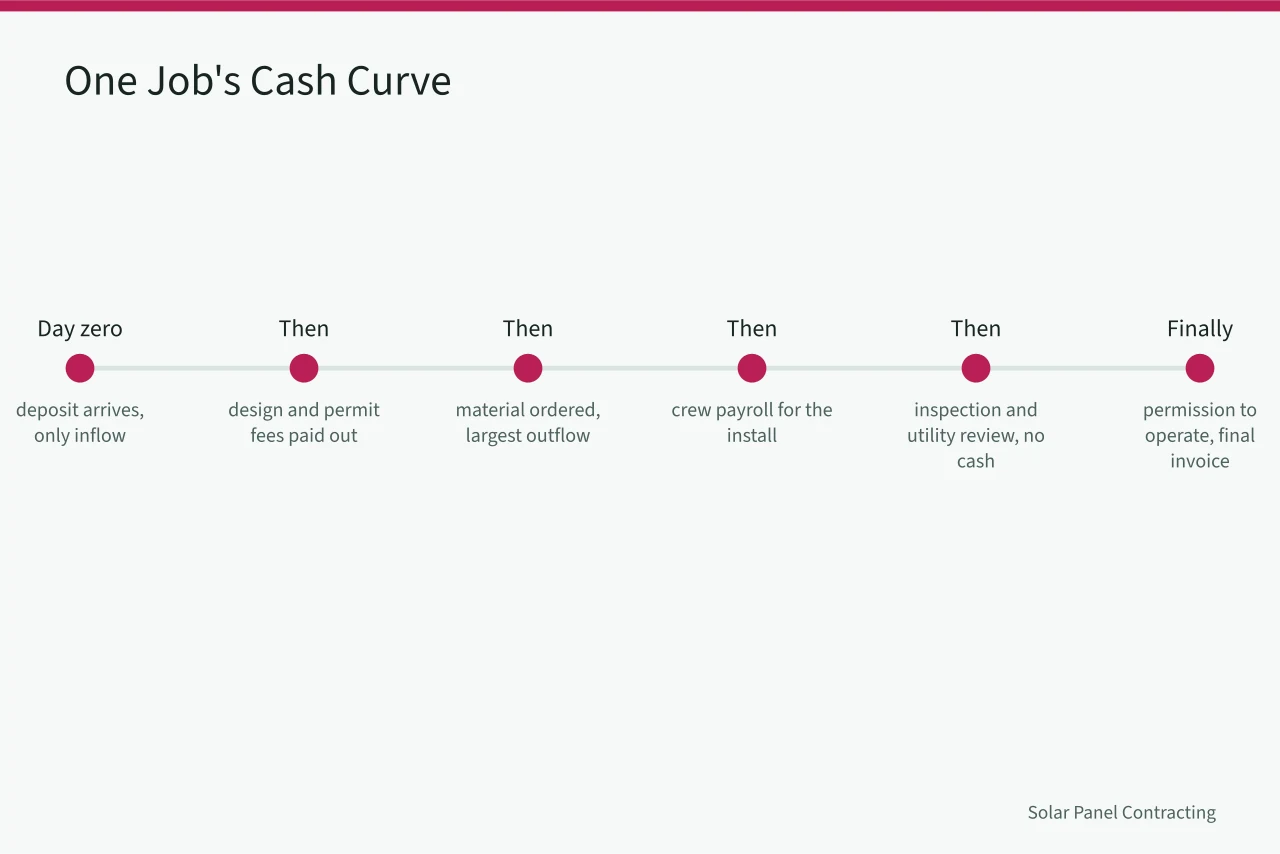
Day zero: a deposit arrives. This is the only inflow until the end.
Then: design time and permit fees go out. Small amounts, but they go out before anything is certain.
Then: material is ordered and paid for, or invoiced on terms that will come due. This is the largest single outflow and it happens before installation.
Then: crew payroll for the install. Paid on your payroll cycle regardless of anything else.
Then: nothing, for a period you do not control, while inspection happens and the utility processes the interconnection.
Finally: permission to operate, and the final invoice becomes due. Then collection, which takes its own time.
| Stage | Direction | Size | Timing you control |
|---|---|---|---|
| Deposit | In | Partial | Yes, subject to state rules on home improvement deposits |
| Design and permit fees | Out | Small | Yes |
| Material | Out | Largest single item | Partly, through supplier terms |
| Install payroll | Out | Large | No, it follows your payroll cycle |
| Inspection and utility review | Neither | None | Only the first two of three gaps |
| Final payment | In | The balance | No, if it is tied to permission to operate |
The variables to fill in
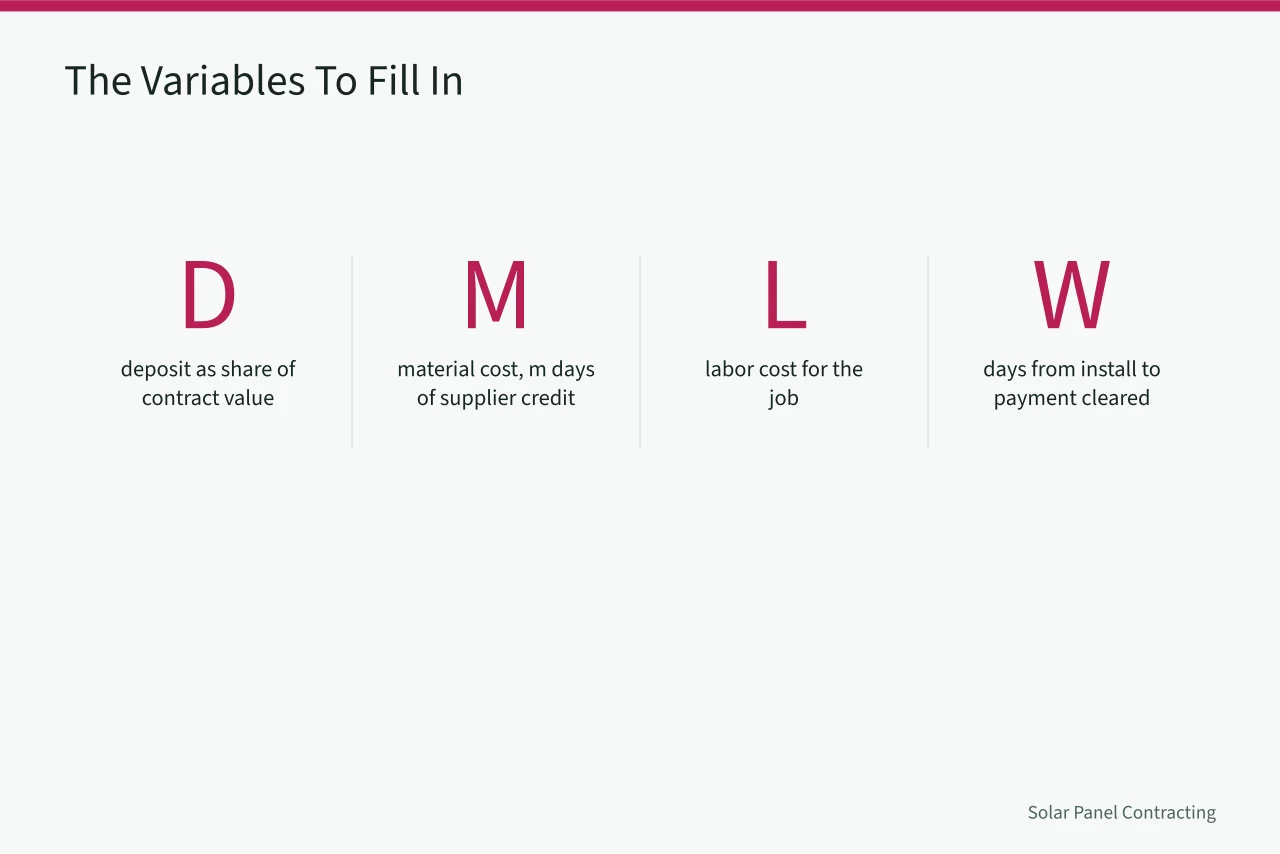
- D is the deposit, as a share of contract value.
- M is material cost, and m is the number of days of supplier credit you have.
- L is labor cost for the job.
- W is the number of days between installation and final payment cleared.
- J is the number of jobs you have in flight at once.
Cash exposed on one job is roughly M plus L minus D, adjusted for m if your supplier terms let you pay after installation.
Cash exposed across the company is roughly that figure multiplied by J, held for W days.
The uncomfortable consequence: doubling J doubles the cash you need, and improving profitability does nothing about it in the short term.
Why W is the number to watch
W is partly yours and partly not. The days between install and inspection are yours. The days between inspection and your submission to the utility are yours, and they are where small companies lose the most. The days after that belong to the utility.
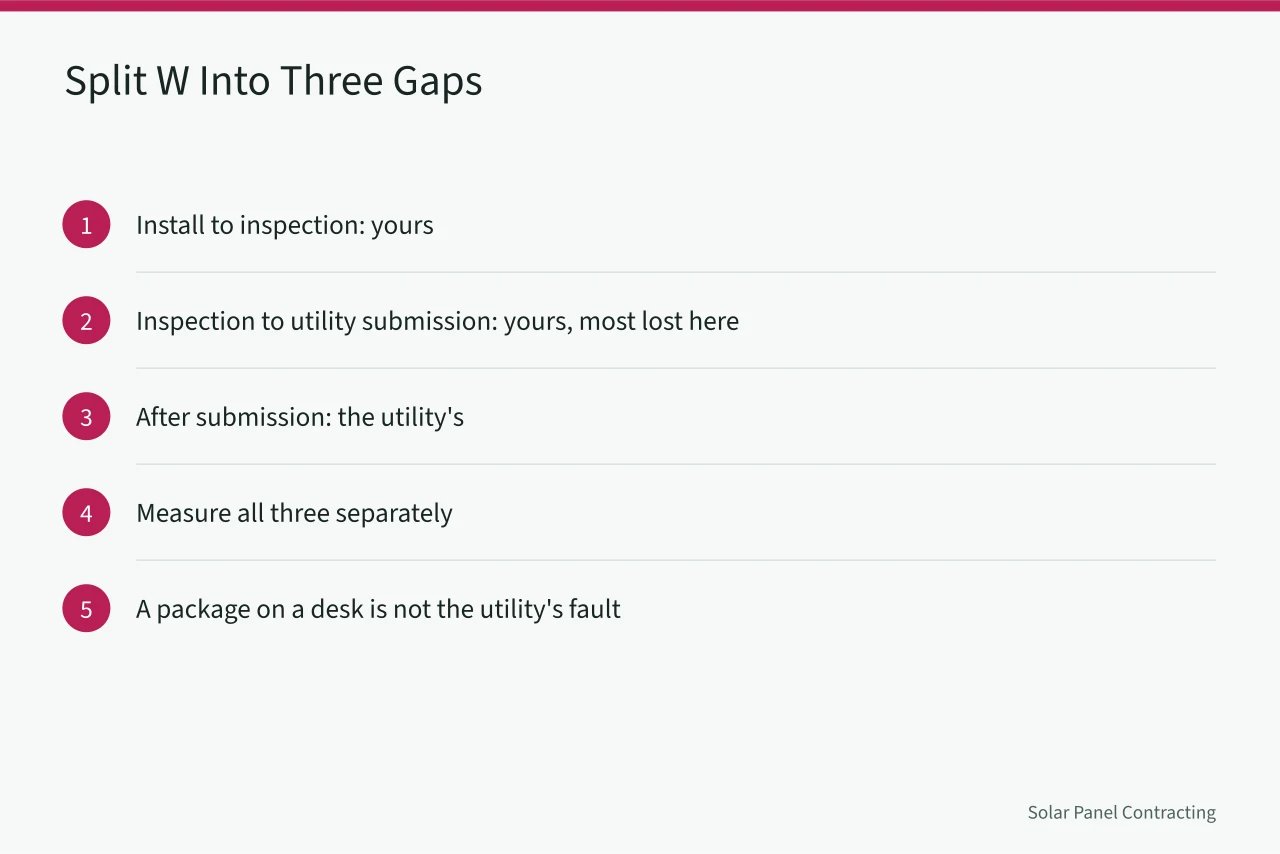
Measure all three separately. A company that believes W is entirely the utility's fault usually finds, on measuring, that a meaningful share of it is a package sitting on somebody's desk.
W also moves without warning. A utility queue lengthens, a jurisdiction changes its review process, and your cash requirement rises before anything else you can see changes.
Deposits are not revenue
A deposit taken for work not yet performed is money you owe in service. Record it that way.
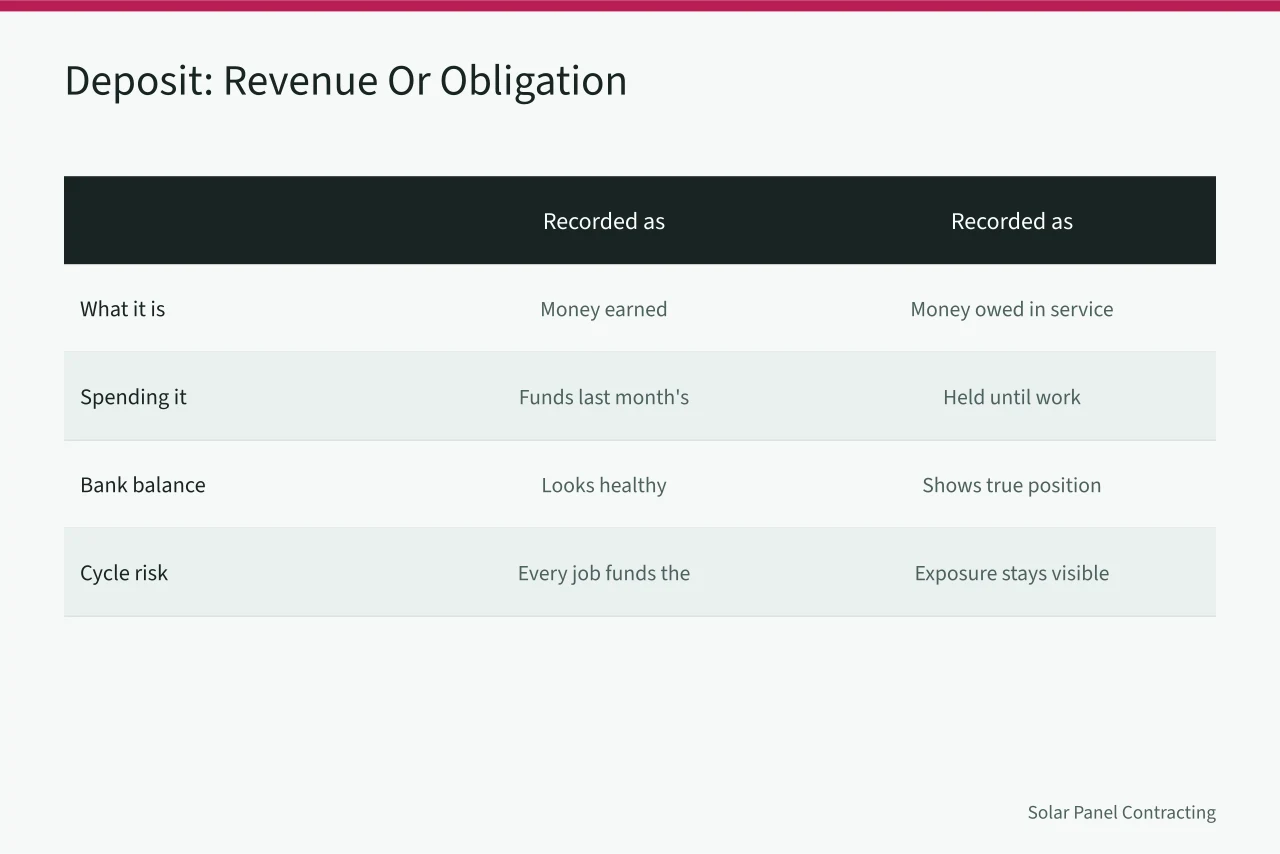
Two practical consequences. It should not be spent on last month's costs, which is the beginning of the cycle where every job funds the previous one. And it should be visible on your accounts as an obligation, so that a healthy-looking bank balance is not mistaken for a healthy business.
Whether you may take deposits at all, and how large they may be, is regulated in some states for home improvement contracts. The state contractor board is the authority on what applies to you, and it is worth asking before setting a deposit policy.
Job costing, which is the whole point
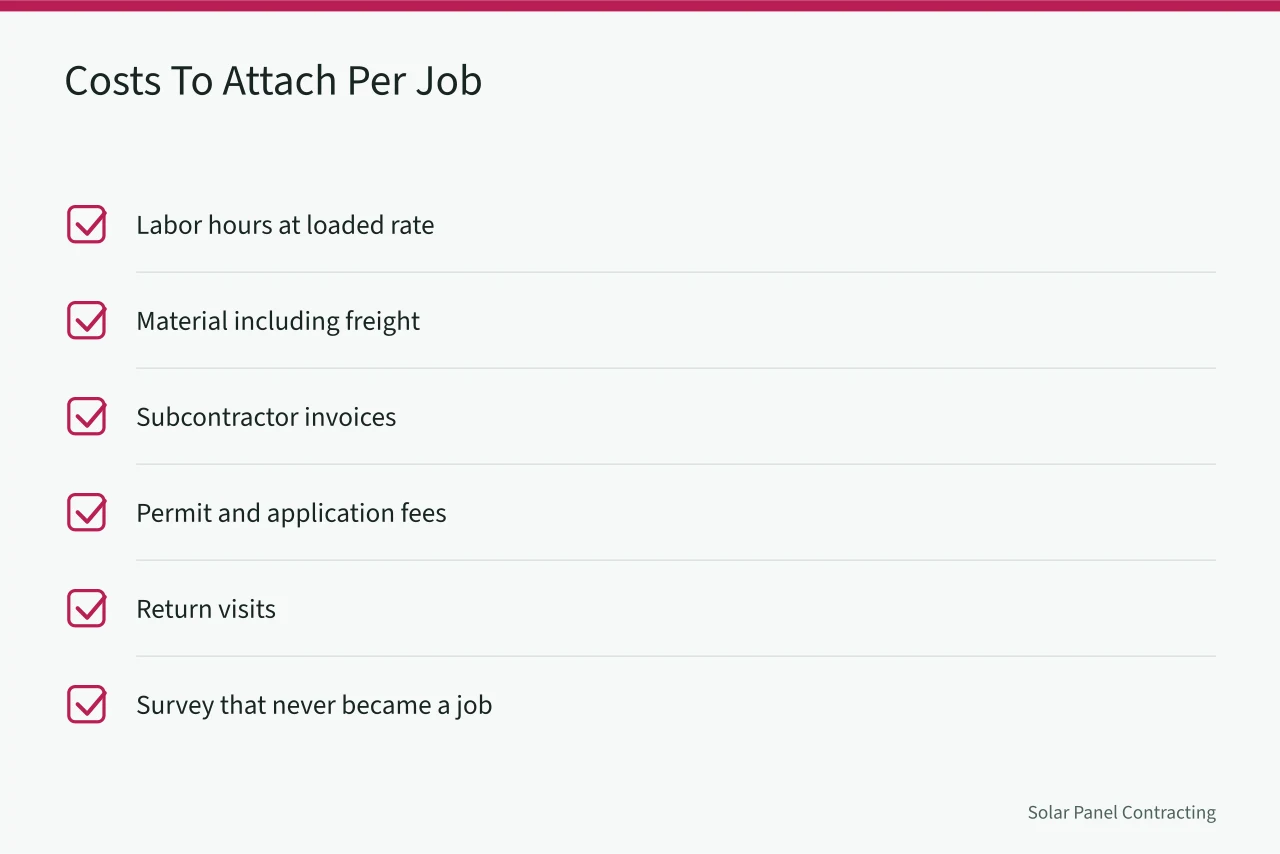
Attach cost to each job as it is incurred: labor hours at your loaded rate, material with freight, subcontractor invoices, permit and application fees, and the return visits.
The Internal Revenue Service's guidance on records a small business should keep describes the standard: a system that clearly shows income and expenses with documents supporting purchases, sales, payroll, and assets. Costing by job satisfies that and answers your operating questions at the same time, which is why it is one piece of work rather than two.
The two costs most often omitted: the return visit, which lands in a later month and is charged to overhead.
The survey that never became a job is carried by the jobs that did.
The loaded crew day rate used for that job costing is built in the wage and labor cost guide for solar installer businesses.
A monthly close that takes an hour
Six steps, in order.
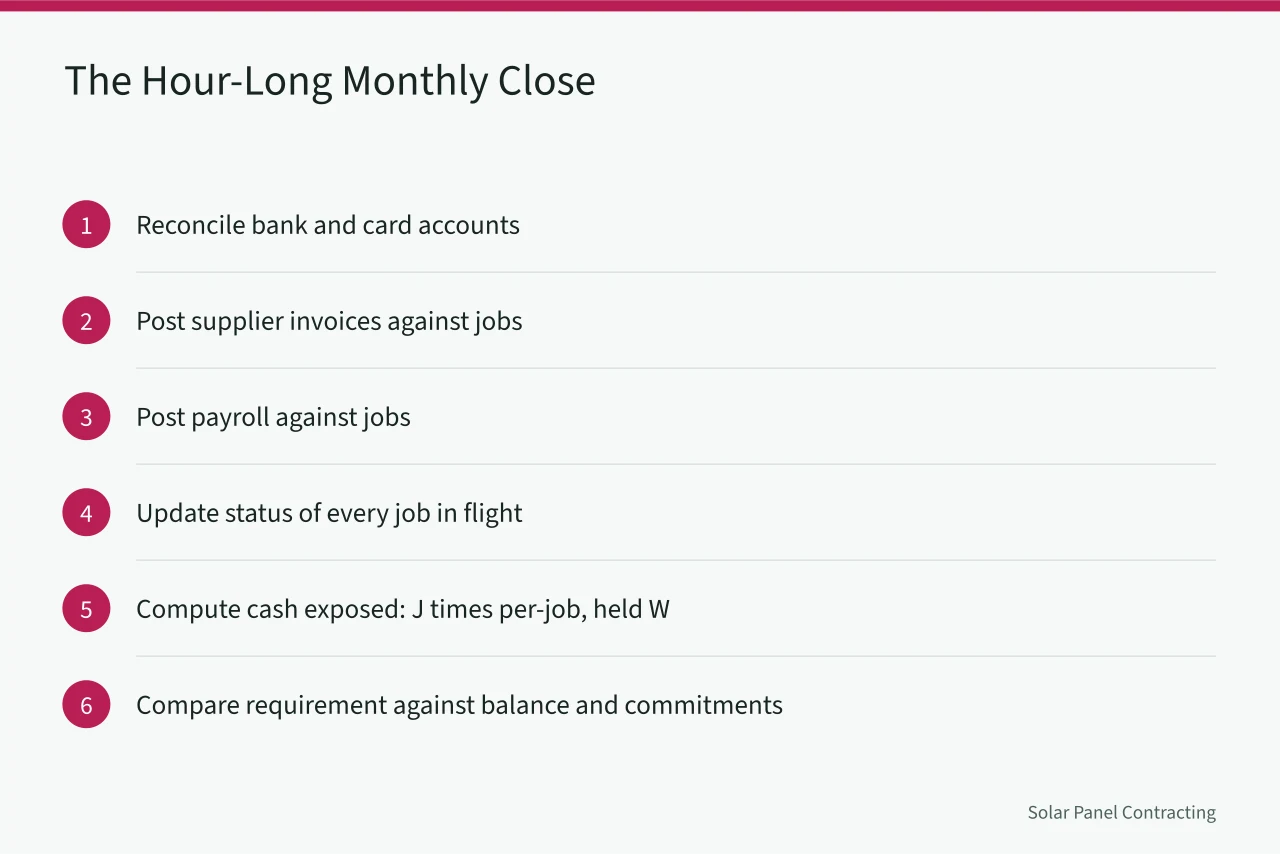
- Reconcile the bank and the card accounts.
- Post every supplier invoice against a job rather than to a general material account.
- Post payroll against jobs, using the crew day records.
- Update the status of every job in flight, with its four dates.
- Compute cash exposed: jobs in flight, times cash out per job, held for W.
- Compare the cash requirement against the balance and the coming month's committed costs.
Step five is the one nobody does and the one that predicts the problem a month before it arrives.
The costs that arrive whether or not the utility acts
Payroll during weeks a crew is waiting on permits. Vehicle payments. Insurance premiums. Software subscriptions. License renewals. Rent on the yard. The supplier's invoice on its due date.
All of them are due on the calendar while your revenue is due on the utility's calendar. That mismatch is the structural fact of this trade's finances, and how crew size drives the largest of these is set out in the hiring and training guide for solar contractors.
Where the numbers come from
Every figure in this page comes off the job record, which is why the record has to hold cost as well as work. What that record needs to contain, and which tools can hold it, is covered in the software and measurement guide for solar owners.
The equipment side has a trap: instrument verification, fall protection replacement, and consumables are recurring costs that crews budget as one-time buys.
The full list is in the equipment and setup guide for solar crews.
Protecting the financial records themselves
Your accounting and job records hold customer addresses, payment details, and often financing information. That is a target.
The National Institute of Standards and Technology publishes small business quick-start guides aimed at organizations with no security staff, and the Cybersecurity and Infrastructure Security Agency maintains resources for small and medium businesses covering the same ground.
The specific risk for a contractor is payment fraud: an emailed change of bank details, purportedly from a supplier or from your own office, arriving during a busy week. Verify any change of payment instructions by a phone call to a number you already had, every time, with no exceptions for urgency.
Growth and cash
The last point, because it is the one that closes companies.
A solar contractor that wins more work needs more cash right away. The extra profit comes later.
If you plan to grow, work out the cash requirement first using J, W, and the per-job exposure above. Arrange for it before the work arrives, not during it.
That calculation belongs in the assessment described in the expansion guide for solar contractors.
Common questions
Should I use cash or accrual accounting?
Ask an accountant, because the answer depends on your size, your entity, and your state. Whichever you use, the cash curve above still has to be managed separately, because a profitable month and a solvent month are different things.
Can I improve W by chasing the utility?
Sometimes marginally. You will do better by shortening the gap between inspection and your own submission, which is entirely within your control and is usually larger than owners expect.
Is supplier credit worth pursuing?
Yes. Terms that let you pay for material after installation shorten the funded portion of the curve considerably, and it is one of the highest-value conversations a new contractor can have.
How much cash should the company hold?
Enough to cover jobs in flight through W, plus the fixed costs of the slowest month of your season. Work out both numbers rather than using a general rule.