Guides
Solar Installer Customer Financing Options Compared: US Lenders and Terms
Solar installer customer financing options compared: GoodLeap, Mosaic, leases and PPAs on terms, FICO tiers, plus federal ITC eligibility rules and dealer fees.
What to take away
- Solar installer customer financing options split into ownership loans and third-party leases or power purchase agreements.
- GoodLeap and Mosaic are the two most common point-of-sale loan platforms for US installers, but neither is objectively better for every job.
- Loans preserve the federal investment tax credit for the homeowner; leases and PPAs shift that credit to the financing company.
- A FICO score in the mid-600s or higher gets the best APR, while scores below 620 often trigger higher dealer fees or secured terms.
- All financing options still leave workmanship, permitting, and service response with the installer.
This comparison walks through the terms a US solar installer should show a customer. Use sample solar installer quotes to see how financing line items appear in a fixed-price proposal. It uses illustrative ranges because published APRs and dealer fees move with borrower FICO, installer volume, and state rules.
Installers often sell financing as a convenience, but the loan changes the sale. A homeowner who cannot use the federal tax credit may prefer a lease. One who plans to sell in five years may need a shorter term or a transferable loan.
Ask whether the loan uses a fixed or variable APR. A fixed APR keeps the payment predictable. A variable APR can rise if the index moves.
The financing products compared
GoodLeap and Mosaic are the two names installers see most often on dealer portals. Both offer solar loans with same-day prequalification in many cases, and both rely on installer networks to fund projects after installation. A solar lease means a third-party owner installs the system and charges a fixed monthly payment. A power purchase agreement charges per kilowatt-hour produced.
The Consumer Financial Protection Bureau describes a solar loan as a personal or home equity loan used to pay for a solar system. For a broader view, see the solar financing models on Wikipedia.
The criteria that matter
The U.S. Department of Energy's homeowner guide separates loans, leases and PPAs and explains that the federal tax credit goes to the system owner. That single fact drives most of the comparison.
Compare the annual percentage rate and total of payments, not just the monthly payment. A lower monthly payment often hides a longer term or a higher dealer fee.
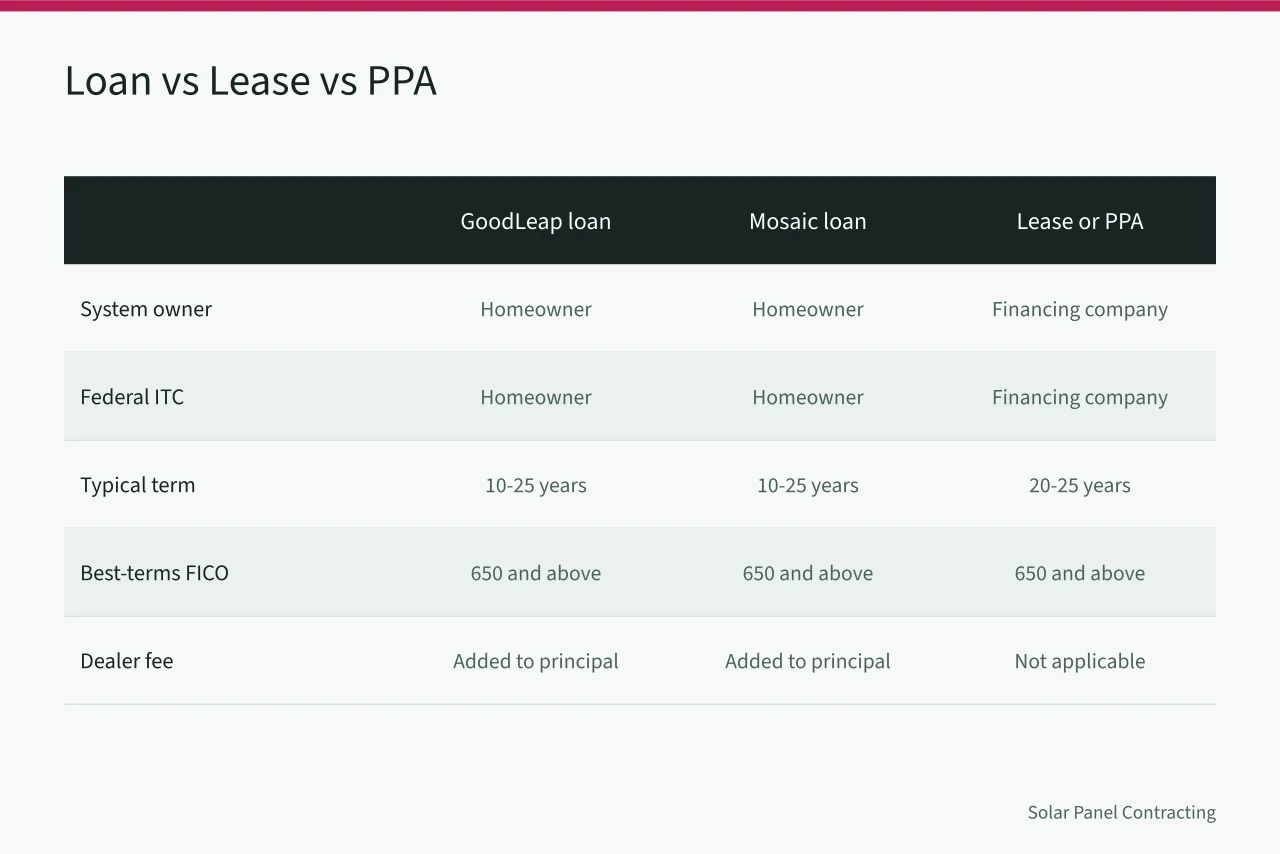
| Criterion | GoodLeap loan | Mosaic loan | Lease or PPA |
|---|---|---|---|
| Who owns the system | Homeowner | Homeowner | Financing company |
| Who claims the federal ITC | Homeowner | Homeowner | Financing company |
| Typical term | 10 to 25 years (illustrative) | 10 to 25 years (illustrative) | 20 to 25 years (illustrative) |
| FICO tier for best terms | 650 and above (illustrative) | 650 and above (illustrative) | 650 and above (illustrative) |
| Dealer fee | Added to principal | Added to principal | Not applicable; return comes from payments |
Where each one wins
GoodLeap fits when an installer wants a widely accepted point-of-sale loan with rapid credit decisions and a large dealer network. Mosaic fits when the installer already uses Mosaic's portal and the borrower wants a loan tied to a specific solar or storage package. A lease or PPA fits when a homeowner cannot use the federal ITC, wants predictable monthly payments, and plans to stay past the break-even point.
If the homeowner wants storage, the financing decision also shifts with Battery attachment economics.
Steps for comparing offers
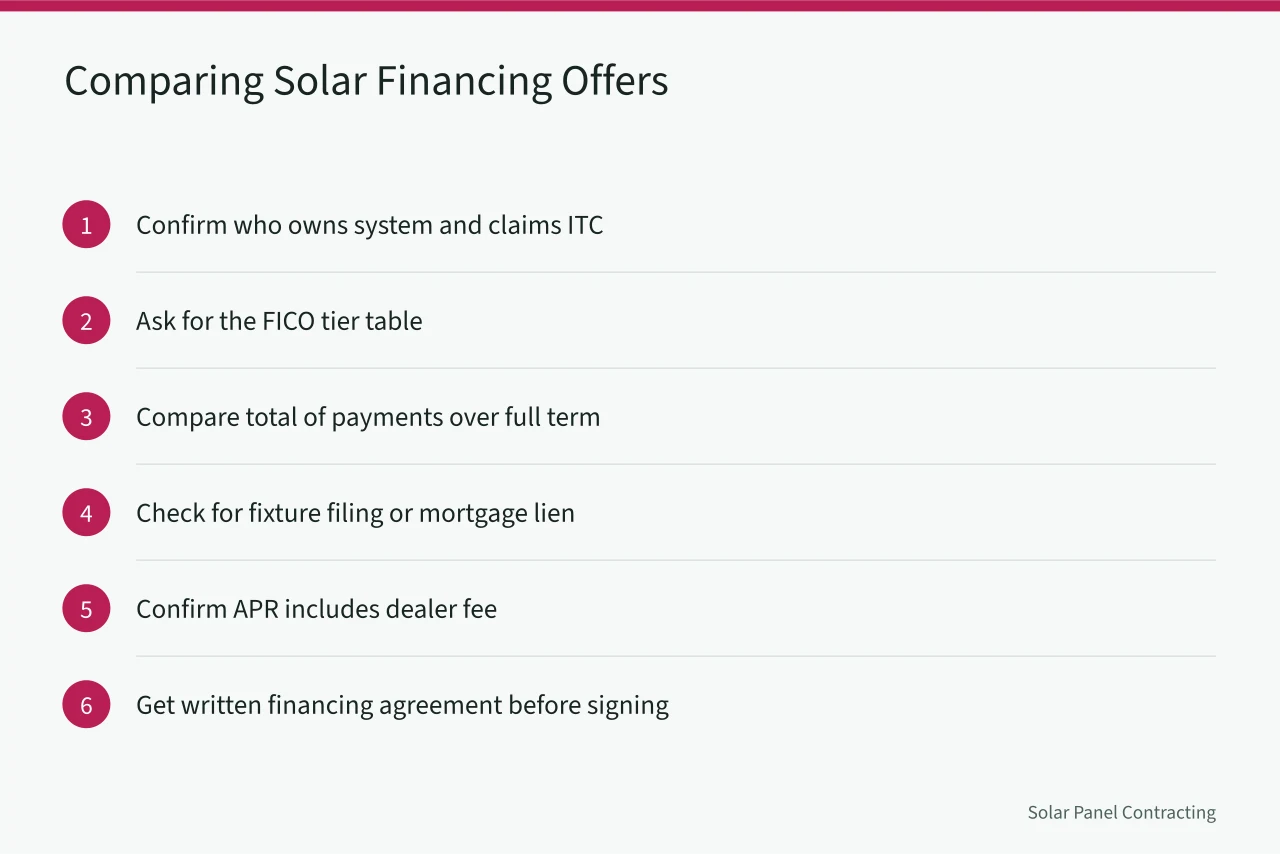
- Confirm who owns the system and who claims the federal ITC. The homeowner gets the credit only with a loan or cash purchase.
- Ask for the FICO tier table: advertised APR at 720 and above, near-prime at 650 to 719, and high-500s if the lender has one.
- Compare the total of payments over the full term. Include any dealer fee added to the principal.
- Check for a fixture filing or mortgage lien. A solar loan can affect a home sale if the balance is not paid at closing.
Check whether the APR includes the dealer fee or whether the fee appears as a separate line item. A loan with a 4.99 percent APR and a 20 percent dealer fee may cost more than a loan with a 6.99 percent APR and no dealer fee. Ask for a written financing agreement before the contract is signed.
The installer must keep the federal solar tax credit paperwork complete at handoff. Missing documentation delays the homeowner's credit and creates a callback.
Example FICO tier impact
Illustrative example: a homeowner with a 720 FICO might see an advertised APR near the lender's lowest offered rate. A homeowner with a 620 FICO might still qualify through GoodLeap or Mosaic, but with a higher APR and a larger dealer fee. That higher fee can be financed into the loan, which raises the total of payments without changing the monthly payment much.
What none of them solve
All three options price the system but do not guarantee the installation. A missed flashing detail or a weak roof attachment may stay hidden for months. Production guarantees often exclude physical damage or installer error. The shared limitation is that financing contracts do not replace the installer's workmanship warranty or service response. If a borrower later disputes the installation, the loan company is usually not the right party to fix it. Use a solar installer complaint handling process before the financing funds.
Common questions
Is GoodLeap always better than Mosaic? No. Both are point-of-sale solar lenders with similar FICO tiers and dealer fee structures. The better choice depends on the installer's platform, volume discounts, and the borrower's approved APR.
Does a solar lease qualify for the federal tax credit? No. The third-party owner claims the federal investment tax credit on a lease or PPA. The homeowner gets the credit only when they buy the system with cash or a loan.
What credit score do I need for a solar loan? Advertised APRs usually require a FICO score in the mid-600s or higher. Some lenders accept scores in the high-500s with a higher APR or a larger dealer fee.
What is the biggest mistake when comparing financing offers? Comparing monthly payments alone. That hides a longer term or a dealer fee rolled into the principal, which raises the total cost.