Guides
Solar Installer Lead Generation Cost: Benchmarks for Owner-Operators
Solar installer lead generation cost in the U.S. runs $25 to $300 per lead depending on source, exclusivity, and state. Benchmarks for owner-operators.
What to take away
- U.S. shared solar leads on marketplaces like EnergySage and SolarReviews typically run $25 to $150 per lead, while exclusive or appointment-set leads run $150 to $300 or more; these are illustrative planning ranges, not guarantees.
- The invoice line is only part of the cost; follow-up labor, CRM software, advertising, and sales time add $40 to $120 per lead in many small shops.
- State competition, lead exclusivity, and source quality are the three biggest cost drivers.
- Use a simple benchmark: if your total cost per signed job stays below 10 percent of contract value, the lead pipeline is usually healthy.
Solar installer lead generation cost in the U.S. separates into what a vendor charges and what it costs you to work the lead. A shared lead from EnergySage or SolarReviews is not a signed contract; it is a name on a list. Owner-operators who buy leads without a follow-up budget waste the lead fee.
What the range covers
Shared marketplace leads cost the least because the same homeowner request goes to multiple installers. EnergySage and SolarReviews are the two platforms most small shops test first, and shared solar leads run about $25 to $90 in a competitive metro. California, Massachusetts, and New York metro areas sit at the high end.
Exclusive leads from solar sales lead vendors commonly run $100 to $300. Pre-set appointments and call transfers cost $150 to $500 or more, since the vendor did part of the sales work.
These are planning ranges, not price lists. A vendor may quote $45 per shared lead in Phoenix and $120 for the same lead type in San Jose.
Local competition and utility savings change a homeowner's interest value, and solar lead pricing varies more by state than by platform. State residential solar demand varies widely; Solar power in the United States shows California, Texas, and Florida among the largest markets, which changes how vendors price leads.
Line by line costs
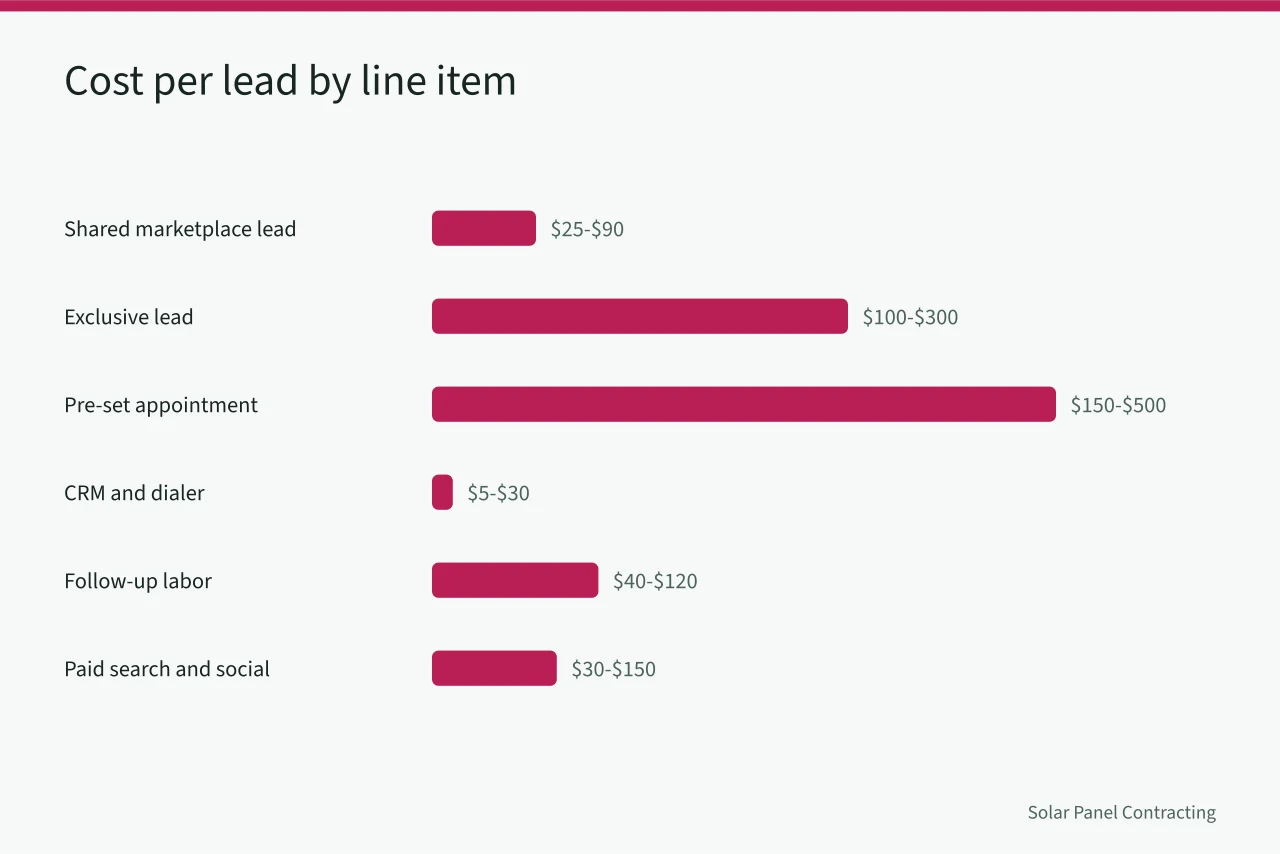
A lead invoice rarely shows the full cost. Use this table to separate the invoice from the internal spend.
| Cost line item | Illustrative low per lead | Illustrative high per lead |
|---|---|---|
| Shared marketplace lead (EnergySage, SolarReviews) | $25 | $90 |
| Exclusive lead from solar sales lead vendors | $100 | $300 |
| Pre-set appointment or call transfer | $150 | $500 |
| CRM and dialer software allocation | $5 | $30 |
| Follow-up labor and sales time | $40 | $120 |
| Paid search and social media spend per lead | $30 | $150 |
The table shows why a '$50 lead' can turn into a $200 acquisition cost after follow-up labor and software. Owner-operators often overlook the internal line items because they are not on a third-party invoice. A referral habit can lower the need for paid leads over time.
What moves the number
Three drivers matter most.
- State and local competition. High electric rates and net metering rules in California and the Northeast push up demand, but they also attract more installers. Cost per lead rises because more bidders compete for the same homeowner. Austin installer labor market shows how regional labor costs feed the same competitive pressure.
- Lead exclusivity. A shared lead may cost $40, but five installers receive it. A $250 exclusive lead from solar sales lead vendors may close at 20 percent or more because only you are calling the homeowner. The higher price can be cheaper per signed job.
- Source quality. Aged leads, list buys, and pay-per-click leads without a qualifying question rarely convert. A live transfer from a homeowner who asked for a quote costs more but produces a different conversation.
These drivers interact. An exclusive lead in a low-competition state may cost $80, while a shared lead in a high-competition metro costs $70.
What quotes leave out
Owner-operators often mistake marketed cost per lead for total cost. A $50 shared lead may require 8 to 12 touches before an appointment, and that labor is not in the $50.
Vendor quotes usually omit match rate, the share of leads with a viable roof and utility bill. They also omit exclusivity terms, chargebacks for bad contact data, and minimum spend commitment.
Before signing, ask for a sample lead report and the definition of a qualified lead. Lead generation cost structures include spend per lead and pay-per-action fees; definitions vary by vendor. Lead generation
Where owner-operators overspend
The biggest overspend is buying exclusive leads before the follow-up process is fast. If a lead sits without a call, an exclusive lead loses most of its value.
Another common overspend is paying for solar leads from a general list vendor without state-level utility verification. Owner-operators in Texas who buy national leads waste money on homeowners with poor solar economics.
A solar service-area map targets utility zones where solar makes financial sense.
Another overspend is paying for premium appointments without checking how the vendor sets the appointment. A confirmed appointment from a call center may be a homeowner who only agreed to receive a brochure. Customer financing options affect close rates; leads with strong credit and a loan pre-approval convert at a different level than cash-poor leads.
Common questions
What is a realistic cost per lead for a small solar installer? A shared marketplace lead in a competitive U.S. metro typically costs $25 to $90, while an exclusive lead runs $100 to $300. Treat those as illustrative ranges, not quotes.
Should I buy exclusive or shared leads first? Start with shared leads if you have fast follow-up. Switch to exclusive or pre-set appointments after your close rate on shared leads is stable.
How much should lead generation cost as a share of a solar job? Many owner-operators keep total customer acquisition cost under 10 percent of contract value. On a $25,000 system, that means $2,500 or less per signed job including all labor and software.
Which platform gives the cheapest solar leads? EnergySage and SolarReviews both sell shared leads, but the price per lead depends on ZIP code, project size, and season. Cheap national leads from a general list vendor usually cost less but close far less often.