Guides
Solar installer team training checklist owners reuse
Solar installer employee training as a competency matrix: what each role must be signed off on, in what order, and who is allowed to do the signing.
What to take away
- Training is a matrix, not a course. Rows are competencies, columns are roles, and a cell is either required or not. Nothing gets signed off in bulk.
- Sign-off has an order, because some competencies are prerequisites for others. Nobody trains on roof attachment before they are signed off on working at height.
- The signature has to mean something. Define who may sign, what they must have observed, and what evidence is attached.
- Keep the records. They are the first thing an occupational safety inspector asks for and the first thing an insurer asks about after an incident.
How the matrix works
Four columns for a typical small residential solar company: installer, roof lead, electrical role, and surveyor. The owner usually occupies more than one.
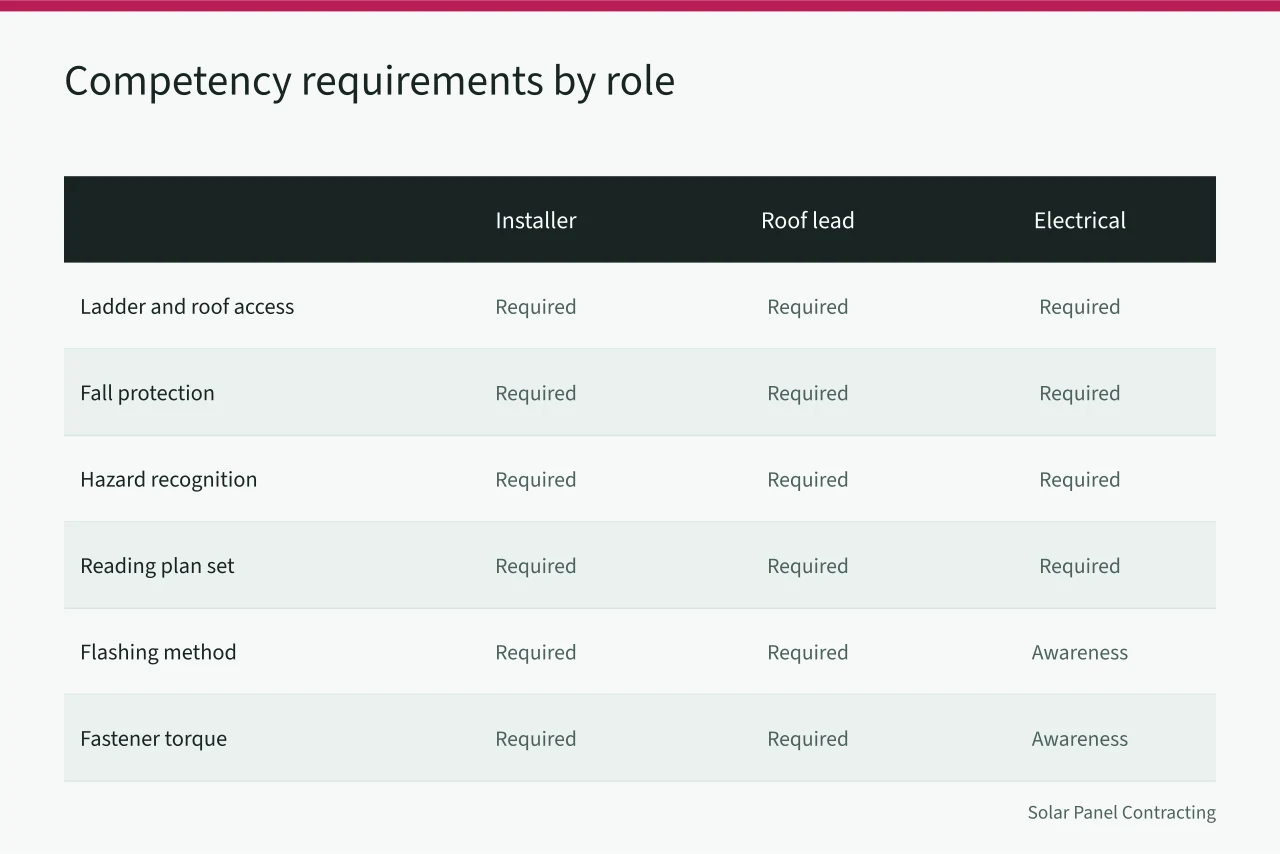
A competency is required, not required, or awareness only. Awareness only means the person must understand enough to recognize a problem and call someone, which matters for roles that visit sites without performing the work.
| Competency | Installer | Roof lead | Electrical | Surveyor |
|---|---|---|---|---|
| Ladder and roof access | Required | Required | Required | Required |
| Fall protection use and inspection | Required | Required | Required | Required |
| Hazard recognition on a residential roof | Required | Required | Required | Required |
| Reading the approved plan set | Required | Required | Required | Required |
| Flashing method by roof covering | Required | Required | Awareness | Awareness |
| Structural fastener torque and recording | Required | Required | Awareness | Not required |
| Conductor management on the roof | Required | Required | Required | Not required |
| Electrical termination torque | Awareness | Awareness | Required | Not required |
| Verifying a circuit is dead | Required | Required | Required | Awareness |
| Labeling to jurisdiction expectations | Awareness | Required | Required | Not required |
| Commissioning and test procedure | Awareness | Awareness | Required | Not required |
| Photographic evidence standard | Required | Required | Required | Required |
| Customer communication on site | Required | Required | Required | Required |
| Service panel assessment | Not required | Awareness | Required | Required |
| Shade assessment method | Not required | Not required | Not required | Required |
| Stop rules and escalation | Required | Required | Required | Required |
Adapt the columns to your own crew shapes, which are set out in the hiring and training guide for solar contractors. What the electrical column may lawfully contain is decided by the state contractor board and the local electrical authority, not by this matrix.
The order of sign-off
Three tiers, and nobody moves up until the tier below is complete.
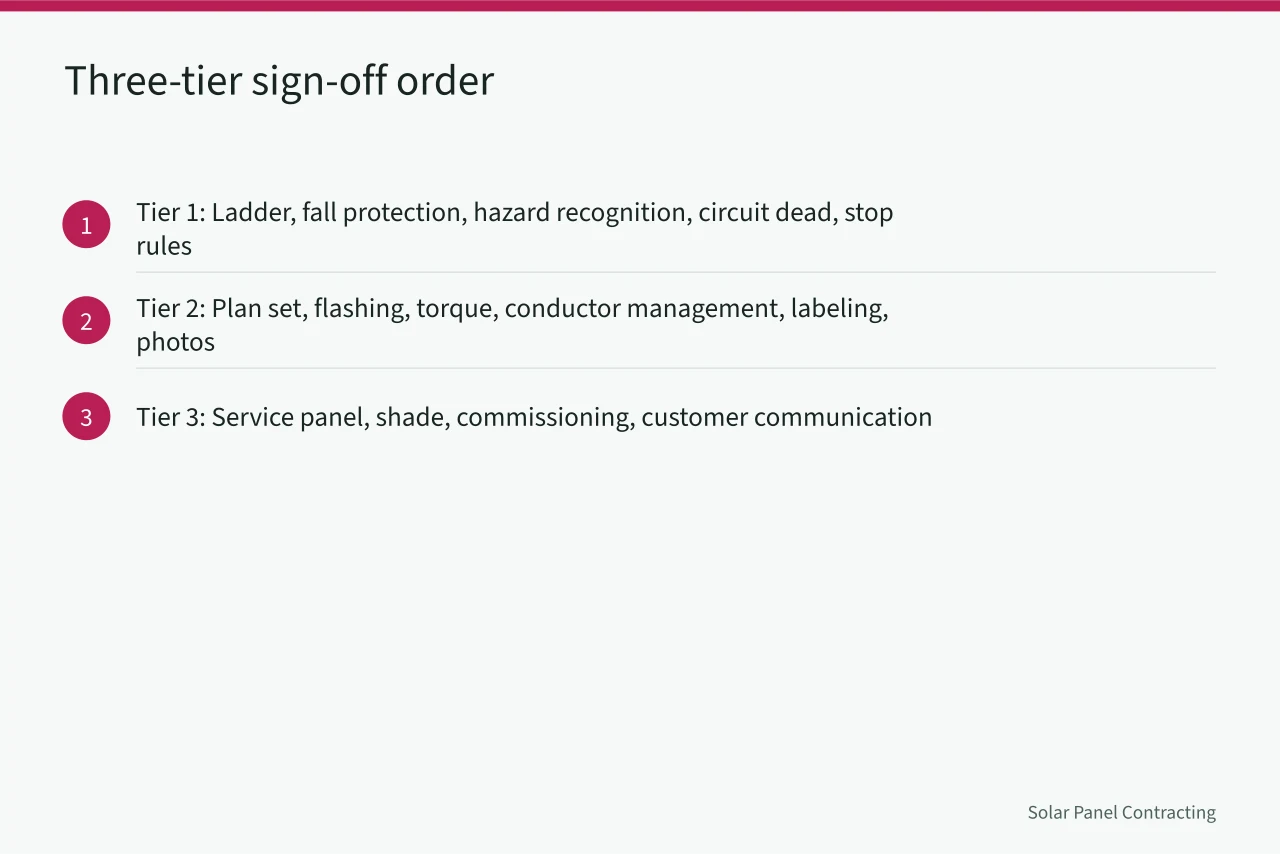
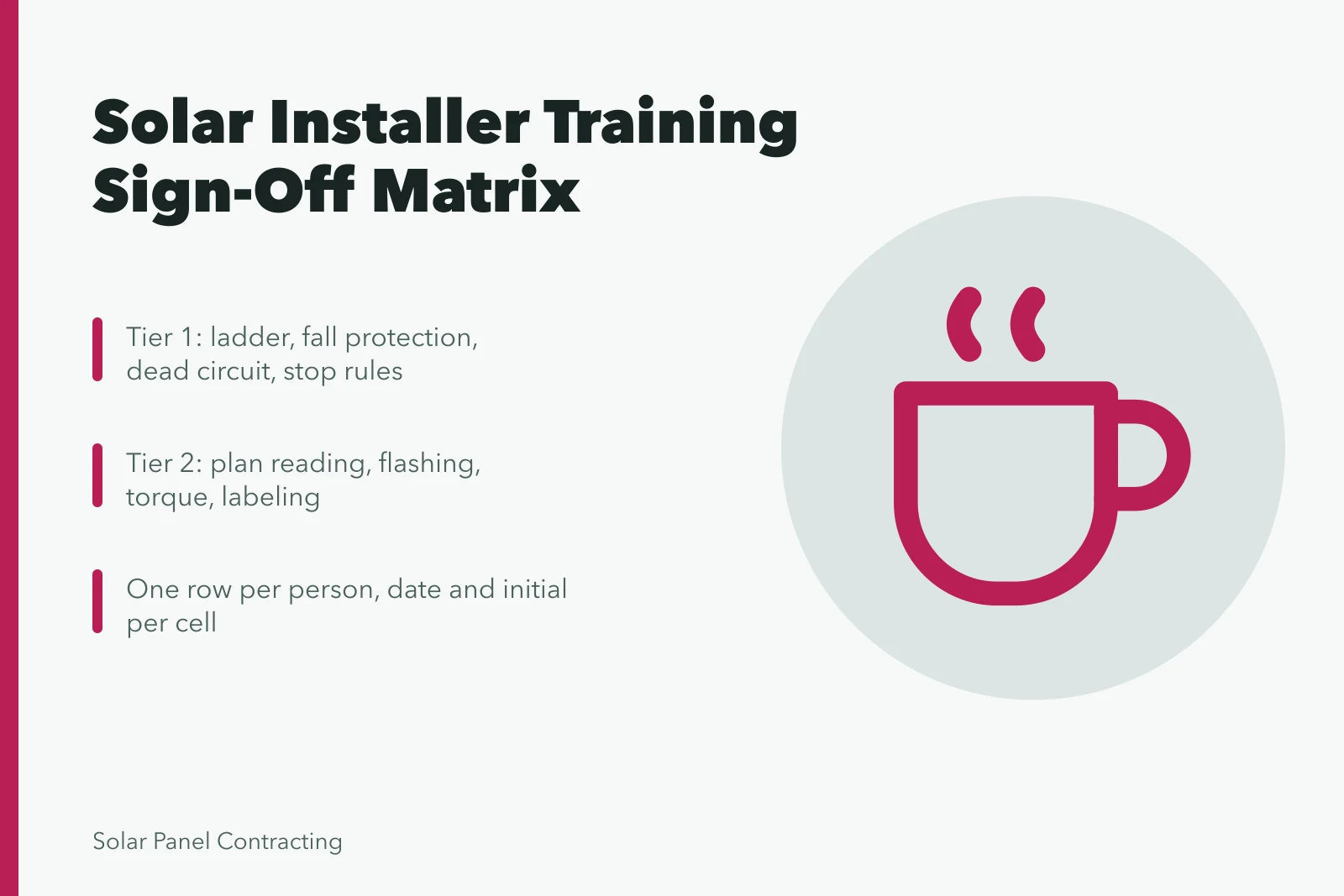
Tier 1, before anyone goes on a roof. Ladder and access, fall protection use and inspection, hazard recognition, verifying a circuit is dead, stop rules and escalation. No exceptions, no partial credit, and no working at height while any of these is outstanding.
Tier 2, the trade competencies. Reading the plan set, flashing method, torque and recording, conductor management, labeling, photographic evidence. These are trained one at a time against the written field cards described in the field card method for solar service standards.
Tier 3, the judgment competencies. Service panel assessment, shade assessment, commissioning, and customer communication under pressure. These take a season and cannot be compressed.
What a sign-off requires
Four things, every time.
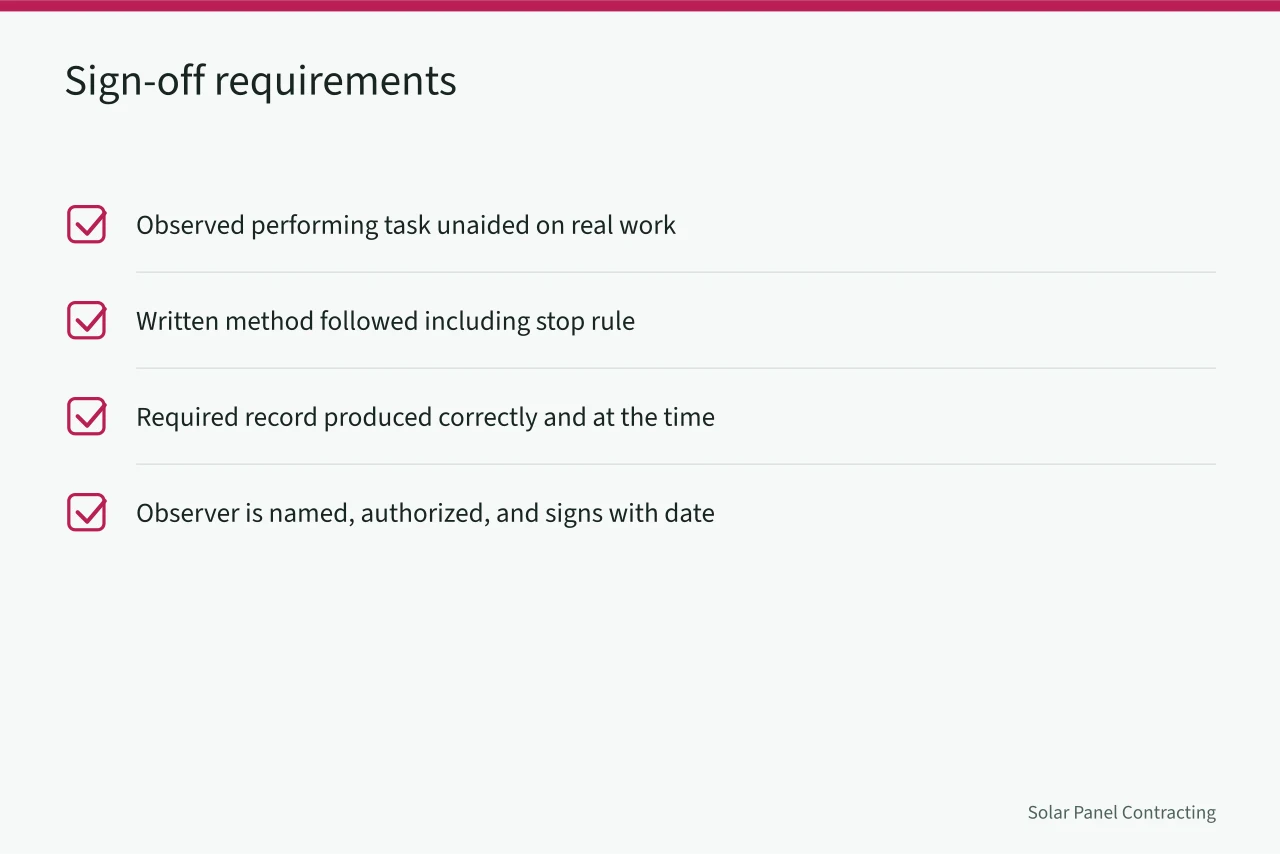
Someone competent observed the person perform the task unaided, on real work, not in a demonstration.
The written method was followed, including the stop rule, which means the observer has to have seen what happens when something is missing.
The record the task requires was produced correctly and at the time, rather than reconstructed afterwards.
The observer is a named person authorized to sign that competency, and they sign with a date.
An observer who signs off someone they have not watched has created a document that will be produced after an incident. Say that out loud when you set the system up.
Recording it
One row per person, one column per competency, a date and an initial in each cell. Keep it where it can be produced quickly and keep the evidence behind it: the photographs, the torque records, and the observation notes.
OSHA and any applicable state plan set training and record expectations for this work. What binds you depends on the standards and your state.
The practical point holds either way: a company that cannot show who was trained on what and when is in a poor position after any incident.
Refresher intervals
Set them, write them down, and put them on the same calendar as your license renewals.
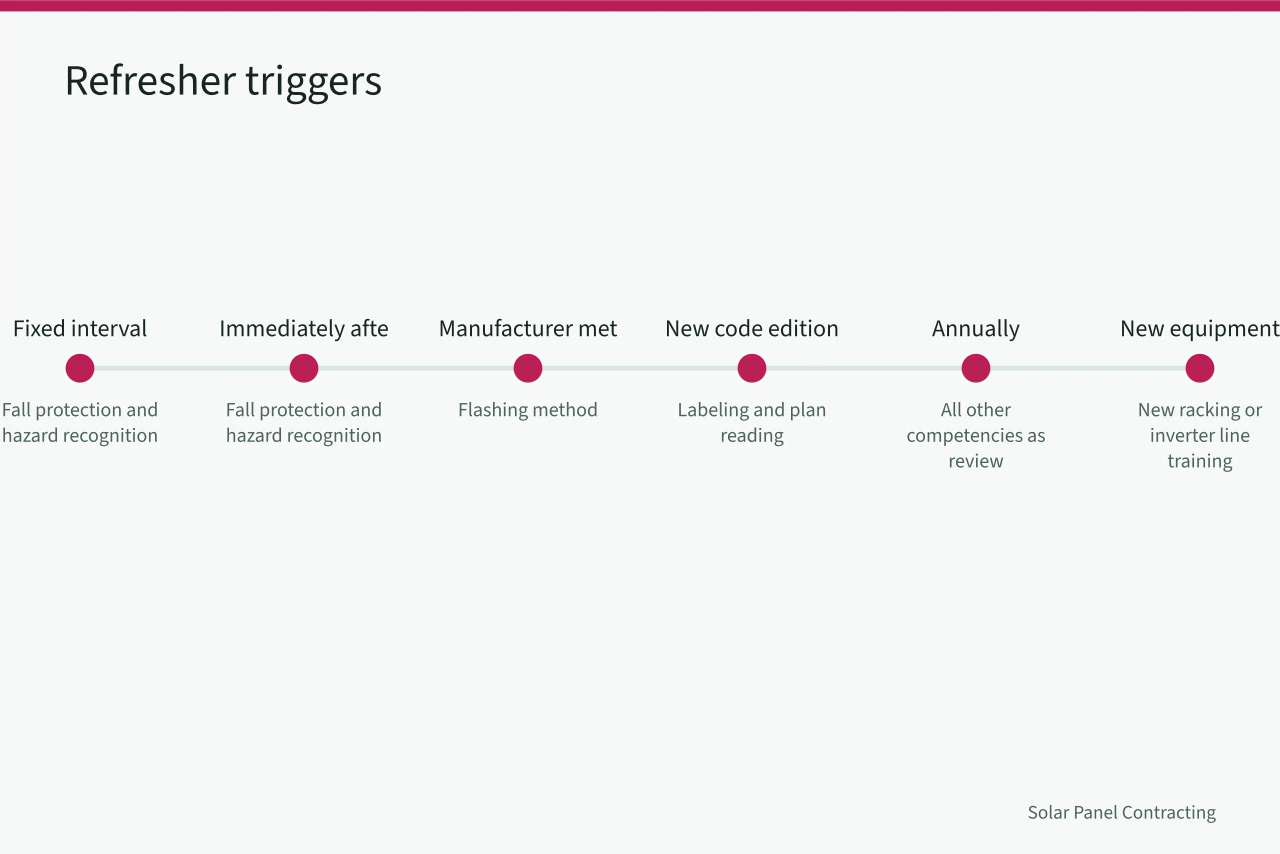
Fall protection and hazard recognition on a fixed interval, whatever your program says, and immediately after any near miss. Flashing method whenever a manufacturer changes a method or you adopt a new system. Labeling and plan reading whenever the jurisdiction adopts a new code edition. Everything else annually, as a review rather than a repeat.
The trigger that people forget is the change of equipment. A new racking system or a new inverter line is new training, not a variation on the old one.
Where training meets pay and hours
Training time is working time.
The Department of Labor's guidance for new and small businesses sets out federal wage and hour responsibilities for most private employment. State law can add to them, and training hours are one area construction employers get wrong.
Pay for it, count it, build it into the loaded labor cost that reaches your prices.
The Bureau of Labor Statistics occupational employment and wage tables give employment and wage estimates by occupation, industry, state, and area as one base-rate reference.
Paid training sits on top and helps explain why a crew day costs more than a wage suggests.
Apply the matrix to everyone in the same role in the same way. The Equal Employment Opportunity Commission's small business resource center is the starting point for the obligations that apply to a small employer, and a matrix applied consistently is both compliant and easier to run.
What the matrix will not do
It will not tell you whether someone has judgment. Tier 3 competencies are signed off on observation over a season, and the assessment approach in the guide to hiring a reliable solar crew is a better predictor at the point of hiring than any training record.
It also will not work if the equipment is not there. Every row assumes particular tools on the vehicle, and the load list in the equipment and setup guide for solar crews is the other half of this document.
Common questions
How long does a new installer take to complete tier 2?
It varies with what they arrived with. Measure it for your own hires rather than setting a target, because a target encourages signing off early.
Can a competent installer sign off another installer?
Only if you have named them as an authorized observer for that competency and they understand what a signature means. Keep the list of authorized observers short.
What happens if someone fails a sign-off?
Nothing dramatic. They train again on that competency and are observed again. A failed sign-off is the system working, and treating it as a problem is how sign-offs stop being honest.
Do subcontracted crews need this?
You cannot train another company's people, but you can require evidence of their competency and their credentials before they work under your contract, and you should.