Guides
Guide to Solar Installer Sales Commission Structure Benchmarks
Solar installer sales commission structure varies widely by state and deal size. Here are the pay benchmarks, per-kW rates and calculator inputs US reps use.
What to take away
- Most US residential solar sales reps earn a base of $0 to $3,000 per month plus commission of roughly $200 to $600 per kW sold, or 3% to 10% of contract value.
- Commission-only structures dominate residential; commercial and utility-scale roles lean toward salary plus smaller per-kW bonuses.
- Three drivers move the number more than anything else: deal size, cancellation rate and whether the company uses in-house or third-party sales.
- The line items a rep never sees on a commission statement, such as clawbacks and chargebacks, often cost more than the headline rate suggests.
Rep pay in this trade is not one number. It is a structure that decides who stays and who quits after the first slow quarter.
A rep selling 8 kW systems at $300 per kW grosses $2,400 on a two-week deal. The same rep selling 12 kW systems at the same rate grosses $3,600, while volume and ticket size, not the rate alone, set take-home pay.
The commission structures in use today
Four models cover nearly every US residential and light commercial employer.
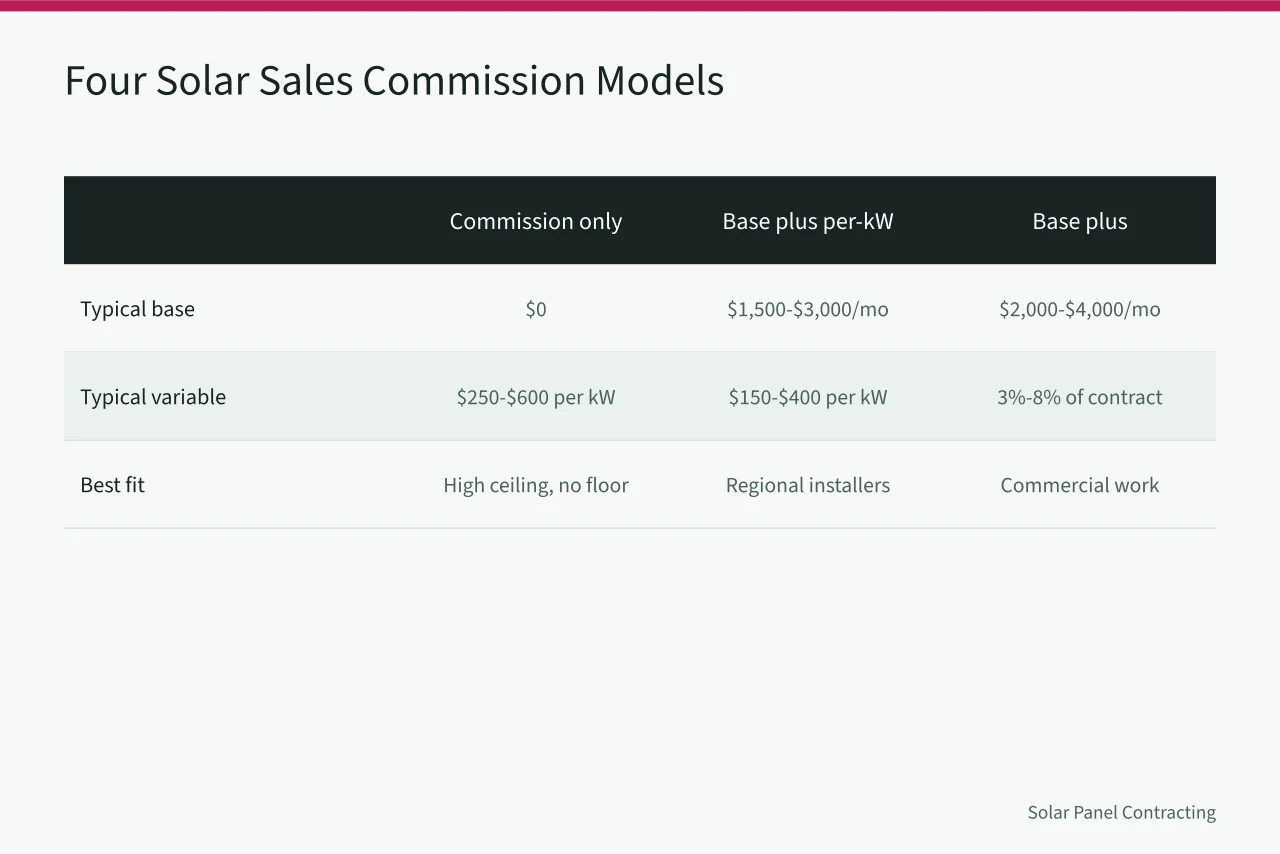
| Structure | Typical base | Typical variable | Notes |
|---|---|---|---|
| Commission only | $0 | $250-$600 per kW | Highest ceiling, no floor |
| Base plus per-kW | $1,500-$3,000/mo | $150-$400 per kW | Common at regional installers |
| Base plus percentage | $2,000-$4,000/mo | 3%-8% of contract | Favored for commercial |
| Salary plus bonus | $45,000-$75,000/yr | $500-$2,000 per deal | Utility and EPC work |
The per-kW column is what reps quote to each other. It is also the one most often misread, because it applies to system size, not revenue.
A 10 kW job at $2.80 per watt is $28,000 in contract value. At $350 per kW, the rep earns $3,500, or 12.5% of revenue. At $250 per kW, the same job pays $2,500.
Percentage structures smooth this out. A rep on 5% of a $28,000 contract earns $1,400. That is less than half the per-kW equivalent, which is why percentage plans usually come with a base.
What moves the number
Deal size. Per-kW rates reward bigger systems. A rep pushing battery attachments and higher-efficiency panels raises the ticket, and the commission follows.
Cancellation and clawback terms. Most contracts let the employer recover commission if the customer cancels within 30 to 90 days, or if the loan does not fund. A 15% cancellation rate on 20 deals a month wipes out three deals of pay.
Lead source. Company-provided leads usually pay a lower rate than self-generated leads. A rep buying leads through lead generation channels carries real cost, so the higher rate is not free money.
Financing mix. Cash deals and loan deals often pay differently. Some employers pay a flat rate on leases and a percentage on loans, which changes the math on every quote.
A commission plan that pays well on paper and poorly in February is a plan built for turnover, not for a sales team.
What quotes leave out
Commission statements rarely show the full picture in month one. Watch for these gaps.
- Whether commission is paid on contract signature or on installation completion
- Whether the rate steps down after a monthly quota is hit
- Whether chargebacks apply to canceled deals and for how long
- Whether a draw against future commission must be repaid if the rep leaves
- Whether the employer classifies the rep as an employee or an independent contractor
That last item matters legally. The US Department of Labor treats commission as part of hours worked for minimum wage and overtime purposes in many arrangements, and its fact sheet on hours worked explains how that applies. A rep classified as an employee under a commission-only plan can still be owed minimum wage in a slow pay period.
Example: a 10 kW job across three plans
A rep closes one 10 kW residential job at $28,000 contract value.
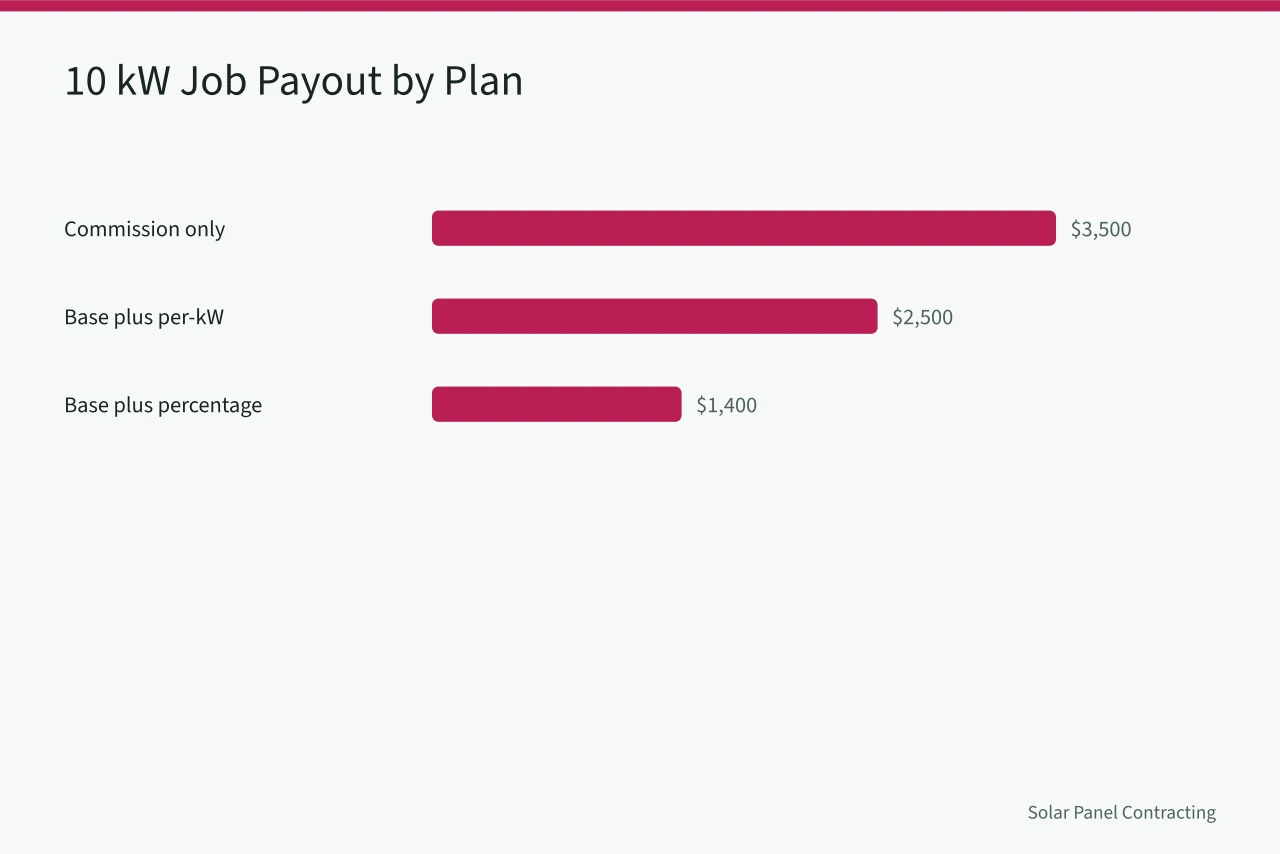
- Commission only at $350 per kW: $3,500 paid after install.
- Base plus per-kW at $2,000 monthly base and $250 per kW: $2,500 for the deal, plus base.
- Base plus percentage at $2,500 monthly base and 5% of contract: $1,400 for the deal, plus base.
Over a year, the commission-only rep who closes 15 deals earns more than the salaried rep who closes 15 deals. The salaried rep earns more in a month when nothing closes. That tradeoff is the whole argument, and it is why pay norms vary so much between companies selling the same hardware in the same state.
Where people overspend
Employers overspend on commission when they pay per-kW without a cancellation clause. Reps overspend when they buy leads at $150 to $400 each and close below 10%, which turns a good commission rate into a loss.
Both sides overspend when the plan is not written down. A one-page schedule covering rate, payment trigger, clawback window and quota steps prevents most disputes. The same discipline applies to how you build a referral habit, because referred deals close cheaper and pay the same rate.
For context on what solar sales roles pay overall, the Bureau of Labor Statistics reports median annual wages for sales engineers, a related category, in its occupational outlook. Solar-specific figures are not broken out there, so treat the ranges above as illustrative of what US employers report in job postings and offer letters.
Common questions
What is a typical solar sales commission rate in the US?
For residential, roughly $200 to $600 per kW or 3% to 10% of contract value, usually with little or no base. Commercial roles tend to pay a salary plus a smaller bonus. These ranges are illustrative market observations, not a published standard.
How does a solar sales commission calculator work?
It multiplies system size in kW by the per-kW rate, or contract value by the percentage rate, then subtracts clawbacks and lead costs. Run it at three deal sizes before accepting an offer.
Are solar sales reps employees or contractors?
It depends on control, schedule and how pay is structured. The Department of Labor fact sheet on overtime and commission pay covers the tests employers apply.
Do commission plans differ by state?
Yes, mostly through deal size and financing mix rather than the rate itself. Markets with high electric rates support larger systems, which raises per-kW payouts.