Guides
Solar installer trends that move demand for 2027
Solar installer demand cannot be forecast from a page. These are eight things to watch, the authority that would confirm each, and what to do if it moves.
What to take away
- Nothing here forecasts demand. Anyone who does is guessing, and a contractor who plans a season around a guess ends up with crews and no work, or work and no crews.
- What follows is eight watch items. Each names the body whose published information would tell you it has changed, and what you would actually do about it.
- Two of the eight move faster than anything else and are checkable by phone: your utility's interconnection queue and your building department's review time.
- Build the habit of checking rather than the habit of predicting. A quarterly hour on this list is worth more than any forecast.
Why there is no forecast here
Residential solar demand in a given territory depends on utility rates, incentive programs set by bodies that revise them, interest rates on financed systems, housing turnover, and the trust left in the local sales culture.
No article can know those for your area. By the time any of them is publishable, it has already moved.
What a contractor can do is watch a short list of things that would change the picture, know where each is published, and know in advance what the response would be.
Watch item 1: your utility's interconnection queue
Where it is published: the utility itself, usually alongside its interconnection standard.
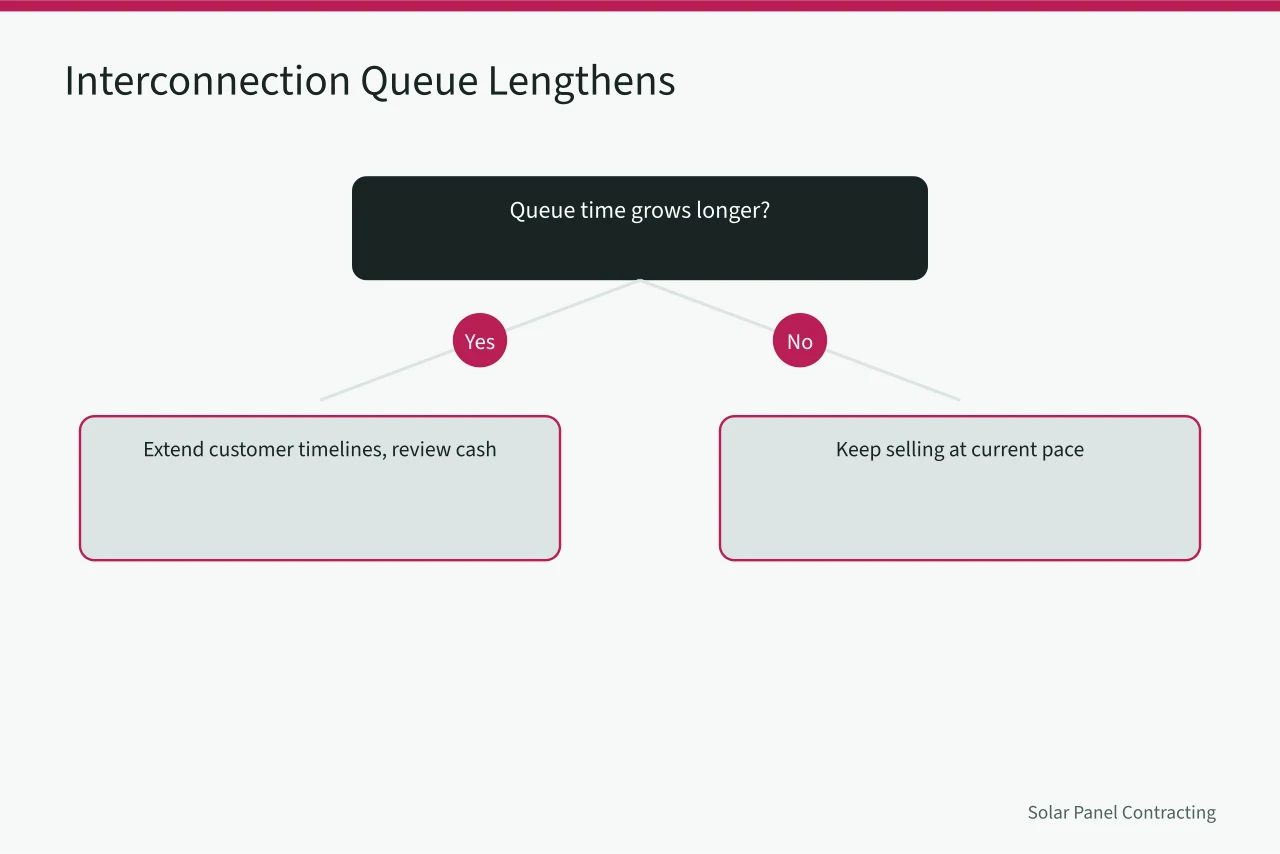
Why it matters: it is the largest single determinant of how long your cash stays out, and it moves without announcement.
What to do if it lengthens: extend the timeline you give customers, review your cash position against jobs in flight, and consider whether to slow selling until it clears. The arithmetic is in the pricing and profit guide for solar contractors.
Watch item 2: your building department's review time and code edition
Where it is published: the jurisdiction, and available by asking.
Why it matters: a new adopted code edition can change what your standard plan set must show, and a longer review time changes your schedule.
What to do: take a completed plan set in and ask what would now come back for correction. Update your standard design before the first rejection rather than after it.
Watch item 3: federal residential credit rules
Where it is published: the Internal Revenue Service.
Why it matters: it changes what customers expect and what they ask you about. It does not change what you may promise, which remains nothing.
What to do: update your proposal wording to point at the current IRS material, and brief anyone who sells for you. Never state a percentage, and never present a net price that assumes an outcome depending on the customer's own tax position.
Watch item 4: state and utility incentive programs
Where it is published: the state energy office and the utility.
Why it matters: a program opening or closing changes inquiry volume sharply and often at short notice.
What to do: check quarterly. If a program is closing, expect a surge followed by a trough, and resist hiring into the surge. The seasonality reasoning in the hiring and training guide for solar contractors applies to program-driven surges too.
Watch item 5: utility rate structures and net metering arrangements
Where it is published: the utility and the state regulator that approves its tariffs.
Why it matters: it changes the customer's own arithmetic and therefore their motivation, and it can change which system designs make sense.
What to do: understand the current arrangement well enough to explain it accurately, and point customers at the utility's own material rather than characterizing it yourself.
Watch item 6: equipment supply and lead times
Where it is published: nowhere reliable, which is why your distributor relationship is the source.
Why it matters: a long lead time on a product line you have standardized on stops you selling, not just installing.
What to do: keep a second product line you have actually installed, and check the substitution policy before you need it. What that means for purchasing is in the equipment and setup guide for solar crews.
Watch item 7: local labor availability
Where it is published: the Bureau of Labor Statistics occupational employment and wage tables publish employment and wage estimates by occupation, industry, state, and metropolitan area, which is one indicator of whether the relevant trades exist in your area and at what level.
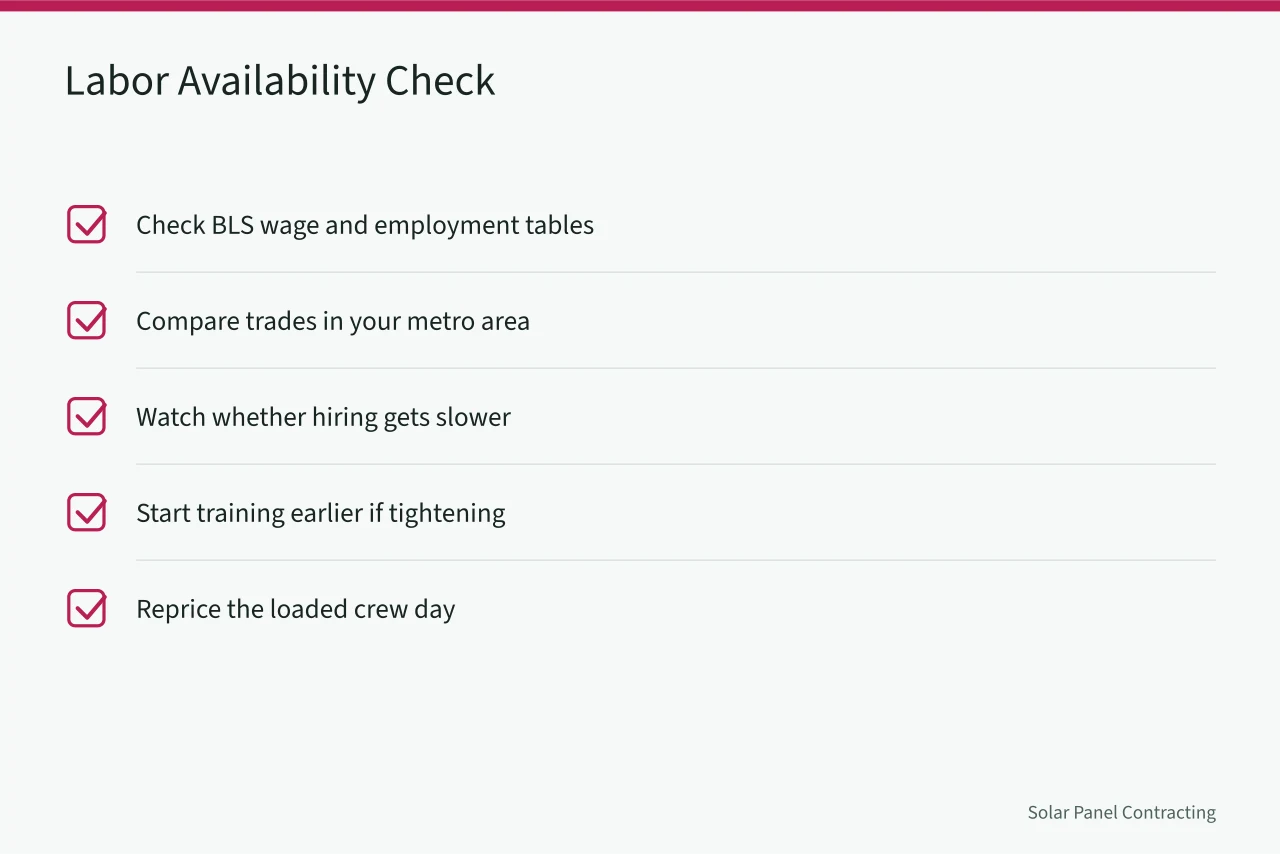
Why it matters: demand you cannot staff is not demand.
What to do: if the trades you hire from are tightening, start training earlier and expect the loaded cost of a crew day to rise.
Watch item 8: the local sales culture
Where it is published: in your competitors' reviews, and in what homeowners say when you knock on a door.
Why it matters: a territory where high-pressure solar sales have damaged trust is harder to sell in honestly, and it changes how long your sales process takes.
What to do: lead with the checkable things instead of adjectives, which is the argument in the marketing and growth guide for solar owners. In a damaged market, honest documentation is a competitive advantage rather than a courtesy.
The quarterly review
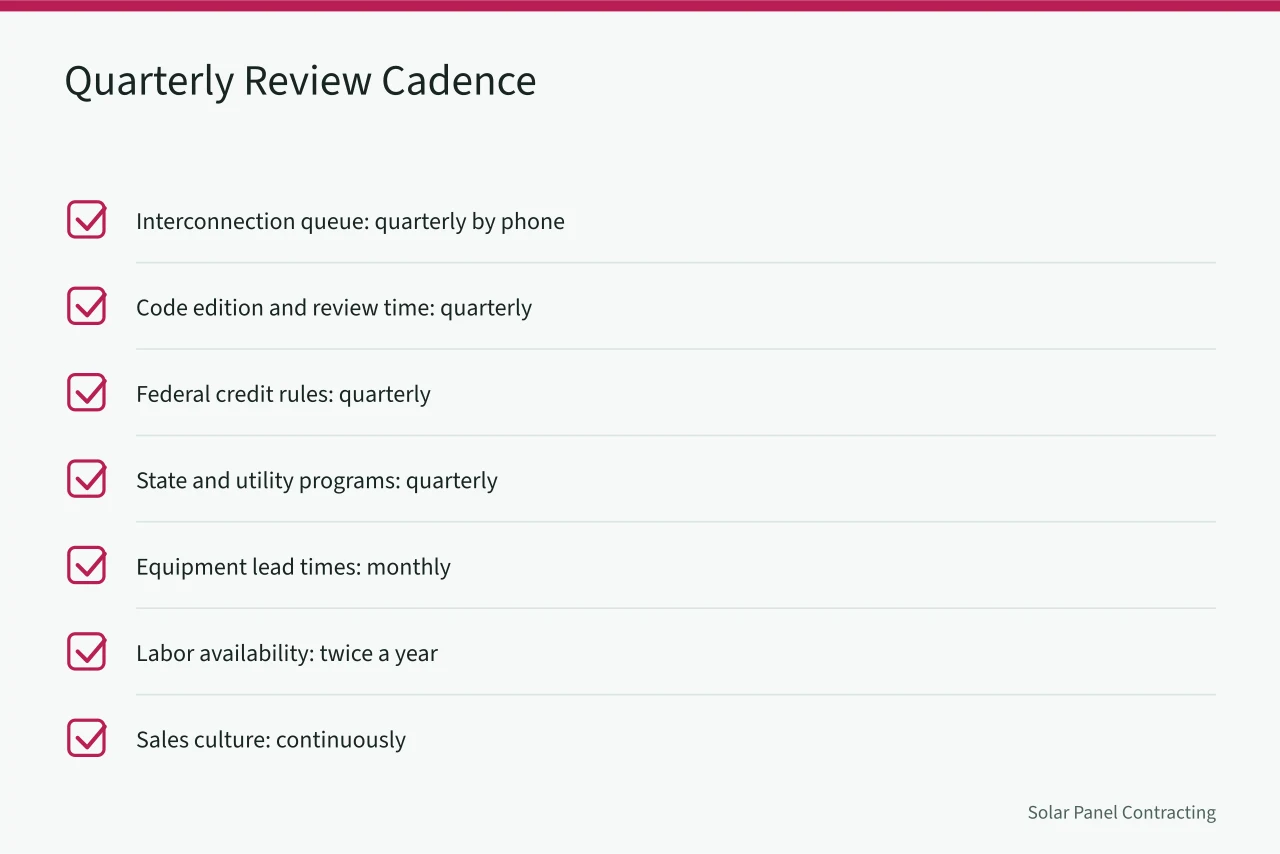
| Item | Source | Check | Response if it moves |
|---|---|---|---|
| Interconnection queue | The utility | Quarterly, by phone | Extend timelines, review cash |
| Review time and code edition | Building department | Quarterly | Update the standard plan set |
| Federal credit rules | The Internal Revenue Service | Quarterly | Update proposal wording only |
| State and utility programs | State energy office, utility | Quarterly | Plan for surge and trough |
| Rate structures | Utility and state regulator | Quarterly | Update how you explain the arithmetic |
| Equipment lead times | Your distributor | Monthly | Keep a second product line live |
| Labor availability | Published wage data, plus hiring | Twice a year | Train earlier, reprice the crew day |
| Sales culture | Reviews and doorstep reactions | Continuously | Lead with checkable claims |
An hour a quarter covers the first five. The rest happen while you work.
What none of this predicts
Whether you will be busy in six months. Nothing on this list predicts that, and the honest position is that no contractor can plan a season on a forecast.
Stay flexible. Keep a scope that does not depend on new installations, such as service work and reinstallation for reroofing. Keep a core crew, not one sized to the peak. Keep cash for the trough.
Those three make a company survive a bad forecast. That beats one built on a good one.
The permit process as a constant
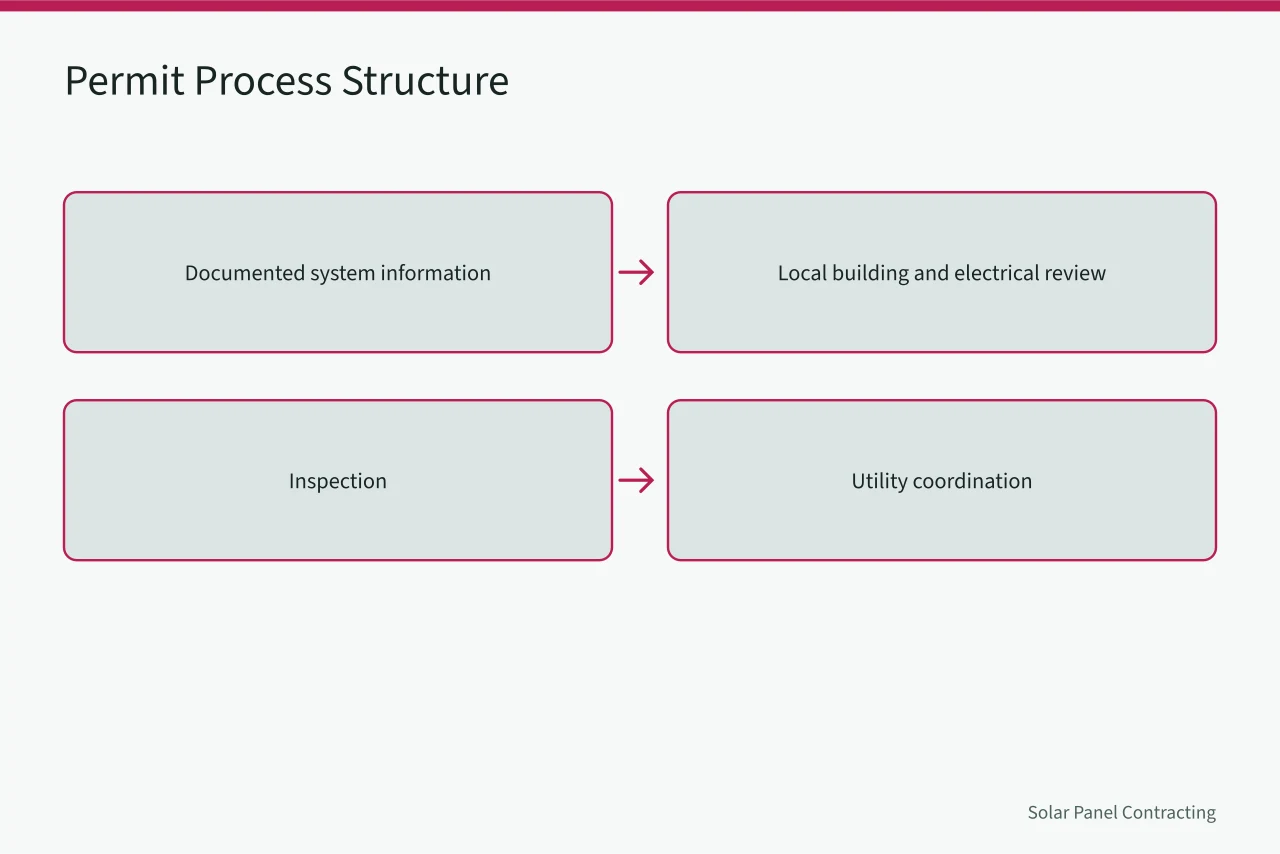
The Department of Energy's solar permitting guidebook shows how documented system information, local building and electrical review, inspection, and utility coordination fit together, and that structure stays stable while details change.
Your jurisdiction's adopted codes and its own published process control the detail. Those are watch items 1 and 2.
Which credentials you must hold to operate within that process is a separate constant, answered by the state contractor board and the local electrical authority, and mapped in the licensing and compliance guide for solar contractors.
Where the general business planning sits
The ordinary business responses to changing demand, financing, staffing, and managing through a slow period, are covered in the SBA business guide in the general case. What that cannot cover is the trade-specific fact that your revenue timing belongs to a utility, which is what makes flexibility worth more here than in most trades.
Common questions
Should I plan capacity on a published growth figure?
No. Regional or national growth figures say nothing about your territory, your utility's queue, or your ability to staff. Plan on your own booked work and your own trailing conversion.
What is the earliest warning of a downturn?
Usually inquiry volume and survey survival rate moving together. A drop in one alone can be seasonal; both moving is a signal.
How do I talk to customers about a program that is changing?
Point at the source and say what you know. Never use a closing program as a pressure tactic, and never state an amount. The state energy office, the utility, and the Internal Revenue Service are the authorities, and the customer can check them.
Is it worth subscribing to industry forecasts?
They are interesting and they are not operational. The eight items above are what changes your week.