Guides
How state licensing boards change solar crew scheduling across Texas and New York
Texas and New York license solar electricians through different boards, and that split decides when a crew can install, inspect and energize.
What to take away
- Texas licenses electricians through TDLR and leaves solar contractor registration to each city; New York licenses electricians through the Department of State and adds a utility witness test on top of the municipal inspection.
- A crew cleared in Austin is not cleared in Dallas, and a New York City license does not travel to Yonkers or Buffalo.
- Permit issuance and inspection are two separate gates. Booking an install date before the first gate passes is how crews eat unpaid windshield time.
- The rough inspection is the gate that slips most often, because grounding, bonding, disconnects and labeling are checked there before final connections.
- One permit tracker, one buffer rule and one certification matrix let the same crew cross state lines without a second calendar.
Texas: TDLR electricians, city registration, utility interconnection
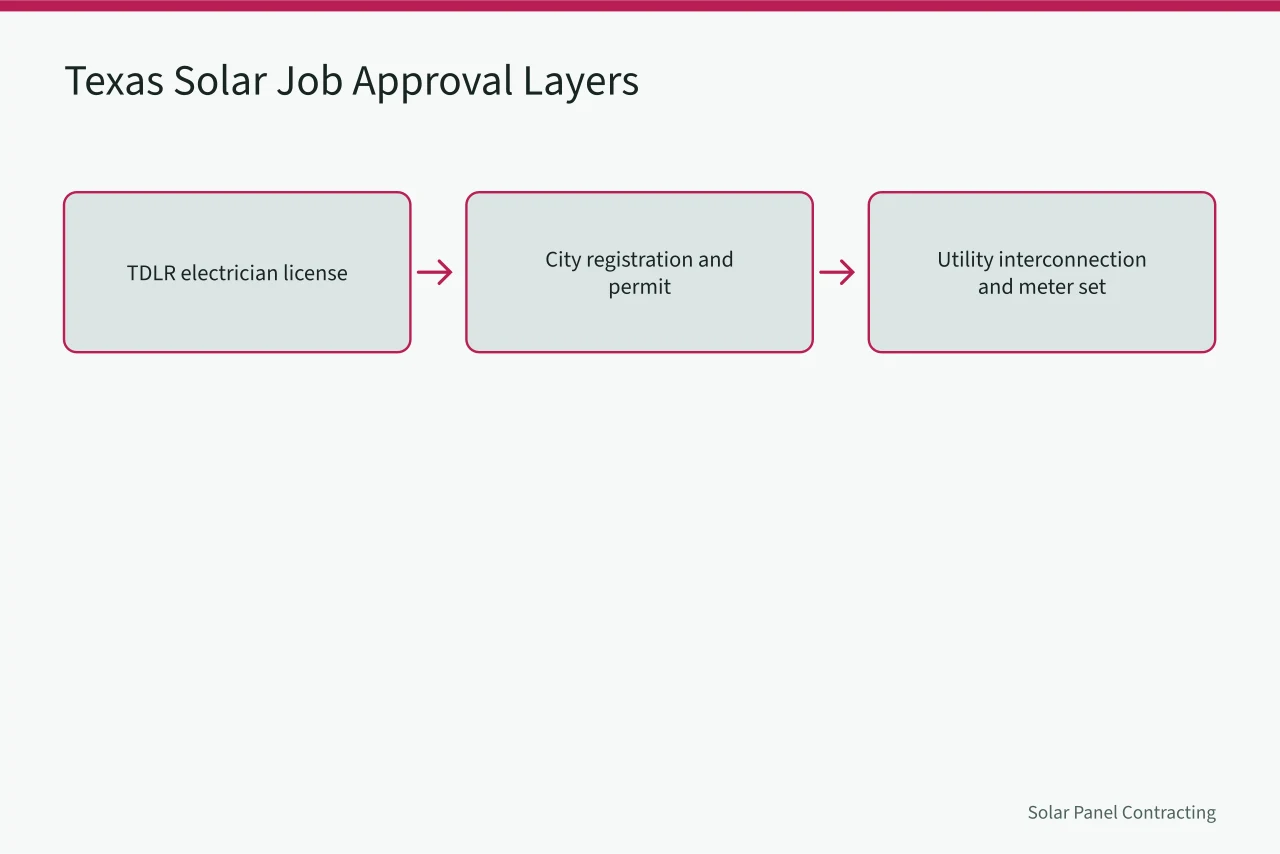
Texas has no statewide solar contractor license. The Texas Department of Licensing and Regulation licenses electricians, and any solar company wiring a system works under those rules. Without a licensed electrical contractor on staff or under contract, the electrical portion of the job cannot be permitted.
That one requirement drives crew design. Many Texas firms keep a single supervising electrician who signs across several install crews, which caps how many jobs can run at once. Add a crew and you may need to add a license, not just a truck.
Cities stack their own layer on top. Austin, San Antonio, Houston and Dallas each run separate registration and permitting systems with their own forms, fees and inspection staff. A crew registered in one metro is a stranger in the next.
Interconnection is the third layer. Oncor, CenterPoint and the ERCOT-area co-ops each run their own application and meter-set process, so the utility, not the city, sets the last date on the calendar.
Texas is an OSHA State Plan state for public employees only. Private solar crews fall under federal OSHA, which matters when you write one safety program for crews working both states. The State Plans map shows which program covers which state.
Before hiring, map all three layers. What a solar installer business must be licensed for is the right place to start.
New York: state licensing plus a second inspection layer
New York licenses electricians at the state level through the Department of State, and several municipalities add their own electrical licensing on top. A crew working New York City, Yonkers or Buffalo may need both, and the paperwork follows the electrician, not the company.
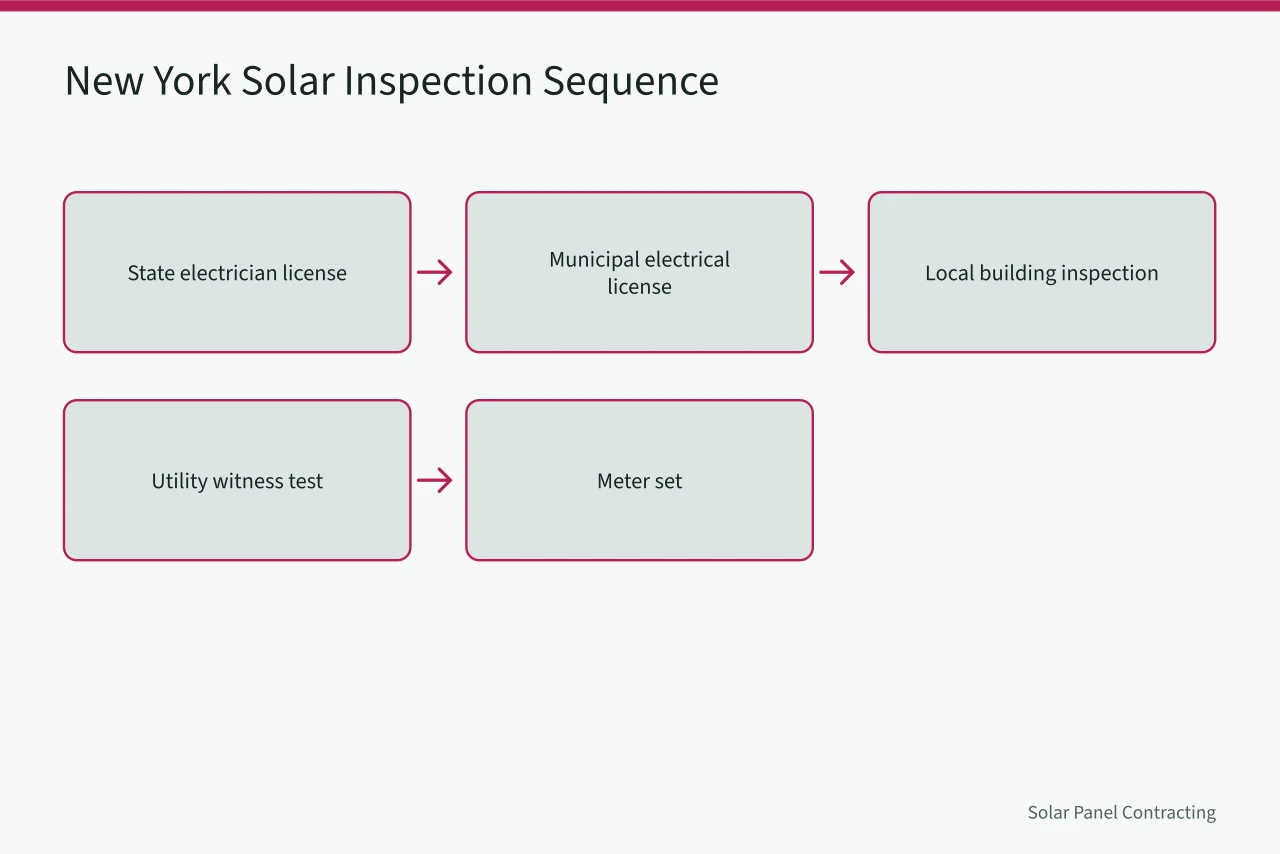
Municipal inspection is stronger here. Local building departments inspect the structural and electrical work, and utilities such as Con Edison and National Grid then require their own witness test before the meter is set. A job can pass the city and still sit for a week waiting on the utility.
Documentation is heavier than in Texas. Expect to file proof of insurance, continuing education hours and a license number for every electrician who touches the job.
New York is also an OSHA State Plan state for private sector workers, so state rules and training records apply to solar crews. Texas private crews follow federal OSHA. Two states means two safety programs and two sets of training files.
Older housing stock adds one more variable. Service upgrades and panel replacements generate permit amendments, and each amendment can reset the inspection clock.
Permit timelines, and why variance costs more than duration
The gap between the two states is not only length. It is spread. A Texas permit might issue in five days or twenty. A New York permit might issue in three weeks or eight, and the inspection queue adds its own wait on top.
Variance is what burns a calendar. A fixed install date booked before the permit issues is a coin flip on whether the crew drives to a job it cannot start.
Track two numbers per market: median days from application to issuance, and median days from inspection request to inspection date. Those two drive every scheduling decision you make.
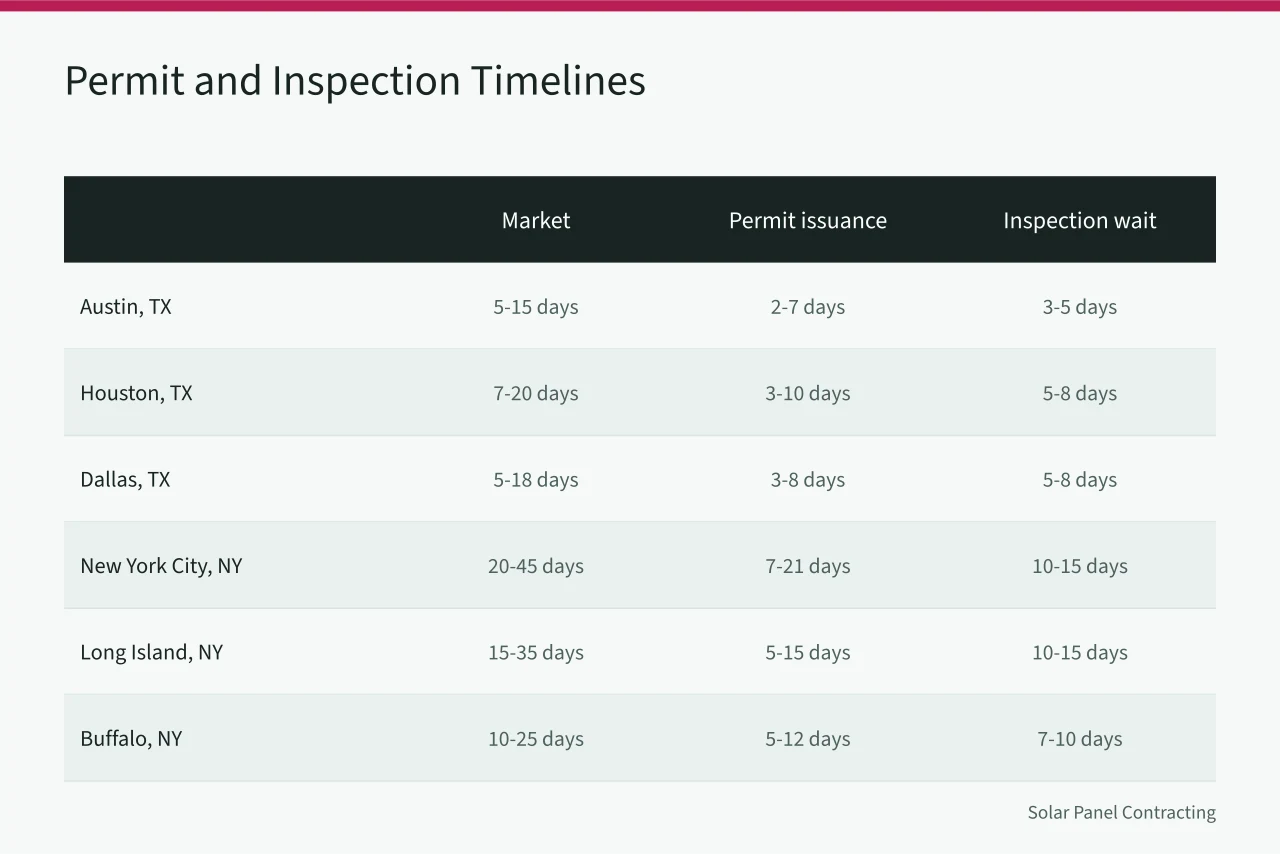
| Market | Permit issuance (typical) | Inspection wait (typical) | Buffer to plan |
|---|---|---|---|
| Austin, TX | 5 to 15 business days | 2 to 7 days | 3 to 5 days |
| Houston, TX | 7 to 20 business days | 3 to 10 days | 5 to 8 days |
| Dallas, TX | 5 to 18 business days | 3 to 8 days | 5 to 8 days |
| New York City, NY | 20 to 45 business days | 7 to 21 days | 10 to 15 days |
| Long Island, NY | 15 to 35 business days | 5 to 15 days | 10 to 15 days |
| Buffalo, NY | 10 to 25 business days | 5 to 12 days | 7 to 10 days |
Treat those ranges as planning estimates. Confirm current timelines with the AHJ and the utility before you commit a crew to a date.
A monthly KPI routine is where these numbers become useful: permit cycle time, inspection pass rate and crew idle days, tracked by market rather than company-wide.
The NEC inspection gate, in order
Both states adopt the National Electrical Code, so the sequence is the same even where the paperwork differs. The NEC is maintained through the NFPA 70 (NEC) Code Development process, and the List of 300+ Codes and Standards is where you pull article numbers when writing a scope.
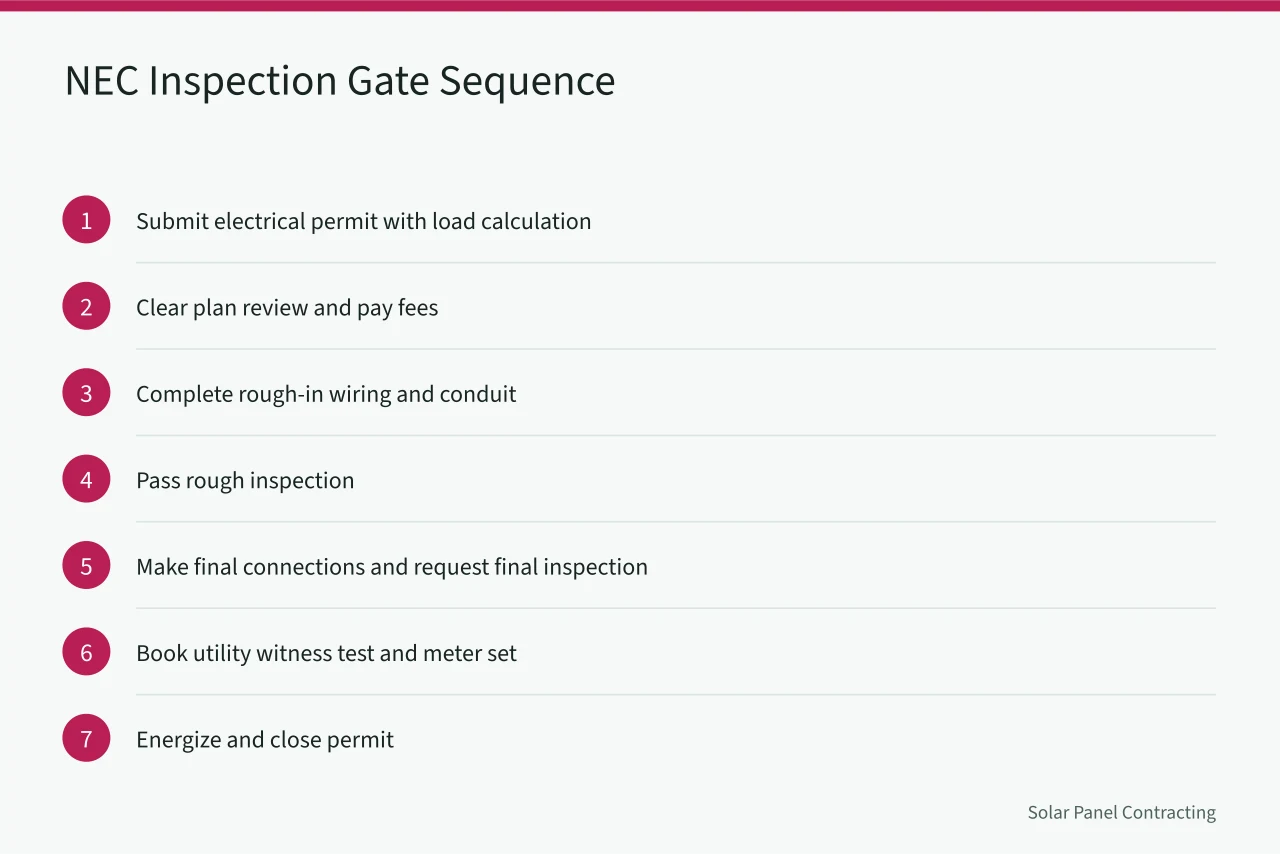
- Submit the electrical permit application with the load calculation, single-line diagram and equipment cut sheets.
- Clear plan review, pay fees, answer comments and resubmit if needed.
- Complete rough-in wiring, conduit and mounting, then request the rough inspection.
- Pass the rough inspection, where the AHJ checks grounding, bonding, disconnects and labeling.
- Make final connections, request final inspection, then book the utility witness test and meter set.
- Energize only after the utility approves, then close the permit and file the inspection card.
Step 4 is the one that slips. A failed rough inspection sends the crew back after corrections, and the utility slot moves with it. Electrical work itself is not a do-it-yourself item: NFPA 70E and the adopted NEC govern it, and a licensed electrician or structural engineer signs the design.
New York adds a municipal layer Texas metros often lack. In New York City, the Department of Buildings and the Fire Department may both need to sign off, while in Texas the AHJ is usually the city or county building department.
Both states generally require the electrical contractor to pull the electrical permit. A solar company without an in-house electrician subcontracts that step and inherits the coordination delay.
Rule changes move these requirements. The Federal Register business and industry section tracks federal rules touching licensing and safety, and the current Federal Register issue shows what is open right now.
Running one calendar across two states
Build one method, then tune it per market. Four parts: a permit tracker, a buffer rule, a certification matrix and a weekly review.
The permit tracker lists every job with application date, expected issuance, inspection request date and booked inspection. It replaces the group chat as the source of truth.
The buffer rule sets minimum days between issuance and install, and between install and inspection. When a crew crosses state lines, use the longer of the two market buffers.
The certification matrix shows which electricians hold a Texas TDLR license, a New York Department of State license, or both, plus current OSHA training for each state plan.
The weekly review moves jobs between crews when a permit slips. A New York delay frees a crew for a Texas job, if the matrix allows it.
A worked example. A crew is booked for a Long Island install on the 10th. The permit issues on the 8th, two days out. Your New York buffer is ten days.
You move the crew to a Dallas job with a permit issued and an inspection already booked. Dallas closes on time, Long Island reschedules without a wasted trip, and the crew stays billable.
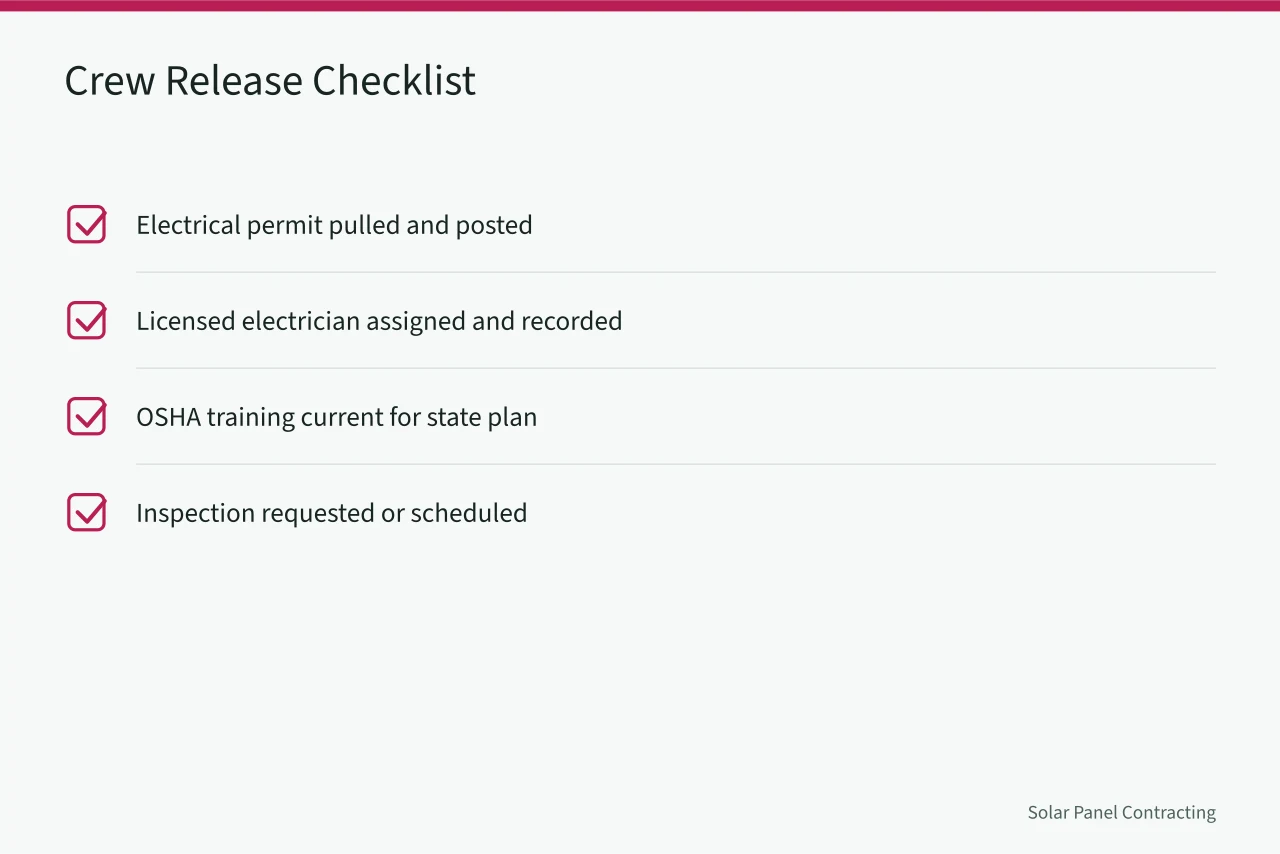
Before releasing any crew to a job:
- Electrical permit pulled and posted on site
- Licensed electrician assigned and license number recorded
- OSHA training current for the state plan governing the job
- Inspection requested or scheduled
- Utility interconnection application acknowledged
- Buffer days confirmed against the market minimum
- Customer notified of any date change
Companies entering new metros should settle service area and utility territory before committing a crew. The utility territory decides which interconnection office and witness test schedule you are working against.
New owners can work through an opening checklist of rules covering licensing, insurance and permits before bidding multi-state work.
Keep the records. Inspection cards, permit numbers and license files are what you produce when a job is audited or a utility disputes an energization. Firms that want to operate legally across state lines keep them current by market, not by company.
Common questions
Does Texas have a statewide solar contractor license?
No. Texas licenses electricians through TDLR, and a solar company doing electrical work must use a licensed electrician. Cities and counties add their own registration and permitting, so the requirements change at each metro line.
Does New York require a state license for solar electricians?
Yes. New York licenses electricians through the Department of State, and many municipalities add local licensing. Utilities then require a witness test before energization, which is a separate gate from the municipal inspection.
What is the rough inspection gate?
It is the inspection where the AHJ verifies grounding, bonding, disconnects and labeling against the adopted NEC before final connections and energization. Failing it sends the crew back for corrections and pushes the utility slot.
How much buffer should a New York job carry?
Plan ten to fifteen days between permit issuance and install in New York City and on Long Island, based on typical inspection queues. Confirm the current wait with the local AHJ and the utility before you lock a date.