Guides
What Happens to Solar Installer Equipment Disposal and Recycling?
Solar installer equipment disposal follows federal RCRA rules and state e-waste laws. Learn the classification, labeling, and manifest sequence.
What to take away
- How to dispose of solar panels changes when a panel fails the toxicity characteristic leaching procedure for lead or cadmium.
- Solar installer equipment disposal follows federal RCRA rules and state e-waste rules; a failed TCLP test makes a panel hazardous waste.
- The sequence is inventory, classify, separate, label, manifest, and ship.
- Classification is the step that decides the result; a visible label and signed manifest are the checks.
- Stop and call a licensed hazardous waste transporter when a panel is crushed, leaking, or fails TCLP.
Most solar installer equipment disposal on a job site is not recycling. It is staging before a licensed hauler arrives.
What has to be true before the first step
Solar installer waste management starts with three site conditions. A signed warranty terms checklist tells the crew whether the manufacturer or the customer owns the failed panel. The site has separate laydown areas for panels, inverters, racking, wire, and batteries. Federal guidance from the EPA treats discarded solar panels as solid waste unless they exhibit a hazardous characteristic.
The sequence
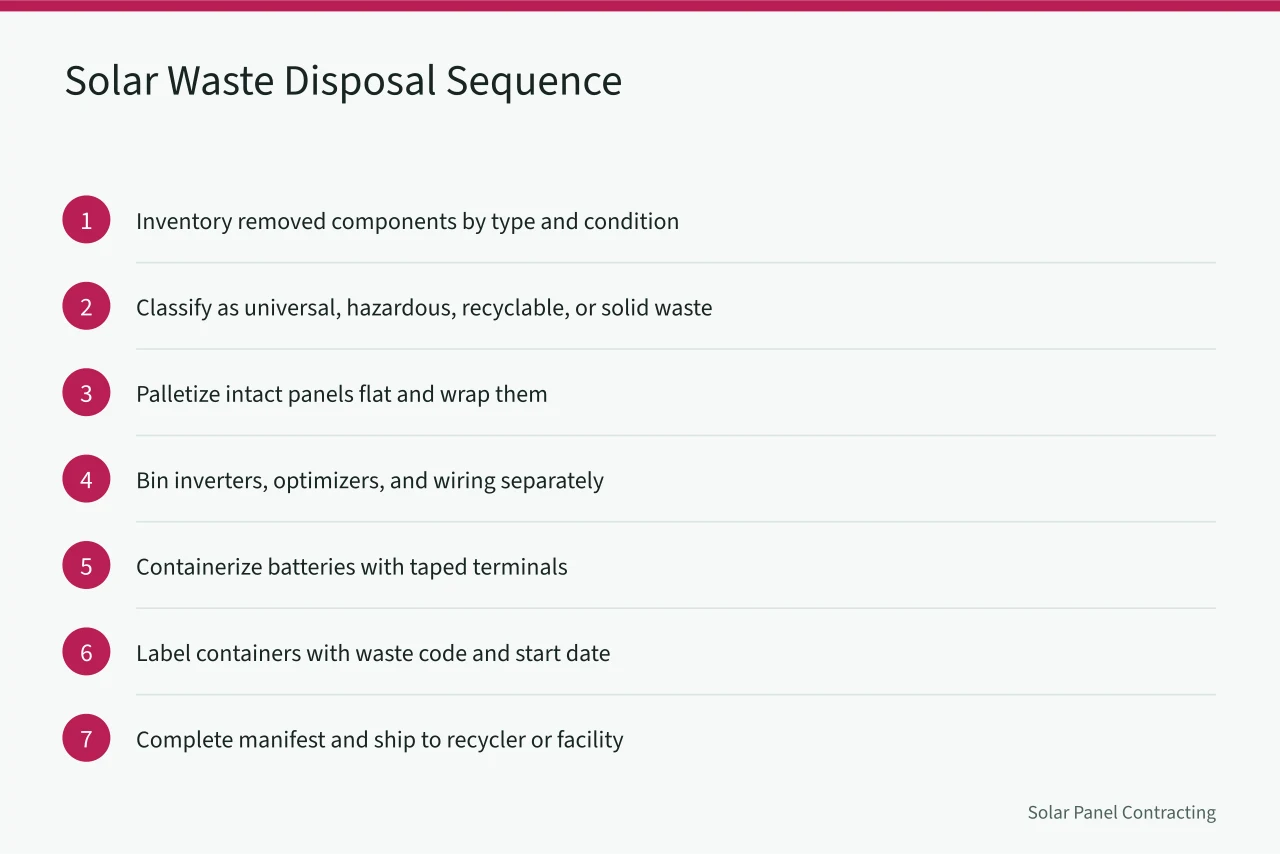
- Inventory every removed component by type and condition.
- Classify each item as universal waste, hazardous waste, recyclable metal, or non-hazardous solid waste.
- Place intact panels flat on pallets and wrap them to prevent glass breakage.
- Put inverters, optimizers, and wiring in separate bins. Place lithium and lead-acid batteries in acid-resistant containers with terminals taped.
- Label each container with the waste code and accumulation start date.
- Complete the hazardous waste manifest for any stream that requires one.
- Ship to a recycler or permitted disposal facility. For crystal silicon panels, send them to SolarCycle or First Solar's take-back program. We Recycle Solar accepts decommissioned commercial arrays.
A crew trained on the team training checklist can sort these materials without a supervisor hovering.
The step that decides the result
Classification decides the outcome. A panel that fails the toxicity characteristic leaching procedure for lead or cadmium becomes hazardous waste under RCRA. State electronic waste rules can add photovoltaic modules to universal waste, permitting less burdensome handling. Panels cracked by hail and snow in Denver may still be non-hazardous, but the classification turns on TCLP results.
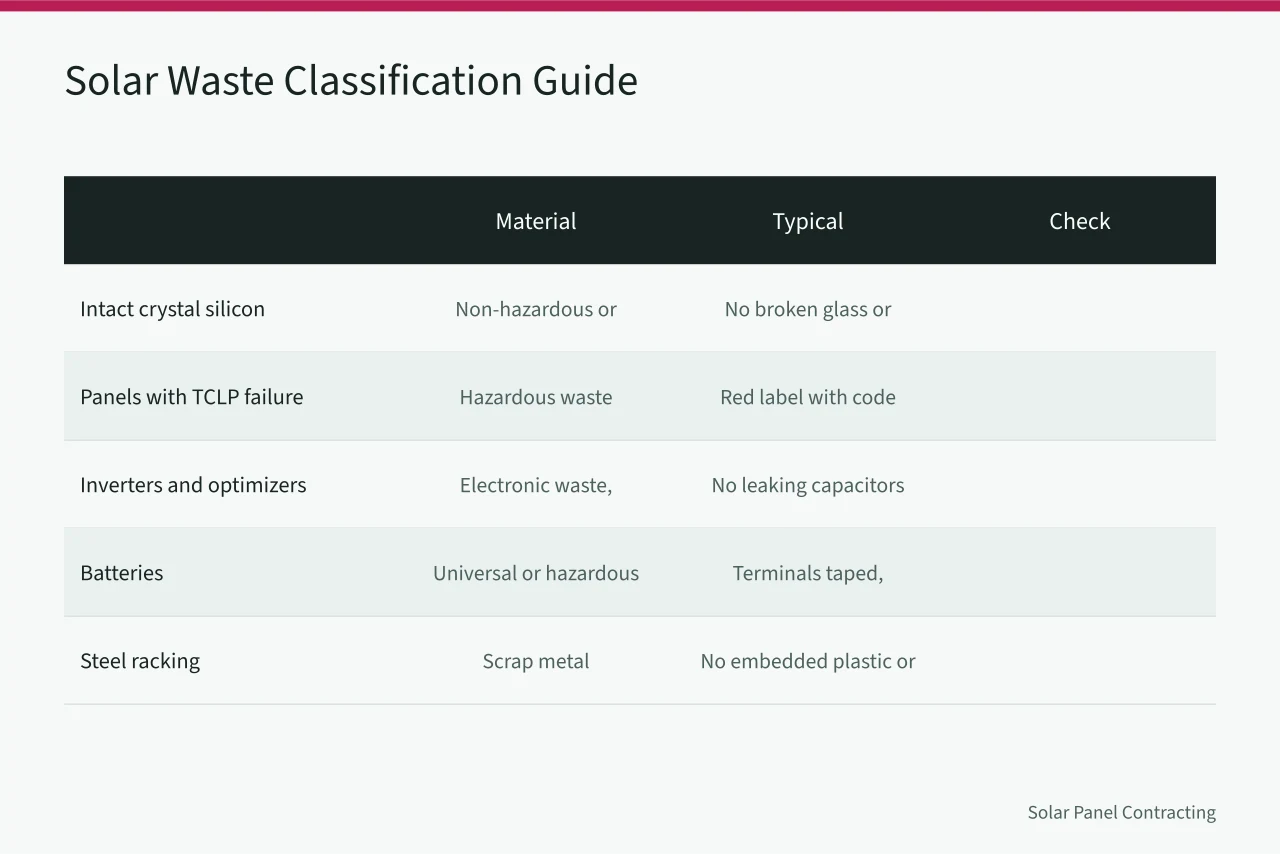
| Material | Typical classification | Check that it came out right |
|---|---|---|
| Intact crystal silicon panels | Non-hazardous solid waste or universal waste, by state | No broken glass, cells sealed, no powder |
| Panels with TCLP failure | Hazardous waste | Red label with waste code and date |
| Inverters and optimizers | Electronic waste, often recyclable | No leaking capacitors, no attached wire |
| Batteries | Universal waste or hazardous waste | Terminals taped, acid-resistant container |
| Steel racking | Scrap metal | No embedded plastic or wiring |
How to check each step came out right
Before pickup, check the container label against the U.S. solar service-area map so state-specific rules are not missed. Use a visible label on each container that shows waste type, date, and generator name. Verify that the manifest matches the actual container count and weight at pickup. Photograph the loaded truck and keep the signed manifest for record retention.
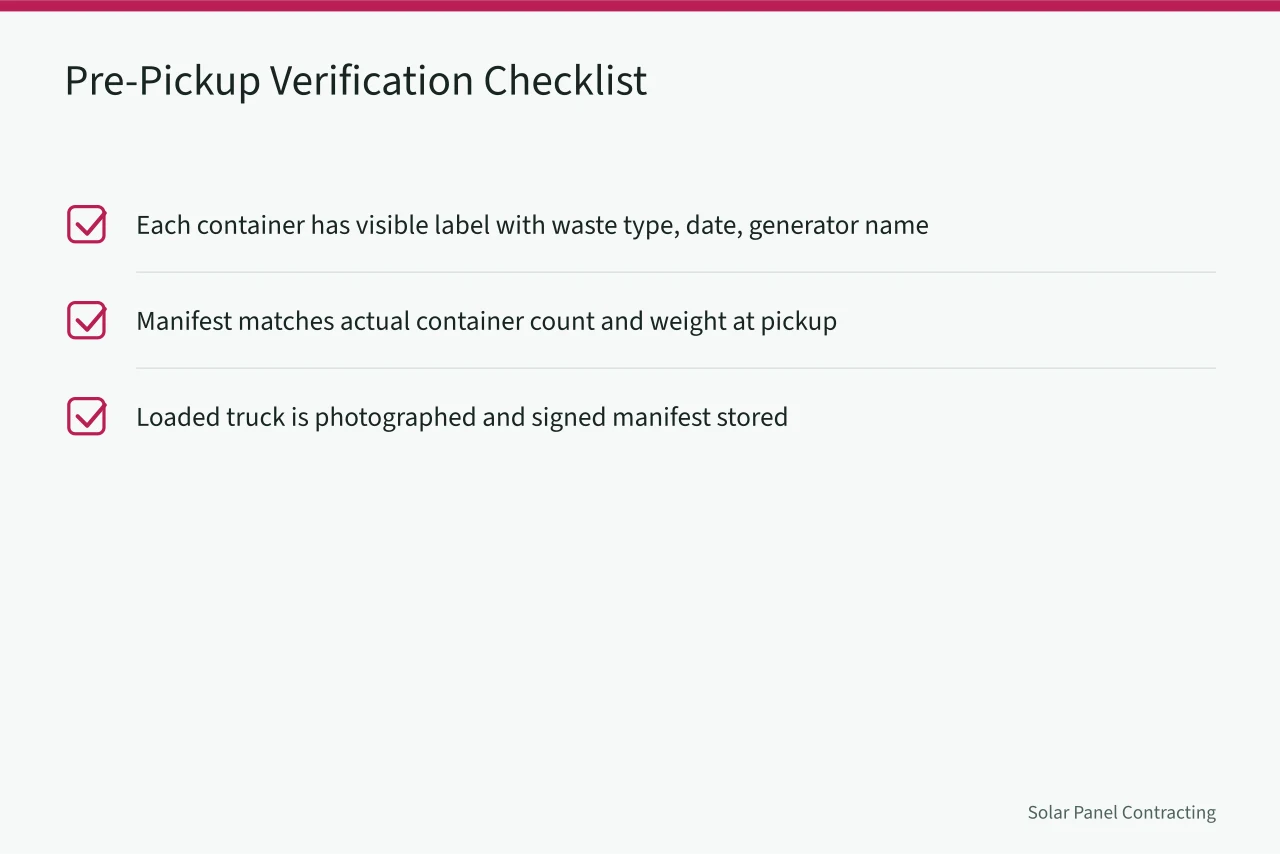
- Each container has a visible label with waste type, date, and generator name.
- The manifest matches the actual container count and weight at pickup.
- The loaded truck is photographed, and the signed manifest is stored.
What to do when a step goes wrong
The common failure is a mixed load. A crew member throws a leaking inverter into a bin with steel racking. Stop loading, re-segregate the bin, and call the receiving facility before the truck leaves. If a hazardous waste manifest has an error, void it and start a new one. Do not scratch out and initial. For batteries with punctured or swollen cells, stop handling and contact a licensed hazardous waste contractor.
When to stop and hand it to a professional
Stop when a panel is crushed and powder is visible, or when it fails TCLP. Stop when a battery is leaking or swollen. In either condition, the job belongs to a licensed hazardous waste transporter and a permitted treatment facility. A crew should not attempt to neutralize or repackage a failed hazardous waste stream.
Common questions
Do solar installers have to recycle panels under federal law? No federal solar panel recycling regulations require recycling, but RCRA hazardous waste rules apply when a panel fails the TCLP test.
Which states treat solar panels as universal waste? State rules vary. Some states, including California, have added photovoltaic modules to universal waste rules, which lowers the storage and labelling burden.
Can old inverters go in the dumpster? No. Inverters and optimizers are electronic waste and often contain capacitors or small batteries. Send them to an e-waste recycler.
How long do I keep hazardous waste manifests? Keep signed hazardous waste manifests for at least three years, and check state rules because some require longer records.