Guides
Austin installer labor market compared with Raleigh solar hiring
Austin solar hiring draws on a deep trades pool and fast offers, while Raleigh fills solar crews slower through referrals and keeps them longer.
What to take away
- Austin's electrical and construction trades pool is deeper, so residential crews fill in weeks rather than months.
- Raleigh's smaller contractor base means fewer poaching attempts and better retention once an installer is trained.
- Texas has no state income tax; North Carolina does, so Raleigh candidates compare take-home pay, not gross.
- Both metros follow the same federal overtime rule: nonexempt installers earn premium pay past forty hours in a workweek.
- Turnover, not the hourly rate, decides long-run crew cost, because a truck and tool set costs the same whether an installer stays eight months or three years.
How the two labor pools differ
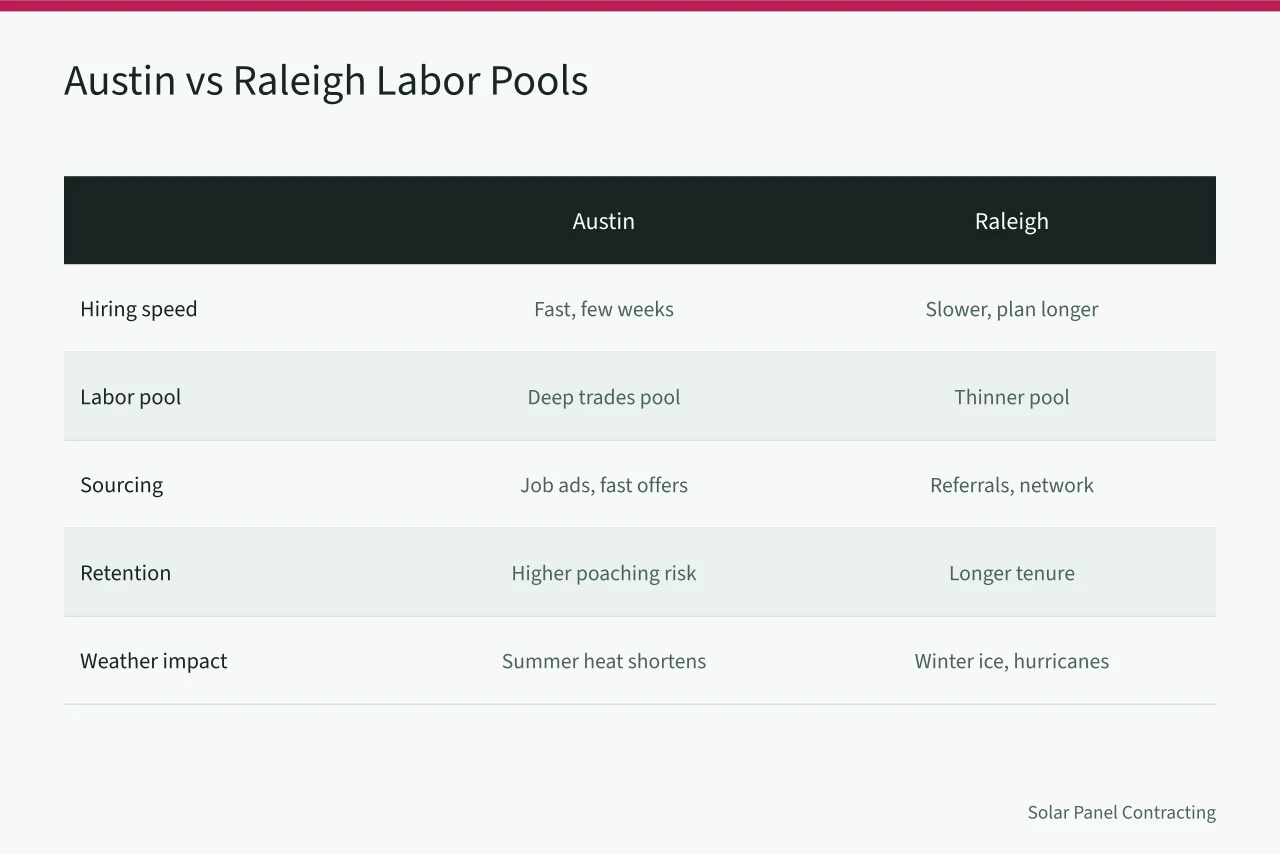
Austin's labor supply favors employers who move fast. The metro has added construction jobs faster than most Texas markets, and its electrical trades grew with it. Solar firms here hire electricians, roofers and general laborers, not only dedicated PV installers.
That breadth cuts both ways. You can hire a licensed electrician with no array experience and teach the mounting work in house. You can also lose that electrician to a commercial electrical contractor across town that bids higher.
Raleigh's pool is thinner. The Research Triangle keeps adding population and construction jobs, but the solar contractor base is smaller. Fewer firms means fewer poaching attempts, and more hires arrive through referrals than through job ads.
Time to fill shows the gap. Austin employers often staff a residential crew within a few weeks. Raleigh employers should plan a longer search, especially for crew leads who hold NABCEP certification or a journeyman electrical license.
Weather sets a different calendar in each metro. Austin's summer heat pushes crews to early starts and shortens productive afternoon hours. Raleigh's winter ice and hurricane season open scheduling gaps of their own. Headcount does not change; billable hours per crew per week do.
Interconnection timing adds another layer. Austin Energy and the surrounding municipal utilities run their own queues, while Raleigh crews work mostly through Duke Energy programs. The two move at different speeds, so the same crew size closes a different number of jobs.
Wage levels against BLS installer data
The Bureau of Labor Statistics publishes wage and employment figures for solar photovoltaic installers by metro. Pull current Austin and Raleigh numbers from the Occupational Employment and Wage Statistics (OEWS) Tables : U.S. Bureau of Labor Statistics before you set a pay band.
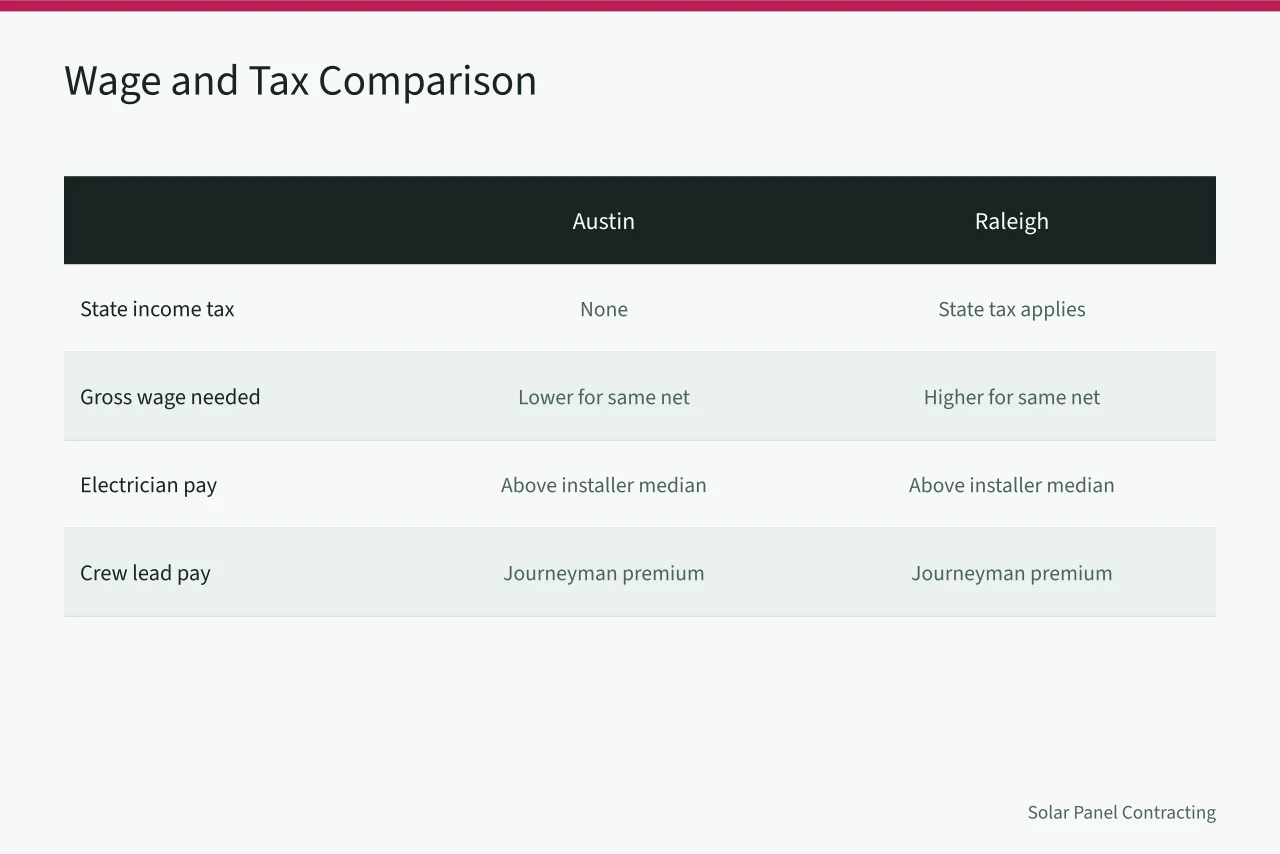
Texas has no state income tax, so an employer can offer a lower gross wage and still match take-home pay. North Carolina levies a state income tax. Raleigh candidates weigh net pay when two offers sit side by side.
Electricians command more than PV installers in both metros. A crew lead who needs a journeyman license belongs above the installer median. A panel mounting and racking role anchors to the installer median.
The BLS outlook for this trade notes that most installers need a high school diploma plus on-the-job training, and that electrical work and certification raise pay. The Solar Photovoltaic Installers : Occupational Outlook Handbook: : U.S. Bureau of Labor Statistics covers the training path and projected openings.
Wage pressure lives beyond the hourly rate. Per diem, truck allowance, tool stipends and paid certification all move the effective number. Build a total compensation model instead of comparing base rates. Our breakdown of wages and labor costs shows how those add-ons change crew cost per installed watt.
| Cost factor | Austin | Raleigh |
|---|---|---|
| State income tax | None | State rate applies |
| Installer supply | Deeper, broader trades pool | Thinner, referral driven |
| Typical fill time | Weeks | Longer search |
| Main poaching source | Electrical and commercial contractors | HVAC, electrical, roofing |
| Seasonal drag | Summer heat | Winter ice, storm season |
Overtime sits on top of the base rate. When an Austin crew makes up heat-lost hours on Saturday, the premium lands in the same payroll period. Raleigh crews see the same effect after storm damage and ice delays.
Contractor clusters and competitive pressure
Austin's contractor cluster is dense. Residential and commercial firms, battery storage installers and electrical subcontractors all recruit from one labor shed. A trained installer can change employers without changing zip code.
That mobility sets a floor under wages. An Austin owner who underpays watches crews leave for a competitor a few miles away, and training investment walks out with them.
Raleigh's cluster is smaller and relationship driven. Firms know each other, and a bad reference travels fast. Churn from pure wage competition is lower. The risk is that one large project absorbs most of the qualified installers for a season.
Subcontractor crews complicate both markets. Firms that staff peak demand with 1099 crews draw scrutiny. The Department of Labor's guidance on Misclassification of Employees as Independent Contractors Under the Fair Labor Standards Act explains the economic realities test. That test decides whether a crew is genuinely independent.
Cluster density belongs in any business location strategy before signing a lease. A dense cluster means easier hiring and harder retention. A thin cluster means the reverse.
Competitive pressure reaches pricing too. In Austin a dozen firms bid the same residential job, so labor cost per job stays visible to customers. In Raleigh fewer bidders leave more room on price and less slack on schedule, because there is no second crew to call when one falls behind.
Recruiting channels that work in each market
Austin rewards volume recruiting. Job boards, trade school partnerships and paid ads all produce applicants because the candidate pool is large. Speed beats polish, since the first credible offer usually wins.
Raleigh rewards network recruiting. Referrals from electricians, roofers and utility contacts outperform job boards, and a referral bonus often beats a larger ad spend.
Both markets respond to paid training. Funding NABCEP certification or a journeyman license gives a candidate a reason to pick you over a firm that only matches the hourly rate.
Trade schools and community colleges are underused in both metros. Austin has more electrical apprenticeship pipelines. Raleigh leans on community college construction programs. A standing relationship with one program beats a one-time job fair.
Our guide to recruitment for owners covers screening steps that filter for people still on the crew after a year. Retention gets its own treatment in the recruit, train, keep playbook.
Put a clock on referral bonuses. Paying half at hire and half at ninety days ties the incentive to people who stay. In Austin, where competing offers arrive within weeks, that structure matters more than the bonus size.
Screen on hands-on work, not conversation. A paid half day on a mock array reveals more about roofing comfort and electrical caution than any interview answer, and Raleigh employers can run the same exercise through a community college shop.
Retention and training costs in both metros
Training cost is similar in both metros because the curriculum is the same. What differs is how fast the investment pays back and how likely the installer is to stay.
Austin payback is faster on paper, since crews ramp quickly. It is also riskier, because a trained installer is a known quantity to every competing firm in the metro.
Raleigh payback is slower. Longer ramp times mean more supervised hours before an installer works alone. Retention tends to be better once someone is trained.
Overtime rules apply the same way in both states. The FLSA requires premium pay past forty hours in a workweek for covered nonexempt employees, and Wages and the Fair Labor Standards Act | U.S. Department of Labor sets out those requirements. Austin crews working long summer days cross that threshold often.
The Department of Labor's WHD Fact Sheets | U.S. Department of Labor cover overtime, travel time and subcontractor compliance questions that come up on installation jobs.
Worked example: what turnover costs
An Austin firm funds a new installer's certification and truck training, then loses that person after eight months to a competitor. The firm absorbed the full training cost and got eight months of production.
The same spend in Raleigh, spread across a two-year tenure, costs far less per installed system.
Vehicle and tool costs follow the same pattern. A truck, ladder rack and personal protective equipment are a fixed outlay whether the installer stays eight months or three years. Turnover turns that outlay into a recurring cost.
Retention spending, not recruiting spending, decides long-run crew cost in both metros. Owners planning a move or a second branch should weigh it alongside market demand in our expansion and market guide.
Common questions
Is Austin or Raleigh easier for hiring solar installers?
Austin is easier to recruit into because the trades pool is larger. Raleigh takes longer to fill roles but tends to hold trained installers longer once they are on board.
Do installers get overtime pay in Texas and North Carolina?
Yes, when they are nonexempt employees under the FLSA. Both states follow the federal forty-hour threshold, and Texas has no separate state overtime statute.
Can I use 1099 crews to install solar panels?
Only if the crew genuinely meets the independent contractor test. The Department of Labor applies an economic realities test, and misclassification exposes the hiring firm to back wages and penalties.
Which metro pays installers more?
Austin generally carries the higher gross wage because local solar and electrical firms compete for the same people. Raleigh's lower gross pay is partly offset by different tax treatment and lower turnover.