Guides
Reading solar installer complaint handling with a sceptical eye
Solar installer complaint handling by type: the leak, the shortfall, the failed inspection, the delay, and the billing dispute each need a different first move.
What to take away
- Five complaint types cover almost everything a residential solar contractor hears, and the correct first move is different for each. Treating them all the same is why complaints escalate.
- The leak is the only one where you send someone the same day, whatever else is happening.
- The delay complaint is the most common and the least about you. It is answered with information, not with an apology.
- Every complaint is a data point about a job you already did. If the process does not feed back into the install, you are running a customer service function rather than a business.
The intake, common to all five
Whoever takes the call captures six things before classifying anything: who is calling and their relationship to the contract, the property, the original install date, what they observed and when, what they have already done, and what they want to happen.
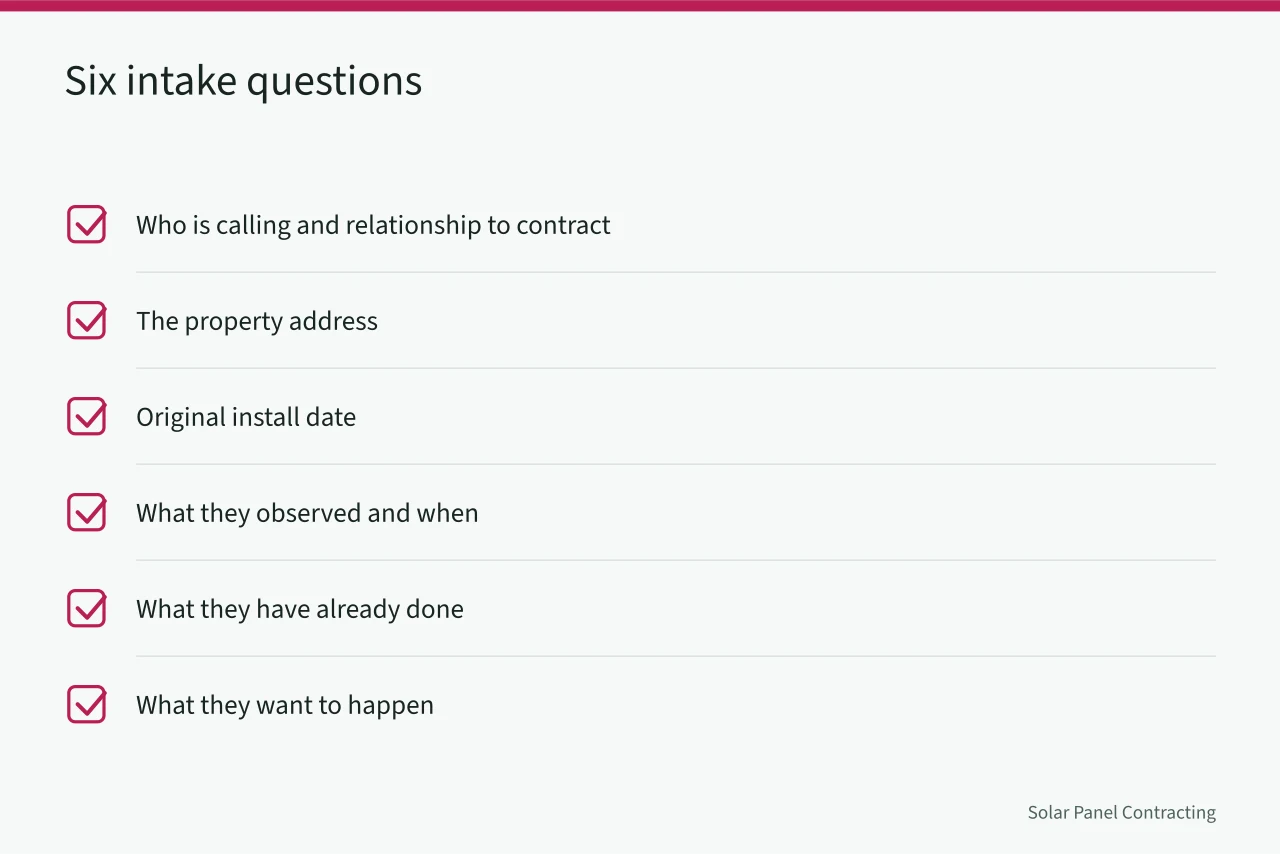
That last item is worth asking directly. A surprising share of complaints resolve because the customer wanted an explanation and was assumed to want compensation.
Then classify. The rest of this page is the five branches.
Type 1: a leak, or any water reported near an attachment
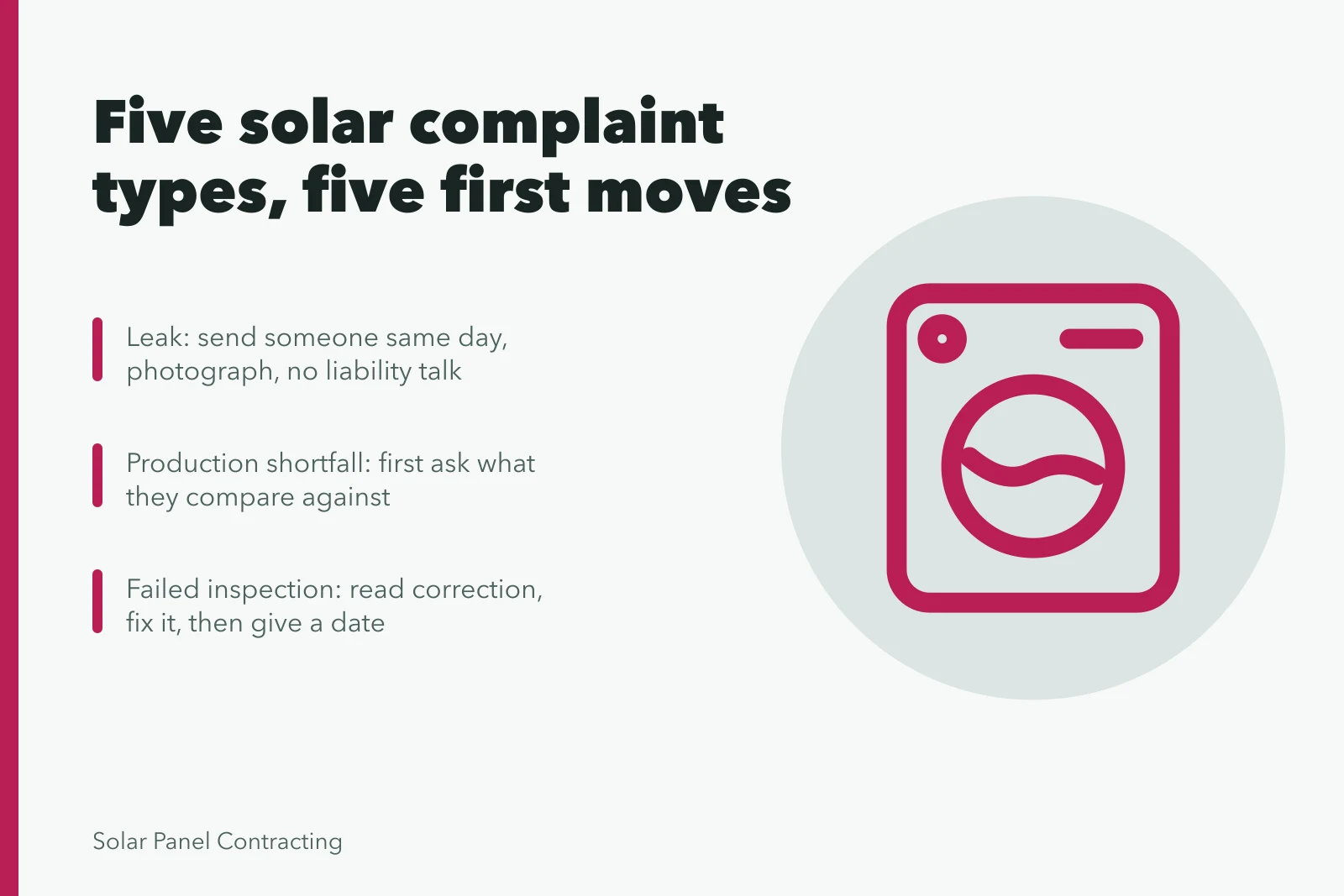
First move: same day, or as close to it as daylight allows. Not because the water damage is necessarily severe but because a leak that is left becomes a claim about your reputation as well as your workmanship.
Send someone who can look, photograph, and make a temporary protection if needed. Do not send someone empowered to accept liability, and do not have anyone say on a wet roof whose fault it is.
Then pull the job record: the photographs of that penetration before it was covered, the flashing system used, the sealant, and the torque record. If your process produced those, as the field card method for solar service standards describes, you now have an evidence-based conversation. If it did not, you have a negotiation.
Notify your insurer according to your policy's terms, even if you expect to handle it yourself. Late notice is a common reason coverage is disputed.
Type 2: production below what the customer expected
First move: find out what they are comparing against. Three very different complaints hide inside this one.
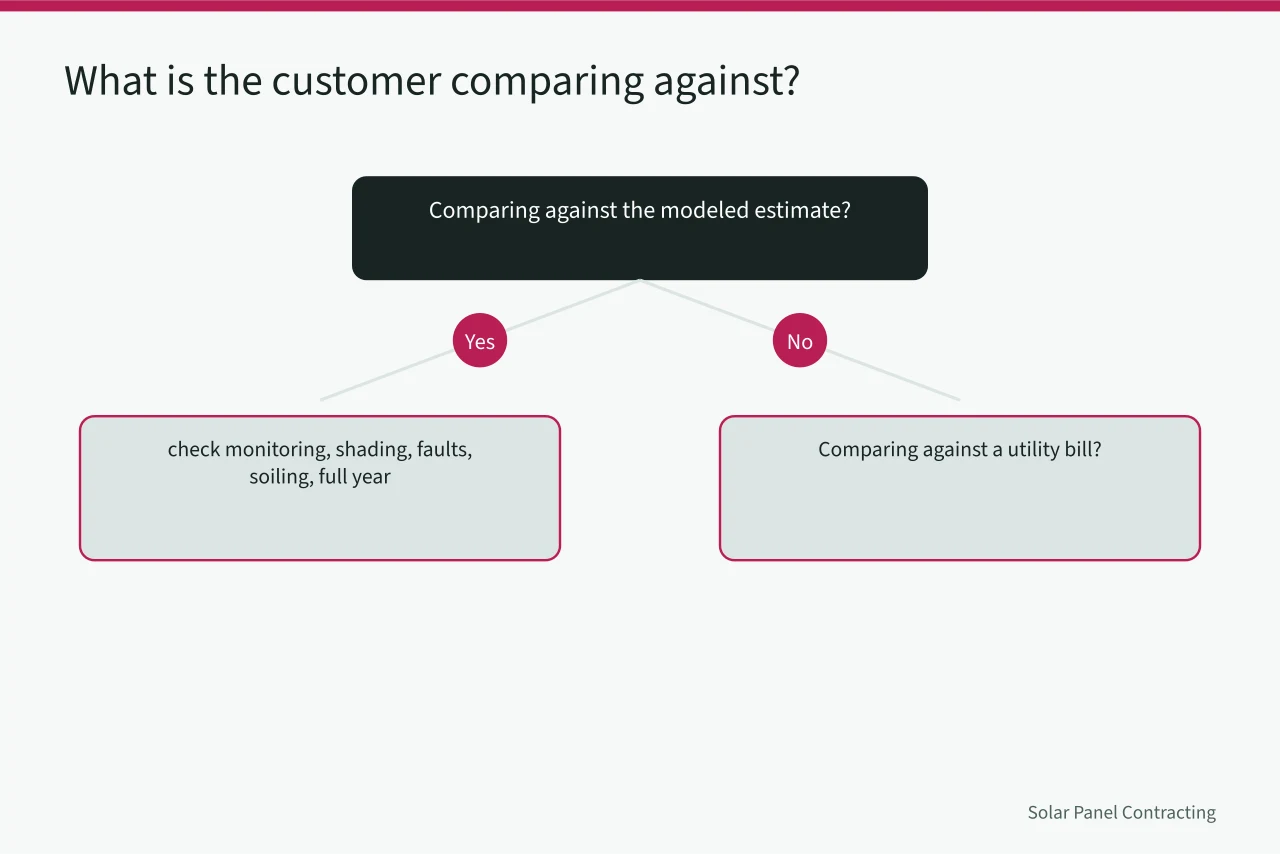
The customer is comparing against the modeled estimate in your proposal. That is a legitimate technical question: check monitoring data, check for shading that was not in the model, check for equipment faults, check soiling, and check whether a full year has elapsed, because a partial year proves nothing.
The customer is comparing against a bill they expected to be lower. That is a utility rate and consumption question, and it is not about the installation at all. It still needs answering, patiently.
The customer is comparing against something a salesperson said. That is your problem, and the fix is upstream: what your sales material states about estimates and about incentives, and whether it names the authorities rather than promising outcomes.
Federal residential credits are administered by the Internal Revenue Service and depend on the customer's own tax position; state and utility programs come from the state energy office and the utility. If a complaint turns out to be about an incentive that did not arrive, that is the honest answer, and it lands much better if your proposal said it first.
Type 3: a failed inspection or a correction notice
First move: read the correction and fix it, before speaking to the customer at length.
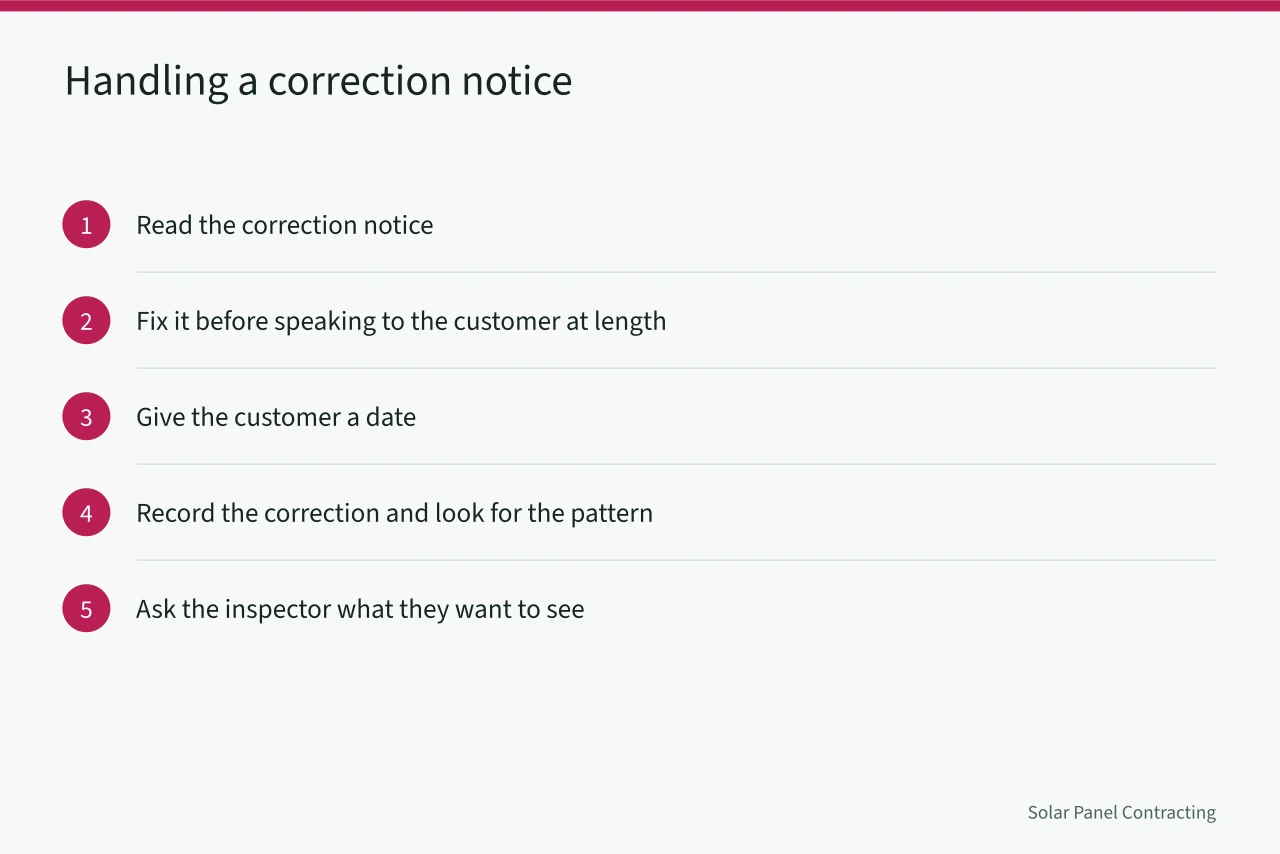
This complaint often arrives from the customer as anxiety rather than anger. What they want is to know it is being handled and when. Give them a date.
Internally this one matters most, because it is objective evidence about your work from an outside party. Record what the correction was for and look for the pattern, which is the input the service quality guide for solar owners is built around. A single correction is noise. Three of the same kind is a training or design problem.
The Department of Energy's solar permitting guidebook explains why so many corrections concern documentation and coordination rather than workmanship, though your jurisdiction's adopted codes and its own practice control what is actually required. Ask the inspector what they want to see; they will usually tell you.
Type 4: the delay complaint
First move: send the dates. All of them, including the ones that are not yours.
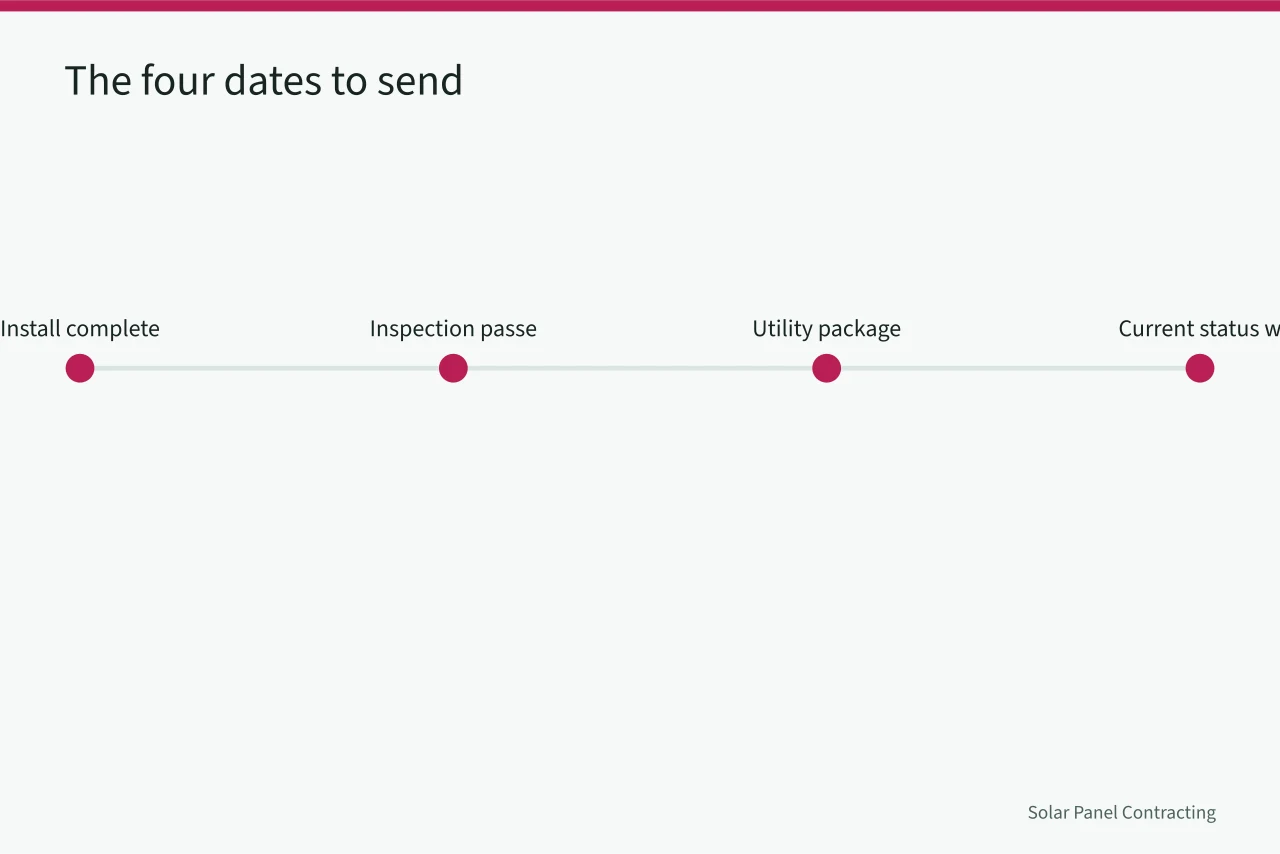
This is the most common complaint in residential solar and it is usually not about anything you did. The customer signed months ago, saw a day of work, and has heard nothing. Give them the four dates that matter: install complete, inspection passed, utility package submitted, and current status with the utility.
Do that and most of these complaints end. The genuine version of this complaint, where the days between inspection and your submission to the utility are large, is yours to own, and the answer is a process fix rather than an apology.
The structural prevention is to contact customers on a fixed schedule during the quiet weeks even when there is nothing to report. Silence is what produces this call.
Type 5: a billing or scope dispute
First move: put the contract and the change orders side by side before responding.
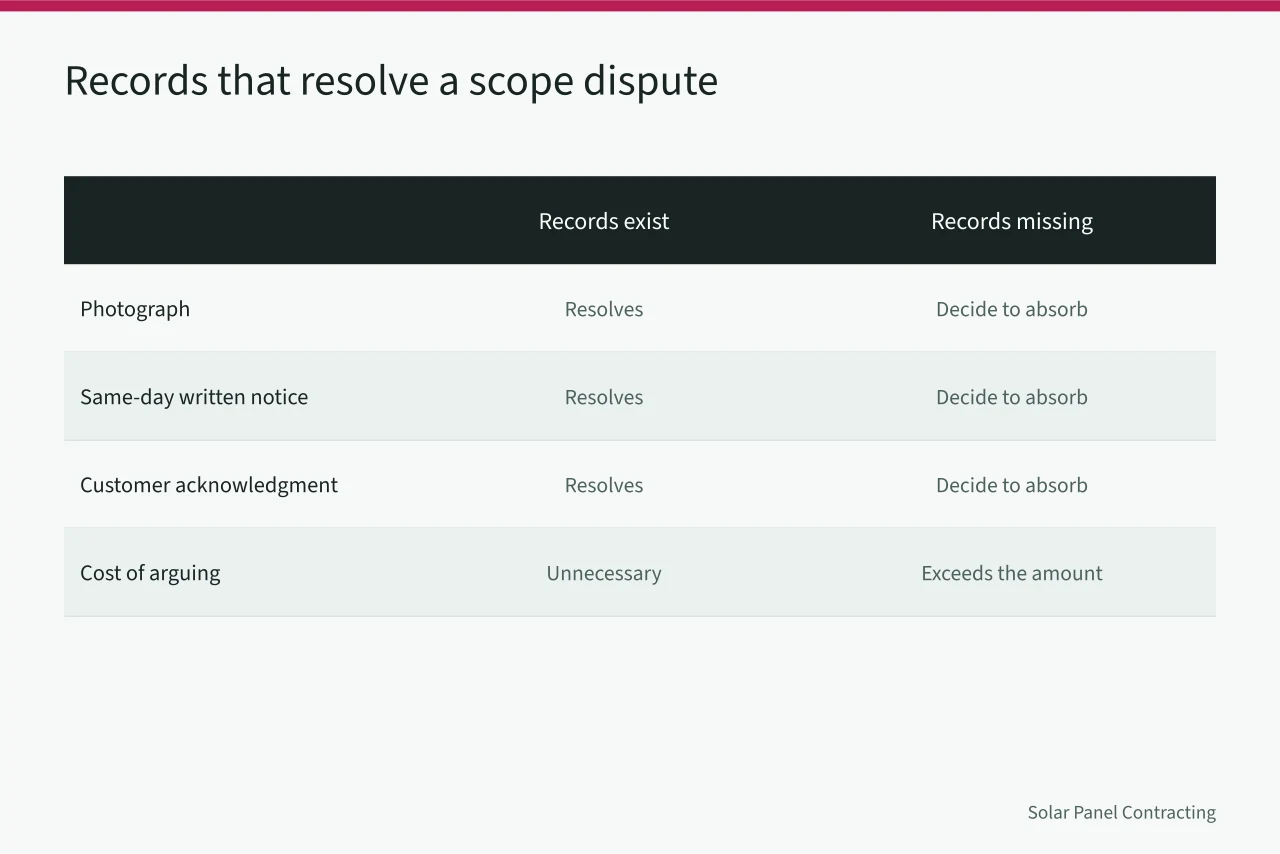
Almost every scope dispute traces to a boundary the proposal left vague, and almost every billing dispute traces to a change order that was verbal or late. If your records show a photograph, a same-day written notice, and the customer's acknowledgment, this resolves. If they do not, decide quickly whether to absorb it, because a long argument over a small amount costs more than the amount.
Then fix the document. The exclusions and the allowance mechanism are the parts of a proposal that prevent this, and they belong in the standard template rather than being rewritten each time.
The escalation ladder
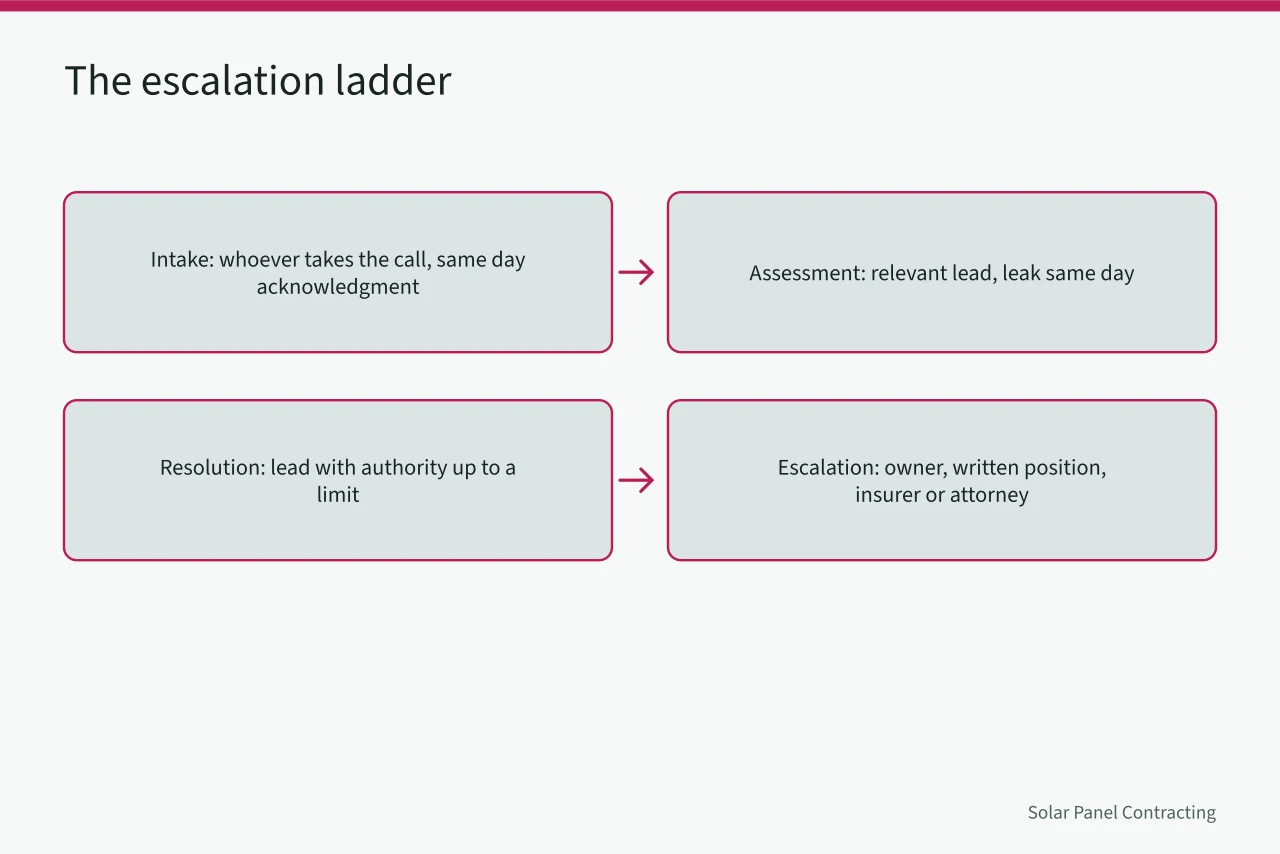
| Stage | Who handles it | Time to respond | What changes |
|---|---|---|---|
| Intake | Whoever takes the call | Same day acknowledgment | Classification recorded |
| Assessment | The relevant lead | Leak same day, others within a stated interval | Evidence gathered from the job record |
| Resolution | The lead, with authority to decide up to a limit | Stated date given to the customer | Action taken and recorded |
| Escalation | The owner | When the limit is exceeded or the customer rejects the resolution | Written position, insurer or attorney if needed |
The limit in row three is the one to set explicitly. A lead who has to ask permission for every small remedy resolves nothing quickly, and speed is most of what a complaining customer wants.
What happens afterwards
Two things, both easy to skip.
Feed it back. Every complaint gets tagged to an install month, a crew, and a cause. Those tags are the only way to see that a run of leaks came from one period when a particular sealant was substituted, or that delay complaints cluster in a jurisdiction whose review time you underestimated. Whether the same pattern will repeat in a new area is part of the assessment in the expansion guide for solar contractors.
Ask for the review afterwards, on the same terms as everyone else. The Federal Trade Commission's guidance on soliciting and paying for online reviews is clear that requests should go to genuine customers without selecting for those likely to be positive. A customer whose complaint you handled well is a genuine customer, and filtering them out would be exactly the selective solicitation the guidance warns against.
Records
Keep the complaint file with the job file: the intake notes, the evidence, the decision, and the outcome. The Internal Revenue Service's guidance on records a small business should keep sets the financial retention standard, and complaint records should follow the same discipline, kept at least as long as your workmanship warranty runs.
The evidence that makes these files useful is captured on install day, not afterwards, which is why the photographs and torque records in the equipment and setup guide for solar crews belong to the complaint process as much as to the installation. Sampling whether that evidence is actually being captured is the job of the quality assurance checks for solar installations.
Common questions
Should the owner take every complaint personally?
Take the first ten personally, to learn the patterns. After that, take the escalations and read the tags.
What if the complaint is unreasonable?
Answer it once, in writing, with the evidence. Then stop negotiating and say what you will and will not do. Endless engagement with an unreasonable claim is worse for everyone than a clear position.
Does a goodwill repair admit liability?
Ask your attorney and your insurer how to handle that in your state before you need to, and have a form of words ready. Deciding it during a phone call with an upset customer is how people say things they regret.
How fast is fast enough?
Same day for anything involving water or safety. For everything else, an acknowledgment the same day and a date within it. The date matters more than the speed.