Guides
Battery attachment economics after net metering changes in San Diego and beyond
Battery attachment now decides solar panel contracting margins in San Diego, where evening peak rates pay more than export credits ever did.
What to take away
- Under SDG&E rates, a kilowatt-hour you avoid buying at peak is worth far more than one exported, so attachment rate beats kilowatts sold.
- Size storage to the household's 4 to 9 p.m. draw, pulled from 12 months of interval data, never to annual consumption.
- Lead every proposal with the customer's own rate schedule and evening load; resilience is the second point, not the opener.
- Price the load study as a standalone deliverable and credit the fee against the install if they buy.
- Match your workmanship warranty to the equipment term instead of exceeding it.
What net metering changes did to San Diego battery math
San Diego sits under SDG&E, where residential rates rank among the highest in the country and the summer evening window carries the steepest prices. The old model was simple: export surplus power, earn a near-retail credit, let the utility bank it.
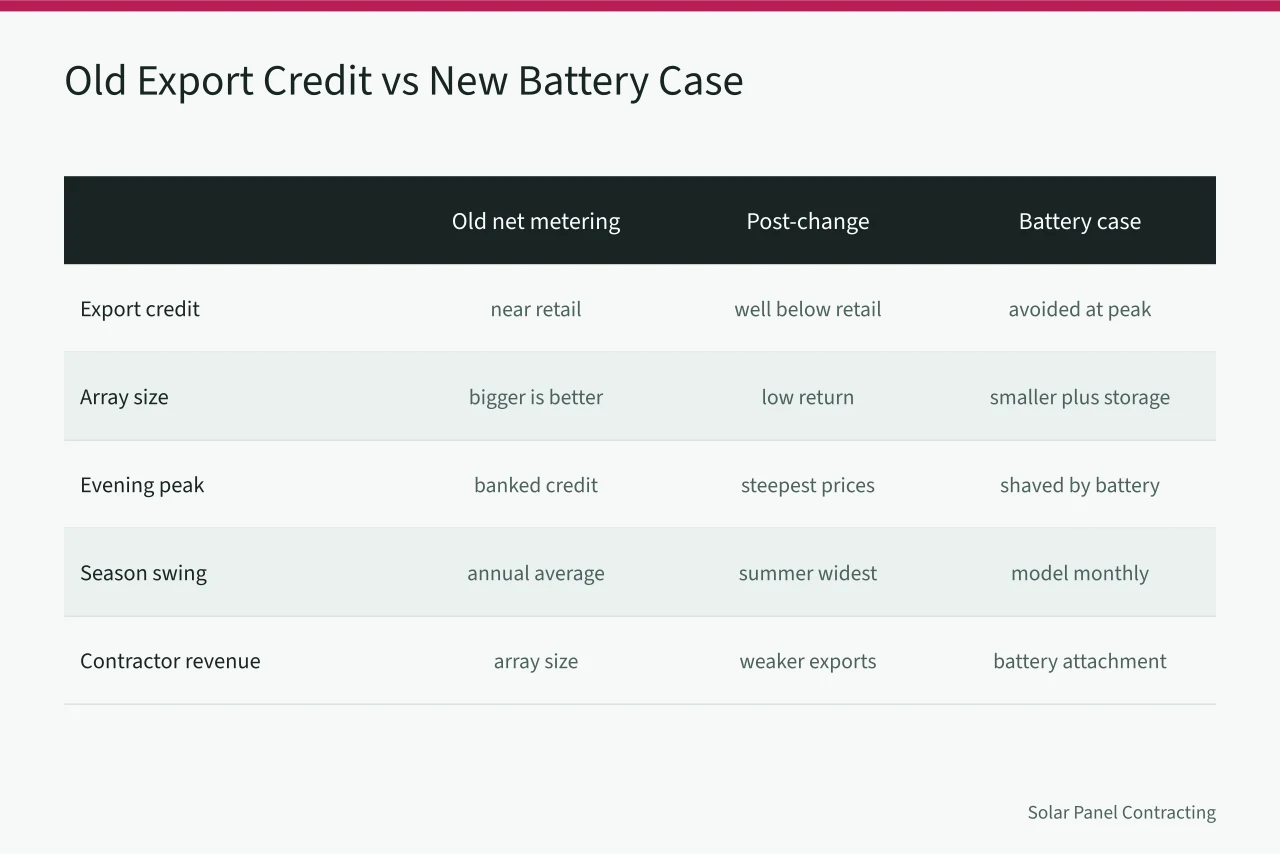
Export compensation now sits well below retail. A kilowatt-hour sent to the grid is worth far less than one you avoid buying at peak, and that single gap is the whole battery case.
Ask a homeowner what their true-up looked like two years ago against now. The difference is usually the moment they start asking about storage.
Retail prices keep climbing, and the spread between what a household pays and what it is paid for exports widens with them, as the Electricity - U.S. Energy Information Administration (EIA) figures show.
For contractors, revenue moves from array size toward battery attachment. A larger array on a low export credit returns less than a smaller array paired with storage that shaves peak load.
The spread shifts with the season. Summer evenings carry the highest rates and the widest gap; winter evenings narrow it. Contractors who model only an annual average miss that swing, and customers notice when January does not look like August.
Storage also supports higher-value money-making services such as monitoring, load control and annual system reviews. It gives you a reason to return to the home every year, and that recurring contact is where the profit lives.
Sizing batteries for time-of-use rates instead of export credits
Under export credits you sized storage to shift surplus generation into the evening. Under a time-of-use rate you size storage to cover the household's actual evening load, hour by hour.
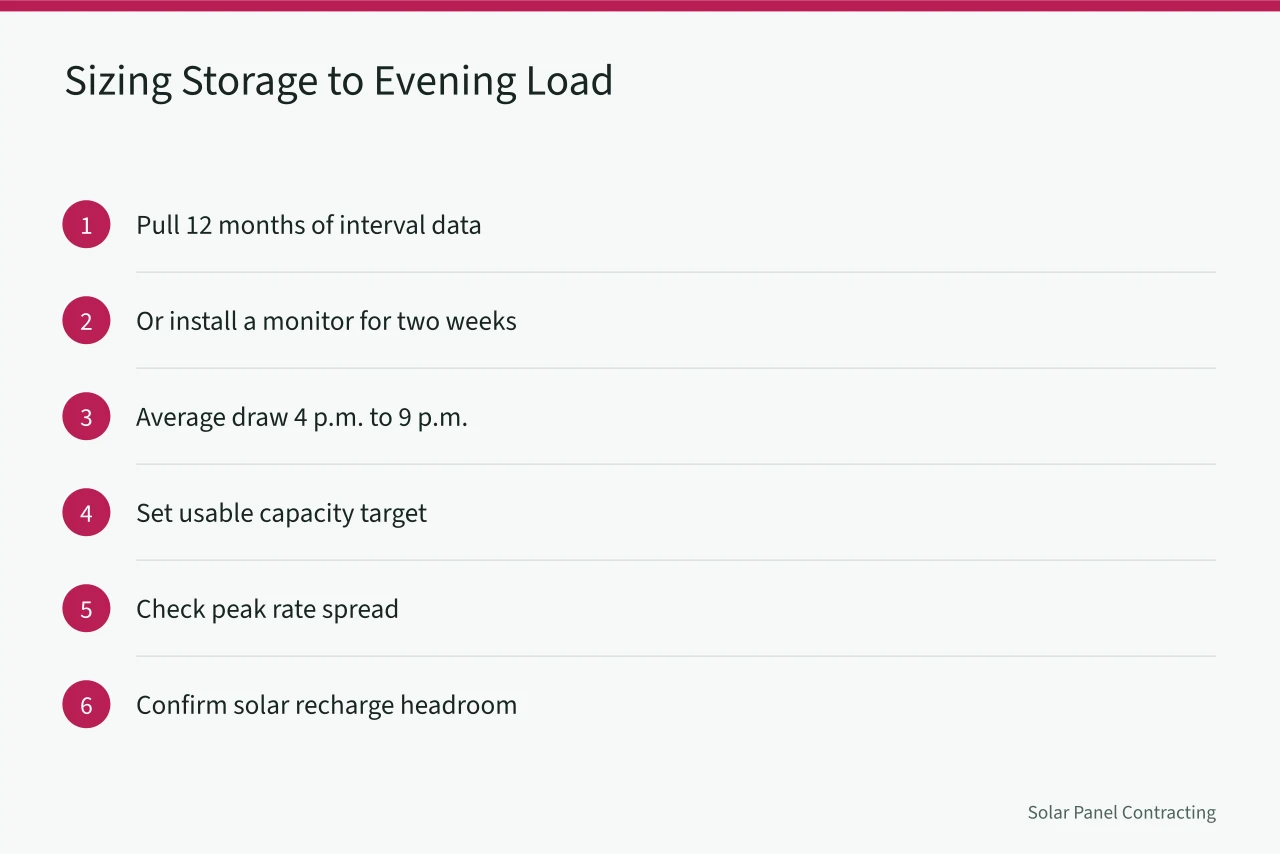
Start with the load profile, not the array. Pull 12 months of interval data from the utility, or install a monitor for two weeks. Then average the kilowatt-hour draw between 4 p.m. and 9 p.m. That number sets the usable capacity target.
When interval data is thin, residential consumption data helps you sanity-check appliance and end-use assumptions. The Residential Energy Consumption Survey (RECS) - Energy Information Administration is the reference most contractors reach for.
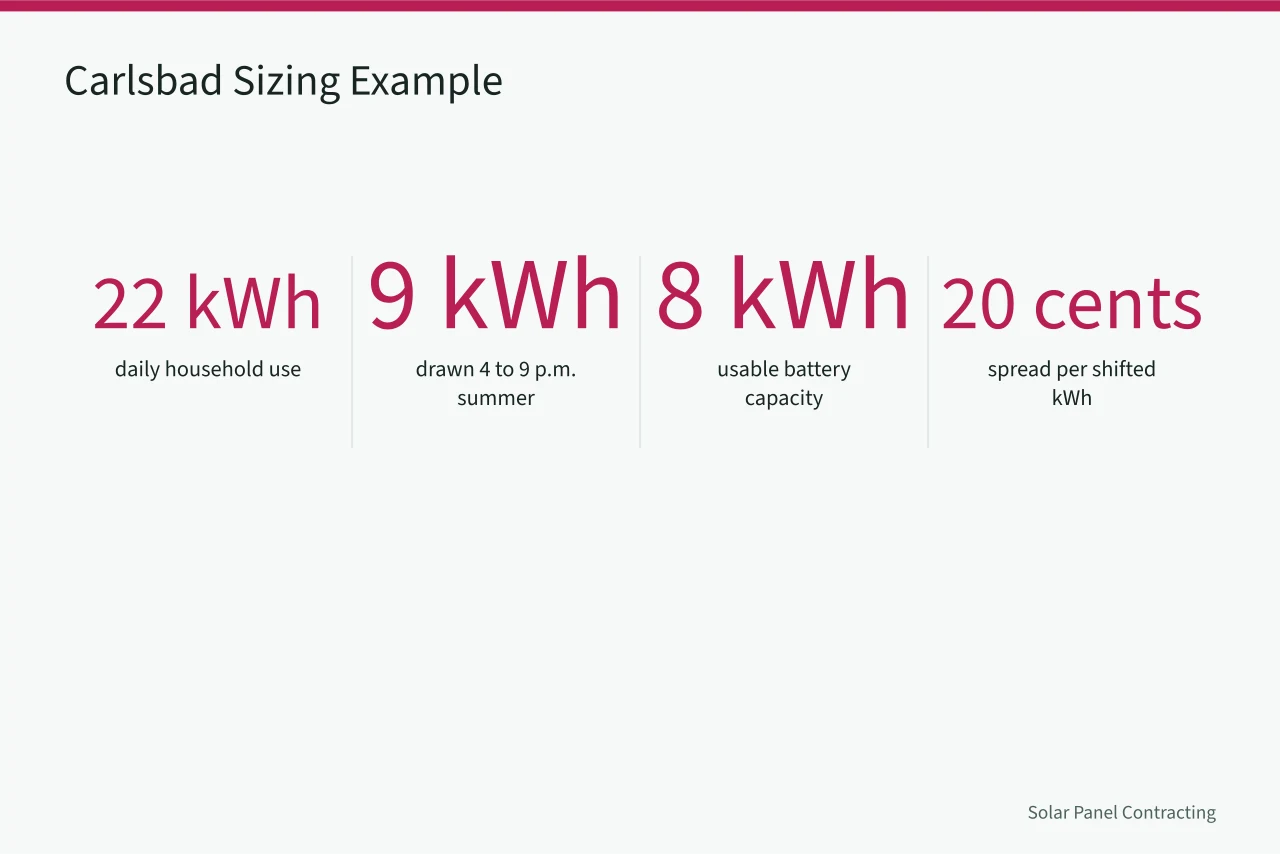
A Carlsbad household uses 22 kWh a day and draws 9 kWh between 4 p.m. and 9 p.m. in summer. A battery delivering 8 usable kWh shaves most of that peak. At a peak rate near 50 cents and an off-peak rate near 30 cents, the spread is roughly 20 cents per shifted kilowatt-hour.
| Sizing input | What to collect | Why it matters |
|---|---|---|
| Evening load | Interval data, 4 to 9 p.m. | Sets usable capacity |
| Peak rate spread | Utility rate schedule | Sets the dollar value per kWh shifted |
| Backup loads | Panel-level list | Sets the critical load subpanel |
| Solar production | Production meter history | Confirms recharge headroom |
| Growth plan | EV, heat pump, ADU | Prevents undersizing |
Round up for loads customers add later. An EV charged overnight does not need battery capacity; a heat pump running into the evening does. Ask about both before you quote.
Two hardware details follow from the sizing method. Confirm the inverter can run backup loads while the battery recharges, or set the recharge window outside peak hours. Build the critical load subpanel list before you pick the battery, because the breaker list decides what stays on during an outage.
Storage capacity keeps growing across the country, and renewable capacity data from the Renewable & Alternative Fuels - U.S. Energy Information Administration (EIA) shows how fast utility-scale and behind-the-meter storage have scaled. That answers the customer who asks whether batteries are a proven product.
Pair the sizing conversation with clear bundles and pricing tiers so the customer picks a level of resilience instead of haggling over hardware. Good, better, best still works when each tier maps to a real load outcome.
Rewriting sales scripts around resilience and peak avoidance
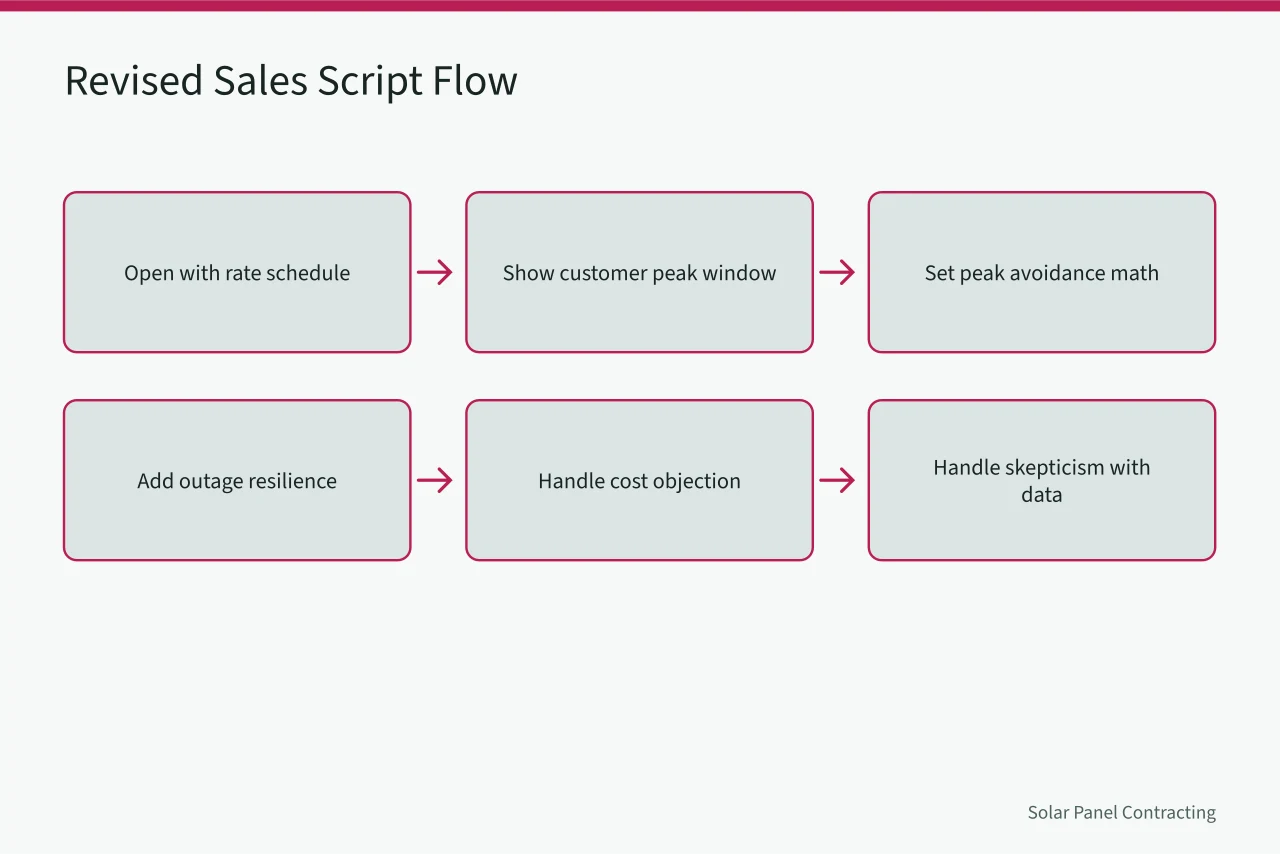
The revised script has one job: replace the export-credit story with a bill-and-backup story. Open with the rate schedule, not the hardware. Show the customer their own peak window and what it costs them.
Homeowners arrive with expectations shaped by the Department of Energy's consumer framing, so use it as your baseline. The Homeowner's Guide to Solar | Department of Energy covers what a customer already believes before you walk in.
Then set up the peak avoidance math in plain numbers. "You buy about 9 kilowatt-hours at the top rate every summer evening. The battery covers most of it." That sentence does more than any efficiency claim.
Resilience is the second half. San Diego County has wildfire-related outages and public safety power shutoffs, so backup power is not hypothetical here. Ask what the household lost during the last outage and let them describe the cost themselves.
Handle the two common objections directly. On cost, compare the battery price to what the household already pays for peak hours it fails to cover. On skepticism, offer a reference customer with a monitored system and let the prospect read the production data.
Keep claims tight. The Federal Trade Commission's guidance on advertising and consumer claims covers savings projections and payback promises, so use documented numbers and keep the Business Guidance | Federal Trade Commission standard in mind before any script reaches the field.
Train the pitch alongside your broader customer base work, because the script that wins referrals is the one a customer can repeat to a neighbor in one sentence.
Service offerings that follow the new economics
Storage changes the service catalog. This is the list that fits San Diego's post-net-metering market.
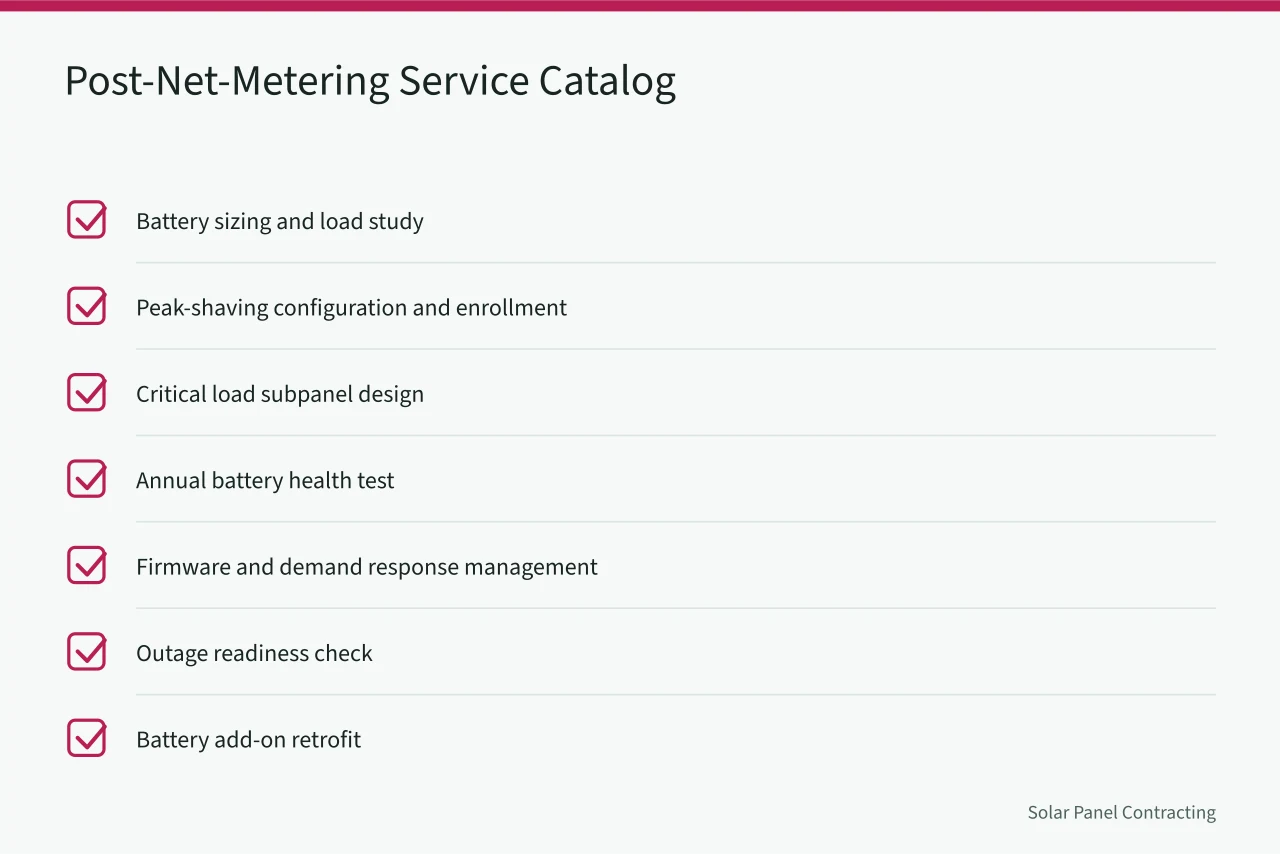
- Battery sizing and load study, priced as a standalone deliverable
- Peak-shaving configuration and rate schedule enrollment support
- Critical load subpanel design and installation
- Annual battery health and capacity test
- Firmware, monitoring and demand response enrollment management
- Outage readiness check before wildfire season
- Battery add-on retrofit for existing solar customers
The retrofit line is the quiet earner. Thousands of San Diego homes already have solar and no storage, and those owners now see a weaker export credit. They are the best-qualified battery leads you have.
Price the load study so it stands alone. If a homeowner pays for the analysis and buys elsewhere, you covered the truck roll and learned the market. If they buy, credit the fee against the install.
Bundle monitoring and the annual test into a recurring agreement. Storage hardware is a one-time sale, but performance drifts, rates change and firmware updates matter. Recurring service keeps the relationship alive between major purchases.
Battery commissioning, rapid shutdown and the National Electrical Code requirements for energy storage systems sit outside what a panel-only crew practices. Have a licensed electrician sign off on the storage scope, and treat certification through the North American Board of Certified Energy Practitioners as a hiring signal.
Treat the storage line as part of your overall pricing and profit model rather than a bolt-on. Margin on batteries is thinner than margin on panels, so labor efficiency and clean scopes carry the deal.
Warranty and service contract implications for battery work
Storage warranties differ from panel warranties in ways that trip up contractors. Panel warranties run 25 years on production. Battery warranties usually specify a term in years and a throughput or cycle limit, whichever comes first.
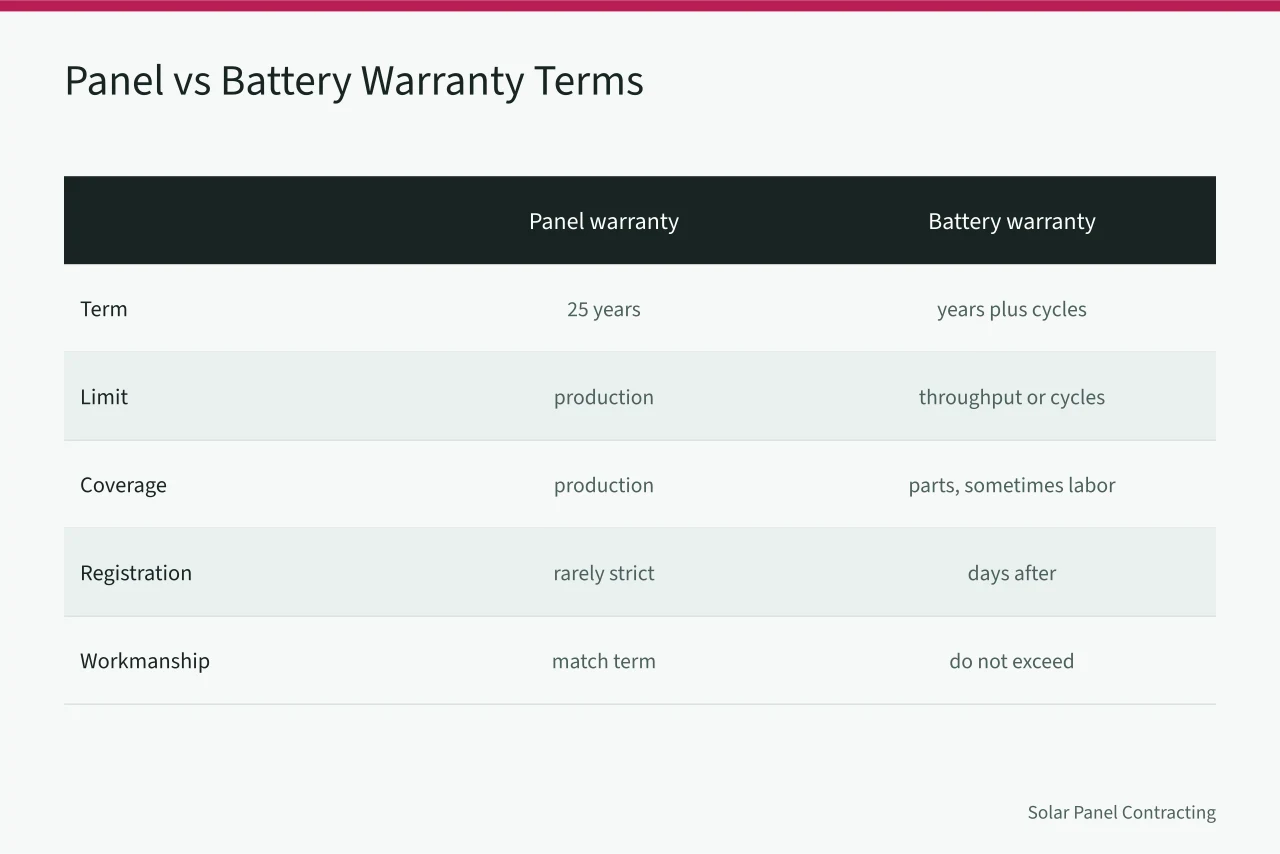
Read the manufacturer terms before you quote. Some cover parts only, some cover labor for a set period, and some require registration within days of commissioning. Miss the window and the customer's coverage suffers.
Set response times in writing. A battery that faults in August is a different emergency than one that faults in a mild month, and customers will hold you to whatever the contract says. State a response window and a parts lead time so nobody promises a same-day fix the supply chain cannot deliver.
Write your own workmanship warranty to match the equipment term, not exceed it. If the battery warranty is 10 years and your labor warranty is 25, you carry 15 years of exposure on a product you do not control.
Service contracts should state what happens at end of life. Capacity fades, and customers will ask what a replacement costs. Give a range and explain that pricing depends on the market at the time.
Document the commissioning data. Nameplate capacity, measured usable capacity and the configured backup loads belong in the file. When a warranty claim comes, that record settles the argument.
Keep the sales promises and the warranty documents consistent. A script that promises whole-home backup while the contract covers a critical load subpanel is a complaint waiting to happen, and it undercuts the marketing worth your attention you are already paying for.
Common questions
How much battery capacity does a San Diego home need?
Size to the 4 to 9 p.m. load, not annual usage. Most homes land between 8 and 15 usable kilowatt-hours, with heat pumps and EVs pushing the upper end.
Does a battery still pay without generous export credits?
Yes, if the peak rate spread is wide enough and the household actually draws power in the evening. The value comes from avoided purchases, not from exports.
What should the sales script lead with?
The customer's own rate schedule and evening usage. Resilience follows as the second point, backed by their outage history.
Should I sell batteries to existing solar customers?
Yes. They already understand production and now see weaker export value, which makes them the strongest battery leads in the territory.