Guides
NABCEP certification and what it changes for American solar hiring and insurance
NABCEP certification shifts solar hiring filters, pay bands and carrier conversations, and it rarely pays back in a small shop that turns crews over fast.
What to take away
- NABCEP is a private credential, not a license. No state requires it to pull a permit or energize a system.
- A "required" line in the job ad shrinks the applicant pool and invites counteroffers. "Preferred, we sponsor" keeps it open.
- Certified leads sit above the local OEWS median, but the premium arrives as a signing bonus or tool allowance as often as hourly pay.
- Carriers price on loss history, payroll and roof exposure. Training credits exist, and they are smaller than most owners expect.
- Sponsor the credential only for people you expect to keep past two years. Below that, the training spend never returns.
What the credential covers, and what it does not
NABCEP, the North American Board of Certified Energy Practitioners, runs the main voluntary credentialing program for U.S. solar workers. It is not a license. No state requires it to pull a permit or energize a system.
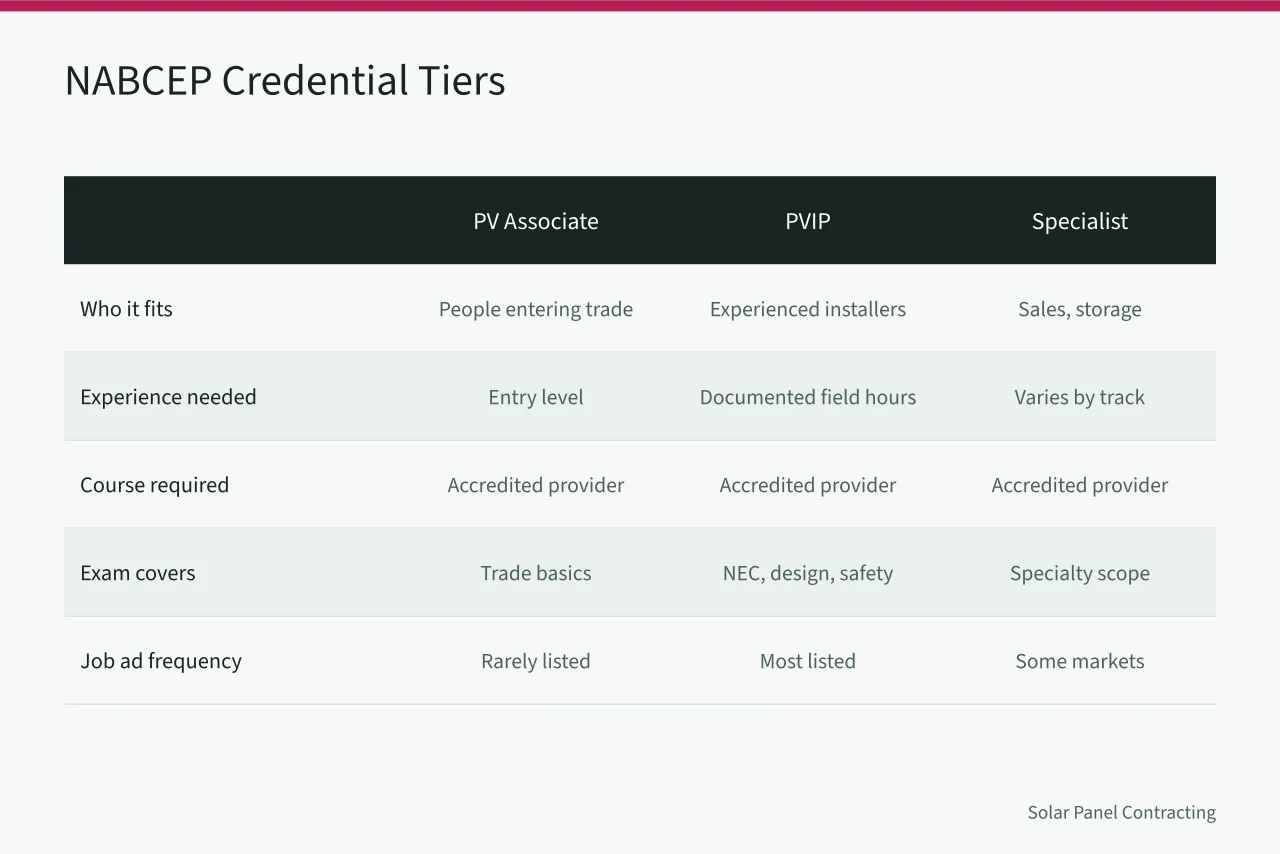
The flagship credential is the PV Installation Professional, written PVIP. Candidates document field experience, complete a course from an accredited provider, and pass an exam on the National Electrical Code, system design, commissioning and safety.
Entry and specialist credentials sit alongside it. The PV Associate exam suits people entering the trade. PVIP is the one most contractors list in job ads. Separate credentials cover technical sales and, in some markets, energy storage.
What it proves is narrower than owners assume. It confirms a candidate cleared an experience threshold and passed a knowledge test. It does not certify that the person can run a crew, size a service upgrade, or absorb a homeowner complaint.
Holders recertify on a cycle, accumulating continuing education units and paying a renewal fee. That lands in your training budget, because you may fund coursework every cycle.
NABCEP is not a government body and does not inspect work. When a utility or an authority having jurisdiction references it, that program is borrowing a private standard for its own rules. The Department of Energy publishes federal solar training resources, useful when you explain credentials to a customer or shop for coursework.
How the credential changes your hiring filter
Most contractors screen on experience. Add a NABCEP requirement and the filter changes shape: you are now checking a credential number, a recertification date and a training provider.
That narrows the pool fast. In most metros you compete for the same small group of certified installers, and they know it. Expect longer time to fill and more counteroffers.
Ad language decides your applicant flow. "NABCEP certified required" reads differently than "NABCEP certified preferred, we will sponsor." The second version lets you build the credential internally.
Sponsorship turns the credential into a retention tool. You pay for the course and the exam, the installer signs a repayment agreement if they leave early, and you get a documented training path. Build that into your recruitment planning for owners rather than promising it verbally at the interview.
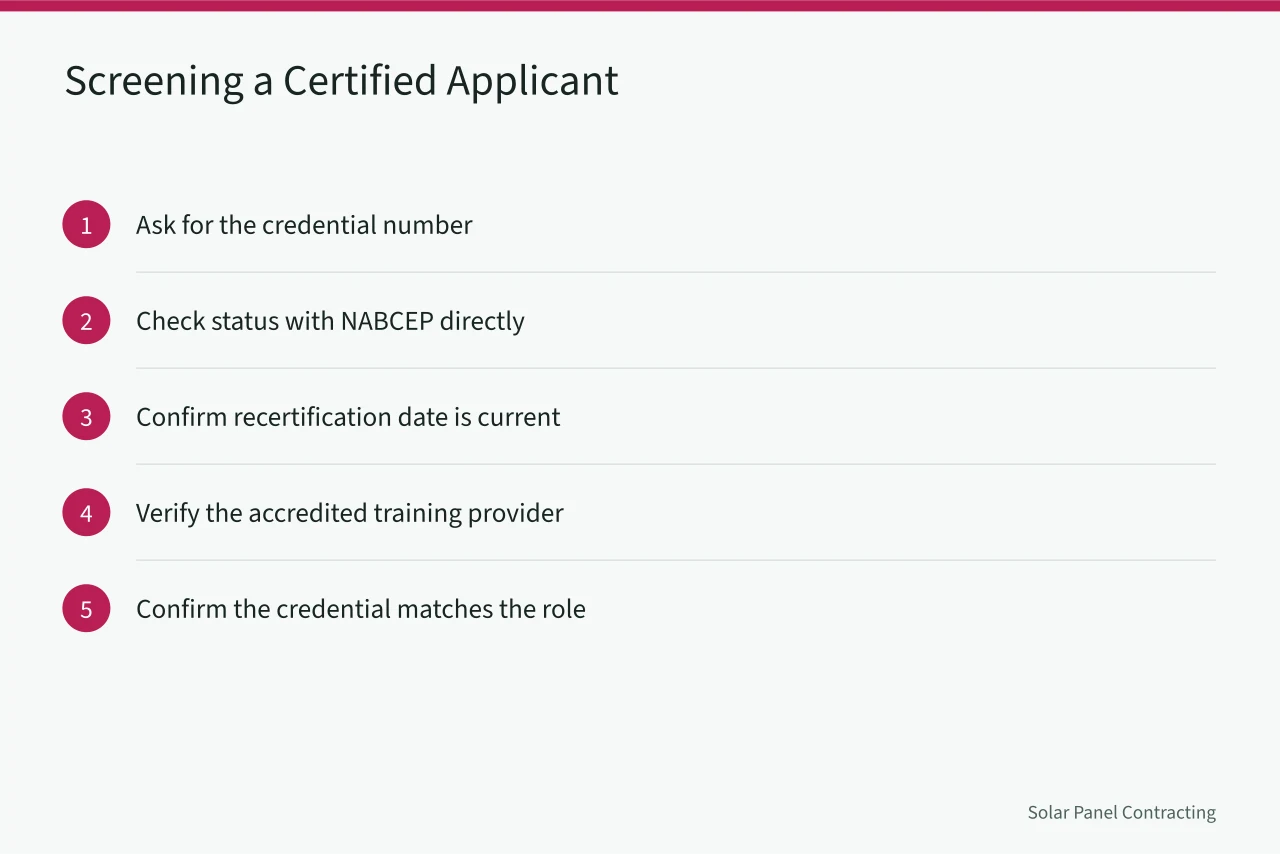
Verify before you hire. Ask for the credential number and check status with NABCEP directly. Lapsed credentials are common, and a lapsed certification printed in a job ad becomes a liability the moment a customer or a carrier asks.
Title inflation is the trap. Calling someone a certified installer after their credential expired is a misrepresentation that surfaces in a deposition after an arc flash or a fall.
A workable screening order for a residential crew lead:
- Confirm state electrical license status where the state requires one.
- Check the NABCEP credential number and expiration date.
- Review documented OSHA 10 or OSHA 30 completion.
- Verify driving record if the role includes a company vehicle.
- Run a hands-on assessment on a mock array before an offer.
For sourcing channels and interview structure, see our guide on how to recruit, train and keep people in a solar installer business.
What certified installers cost against the BLS tables
The Bureau of Labor Statistics publishes the reference point most owners use. The OEWS wage tables break compensation out by occupation and metro, and they are the fastest way to sanity-check a range.
Look up the solar photovoltaic installers line for your state and metro before you set a band. The national median is a starting point, not a budget. California, New York, Massachusetts and Colorado metros sit above it. Parts of Texas, Florida and North Carolina sit near or below it.
The BLS installer outlook data covers training and growth, including that most installers learn on the job. Use it when you write the ad and when you justify a band to a partner.
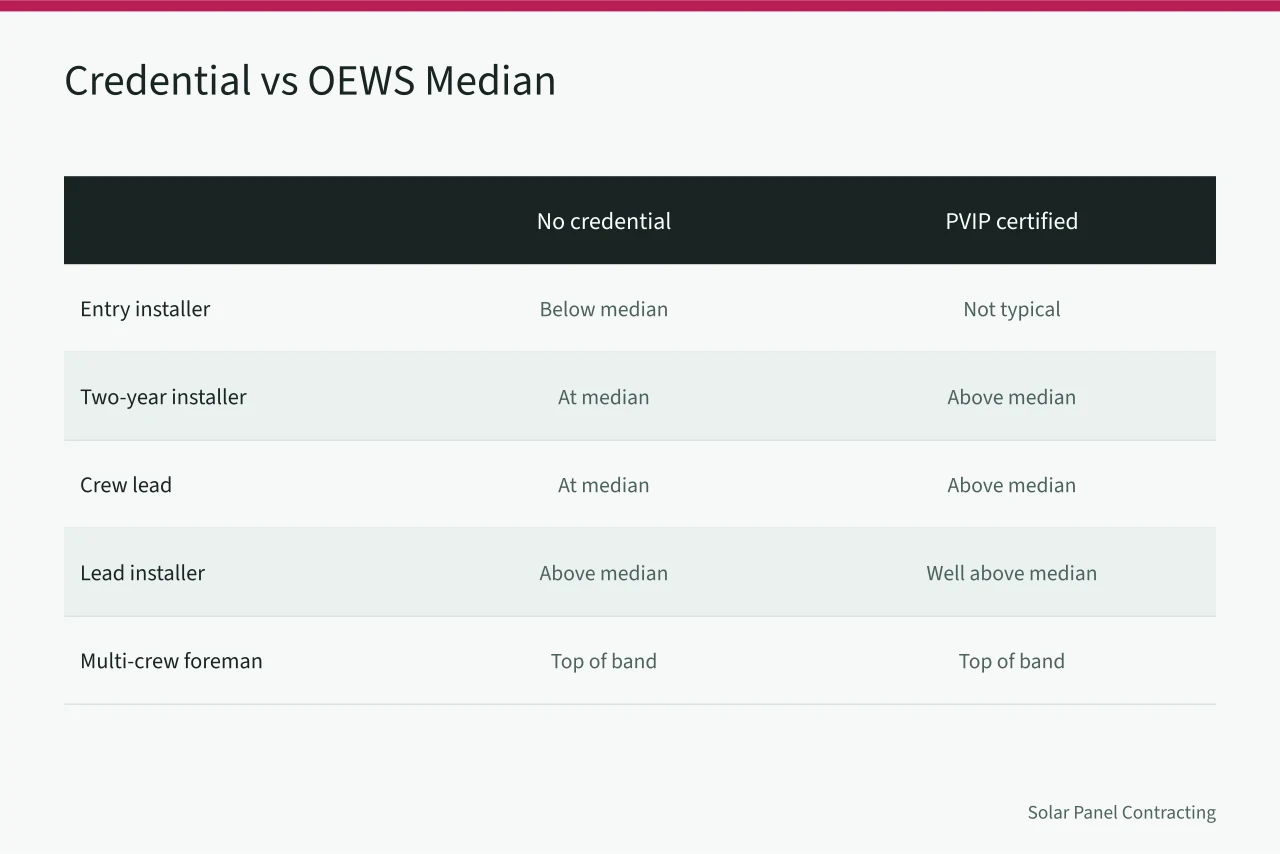
Certified installers typically land above the OEWS median for their area. The premium is not fixed, and it shows up as a higher offer, a signing bonus, a tool allowance or paid training time.
| Role | Credential | Typical position against OEWS median |
|---|---|---|
| Entry installer | None | Below median |
| Installer, 2 years | None | At median |
| Crew lead | PV Associate or in progress | Above median |
| Lead installer | PVIP | Well above median |
| Foreman, multi-crew | PVIP plus state license | Top of local band |
Those rows are directional, not published figures. Your local OEWS table and your own turnover data set the real numbers. For pay bands, burdened labor and billable rates, see our breakdown of wages and labor costs.
One cost owners miss: certification study is unpaid production time unless you schedule it. A lead installer studying for the exam is not on a roof. Budget the hours.
Certified installers also negotiate harder on benefits. Once base pay clears the local median, health coverage, a truck and a predictable schedule often matter more than the hourly rate.
How carriers actually price a certified crew
Underwriting criteria for solar contractors are built around loss experience, not credentials. A general liability carrier wants revenue, payroll, subcontractor use, roof work exposure and claims history.
Workers compensation is where credentials enter the conversation. A carrier may ask about safety programs, OSHA training and documented supervision. A certified lead with OSHA 30 behind them supports that story, and does not replace a written safety program.
Some carriers offer small credits for documented training. Treat any discount as a negotiation point, not a plan. Ask your broker what documentation moves the rate, and get the answer in writing before you spend on certification.
Roof work drives claim severity. Falls, dropped modules and electrical contact produce the large losses. Certification does not change physics, and a carrier knows it.
Heat is a real exposure in Arizona, Texas, Florida and inland California. OSHA heat guidance covers water, rest, shade, acclimatization for new workers and a written prevention plan. Certified or not, your crew needs that plan, and carriers increasingly ask for it.
OSHA employer compliance help is the fastest route to the training tools and recordkeeping rules that underwriting questionnaires tend to mirror.
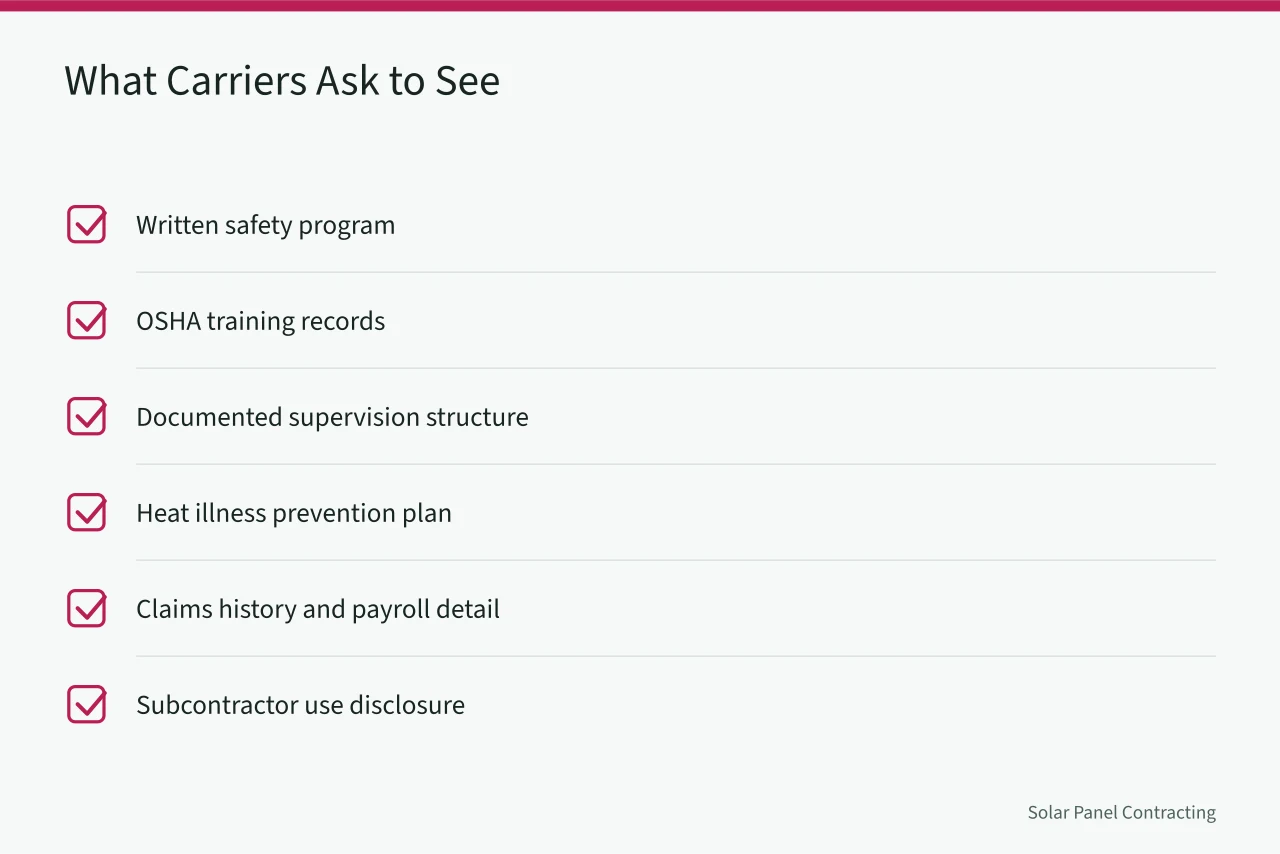
What carriers ask to see:
- Written safety program with a named competent person
- Documented OSHA training records for every field employee
- Subcontractor certificates and indemnity language on file
- Heat illness prevention plan with an acclimatization schedule
- Vehicle and driving records for anyone in a company truck
- Claim history with corrective actions documented
- Electrical licensing where the state requires it
If a carrier says certification lowers your premium, ask which line of coverage and how much. Vague promises are common. Written credits are not. For coverage types, limits and what contractors typically pay, see our guide to insurance types and typical premiums.
Training pipelines that produce certified installers
Certified installers come out of a pipeline. You can buy from it or build into it.
Community college programs are the largest formal source. Schools in California, Arizona, Colorado and North Carolina run solar and electrical programs, often aligned to NABCEP learning objectives. Graduates arrive with course hours already banked toward the credential.
Trade unions and apprenticeship programs feed commercial and utility-scale work. Those candidates usually have stronger electrical fundamentals and a documented safety record, which helps on the insurance side.
Manufacturer and distributor training is the fastest route for your existing crew. Inverter, racking and storage vendors run short courses, and some count toward recertification units.
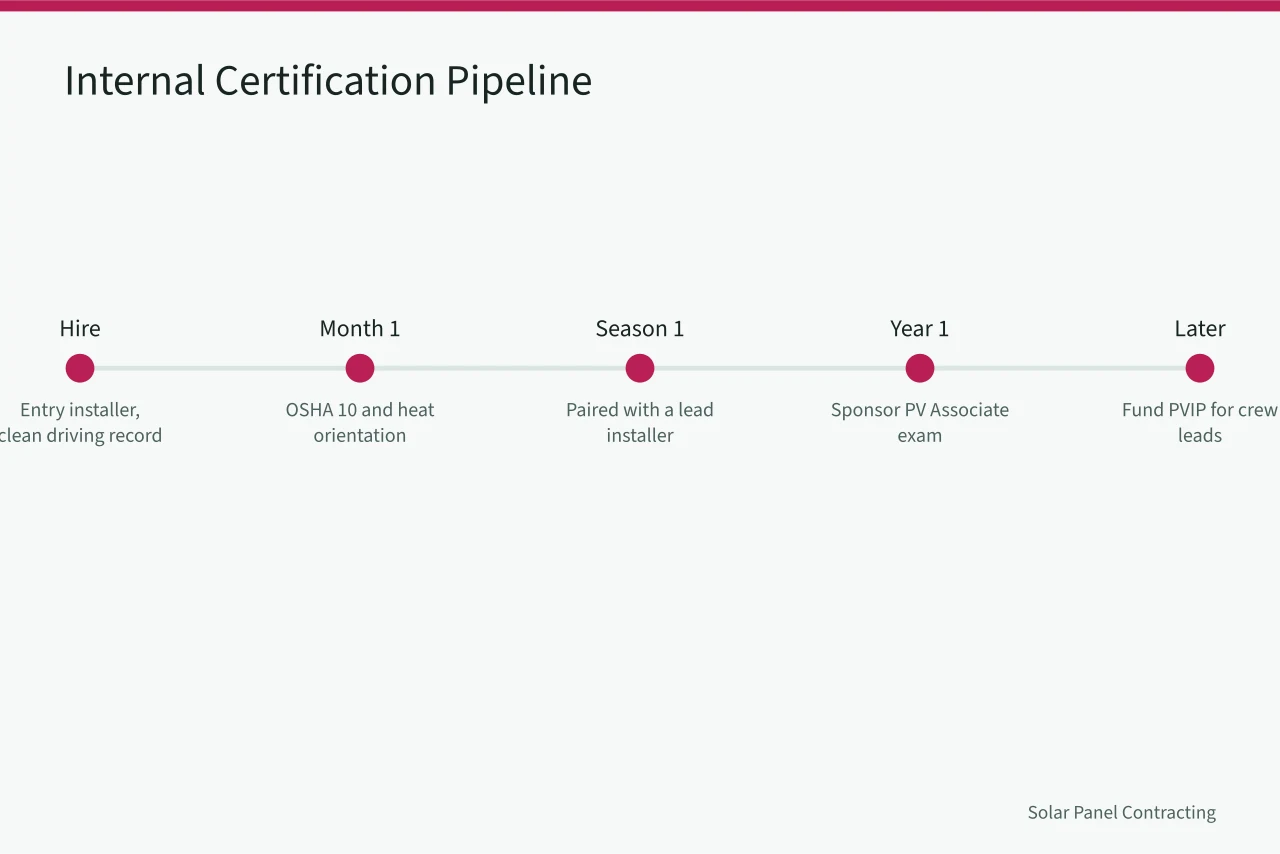
A workable internal pipeline:
- Hire entry installers with a clean driving record and mechanical aptitude.
- Put them through OSHA 10 and a heat safety orientation in the first month.
- Pair them with a lead for a full season of installs.
- Sponsor PV Associate at the one year mark.
- Fund PVIP coursework for the people you want running crews.
Document all of it. A training record satisfies both a carrier questionnaire and a NABCEP experience requirement. Our guide to solar installer licensing requirements covers the records worth keeping.
Retention is the constraint. If certified installers leave inside two years, the training spend never pays back. Track cost per certified installer against the months they stay.
When certification is not worth the money
Certification is a business decision, not a moral one. Several conditions argue against paying for it.
You run a small residential crew in a market with light permitting review and no utility program that references NABCEP. Nobody is asking, so the credential wins you no job and no rate.
Your volume is low and your leads come from referrals. Homeowners rarely ask about credentials. They ask about price, timeline and whether you will still be in business next year.
You cannot absorb the training hours or the turnover. If installers leave inside a year, sponsoring certification is a donation to your competitor.
Your real bottleneck is electrical licensing, not certification. Where a licensed electrician must sign off, spend the money on that path instead.
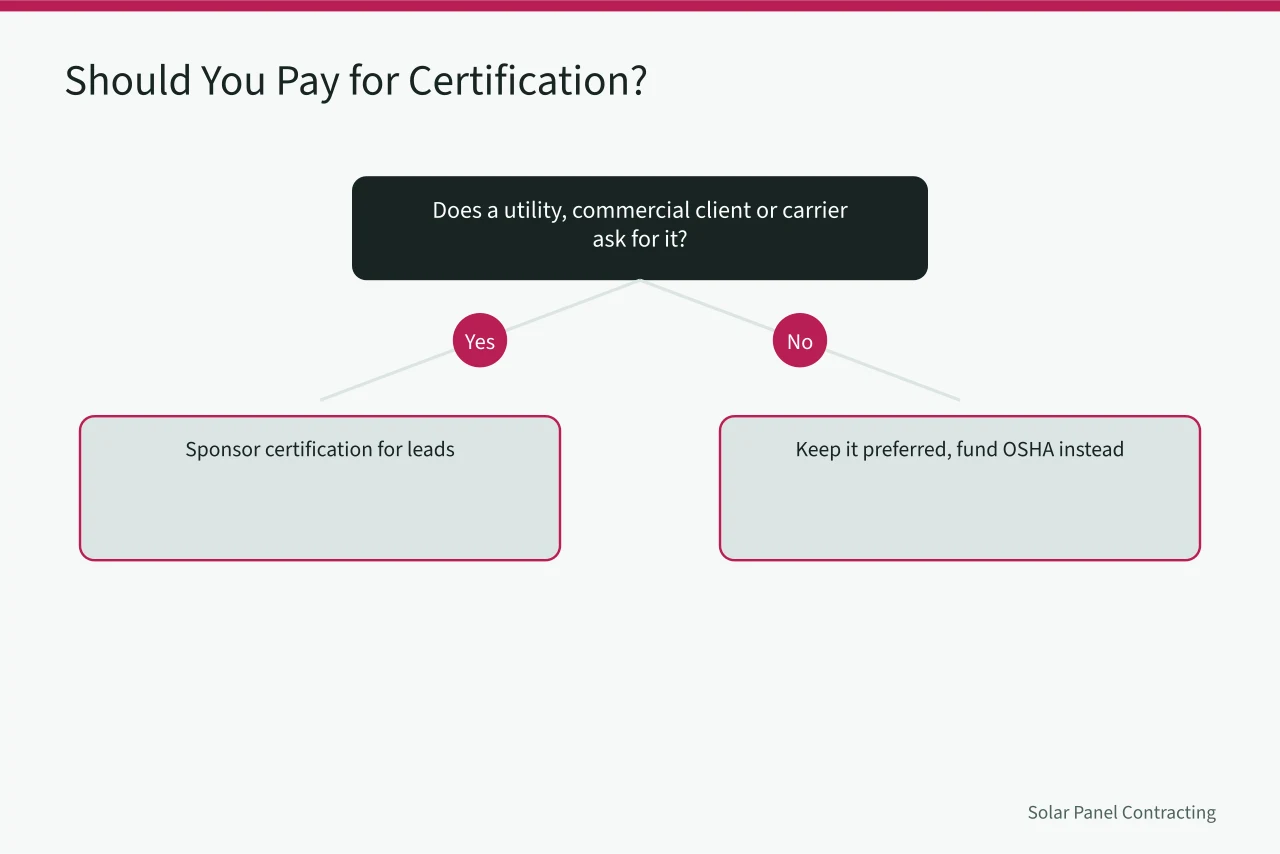
A middle route works for many shops. Keep certification preferred rather than required, sponsor one lead installer, and put the rest of the budget into OSHA training, a heat plan and documented supervision. That combination answers most underwriting questions and most customers.
Revisit the decision when a utility, a commercial client or a carrier starts asking. Certification is easy to add later and hard to justify in advance.
Common questions
Does NABCEP certification replace a state electrical license?
No. Licensing is a state function enforced by contractor licensing boards, and requirements vary widely. NABCEP is a voluntary industry credential. Where a state requires a licensed electrician for certain work, the license is the binding requirement.
Will my insurance premium drop if my crew is certified?
Rarely on the credential alone. Carriers weigh loss history, safety programs, payroll and roof exposure first. Some may offer a modest credit for documented training, so ask your broker what documentation actually moves the rate.
How much more do certified installers earn?
They generally sit above the local median in the OEWS wage tables, but the premium varies by market and role. Check your state and metro tables, then compare against your own offers and turnover before setting a band.
Can I hire good installers without certification and train them up?
Yes, and many contractors do. Hire for aptitude and reliability, run OSHA 10 and heat safety early, and sponsor certification later for the people you want leading crews. The risk is turnover before the training pays back.