Guides
How to Respond to Solar Installer Reviews Without Sounding Defensive
Respond to solar installer reviews with a repeatable method: claim the profile, sort by intent, reply inside the rules, and escalate real disputes.
What to take away
- A review reply is a public document read by future buyers, not a private message to the reviewer. Write for the third party.
- Sort reviews by what they ask for: a fix, a fact, or a fight. Only the first two deserve a public answer.
- Google Business Profile replies are visible to everyone. Federal Trade Commission rules bar incentives tied to positive reviews and bar suppressing negative ones.
- Keep a written log of every reply, the job number, and the outcome. That log is your defense if a state board or the Better Business Bureau asks.
- Escalate to a professional when a review alleges injury, licensing violations, or fraud.
What has to be true before the first reply
You need three things in place. First, verified ownership of the Google Business Profile, because replies from an unverified account get filtered. Second, a job record system that ties a reviewer name to an address and a work order. Third, a named person who owns replies, so two employees do not answer the same review.
Without those, a reply is guesswork. A contractor who cannot find the job number will either ignore a real complaint or apologize for something the crew did not do.
The Federal Trade Commission treats review suppression and fake positive reviews as deceptive practices. Buying reviews or offering a discount only to customers who leave five stars creates legal exposure. The Consumer Financial Protection Bureau explains solar loan terms that customers often misread, which is a frequent source of angry reviews (CFPB solar loan explainer).
The sequence
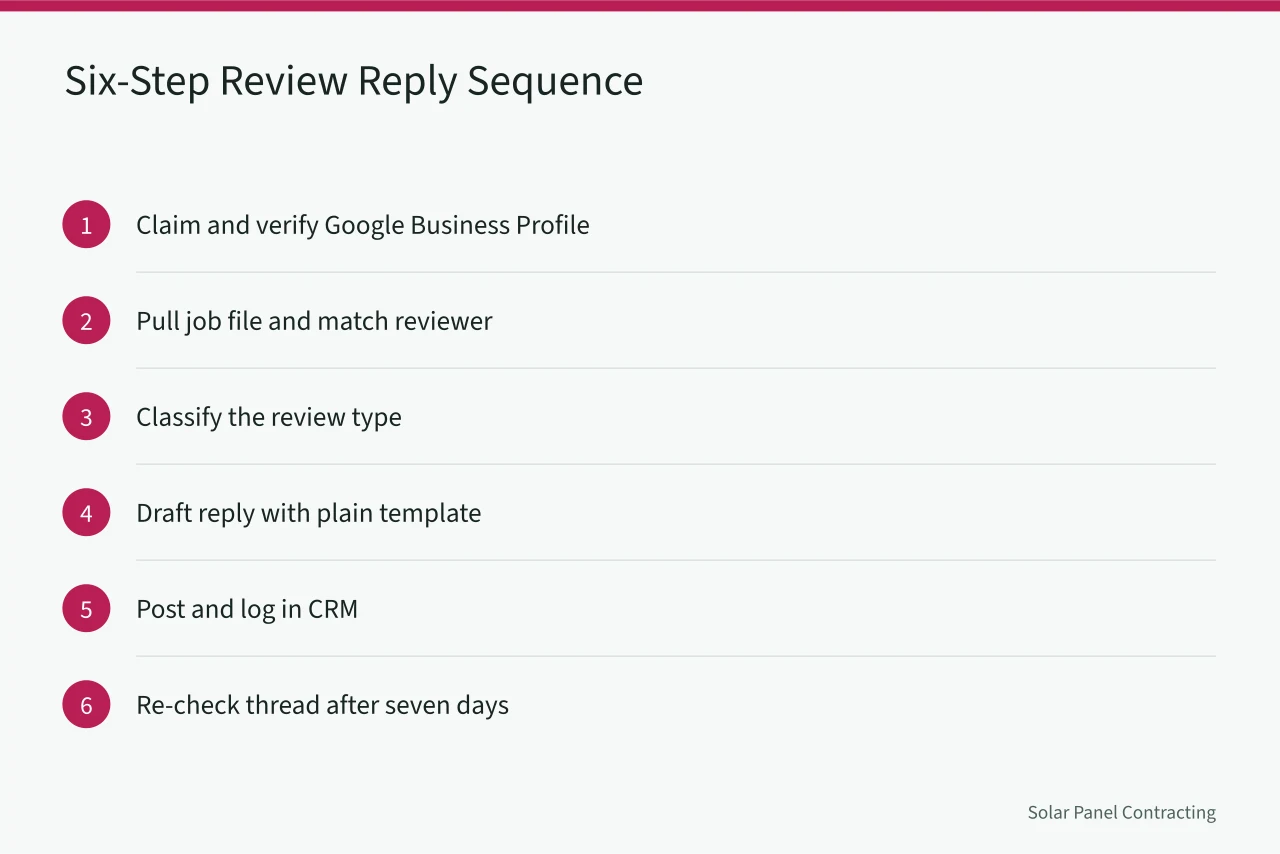
- Claim and verify the Google Business Profile, then turn on review notifications.
- Pull the job file before writing anything. Match reviewer name, address, date, and contract terms.
- Classify the review: fix request, factual error, pricing dispute, or abuse.
- Draft the reply in a plain template with no adjectives about the reviewer.
- Post, then log the reply, date, and follow-up owner in your CRM.
- Re-check the thread after seven days. If the customer replies again, move to a phone call.
Steps 2 and 3 decide the outcome. Skipping the job file produces replies that sound defensive because they are vague.
The step that decides the result
Classification is the hinge. A fix request wants a phone number and a date. A factual error wants a short correction with the record. A pricing dispute usually belongs offline, because the contract terms are not public.
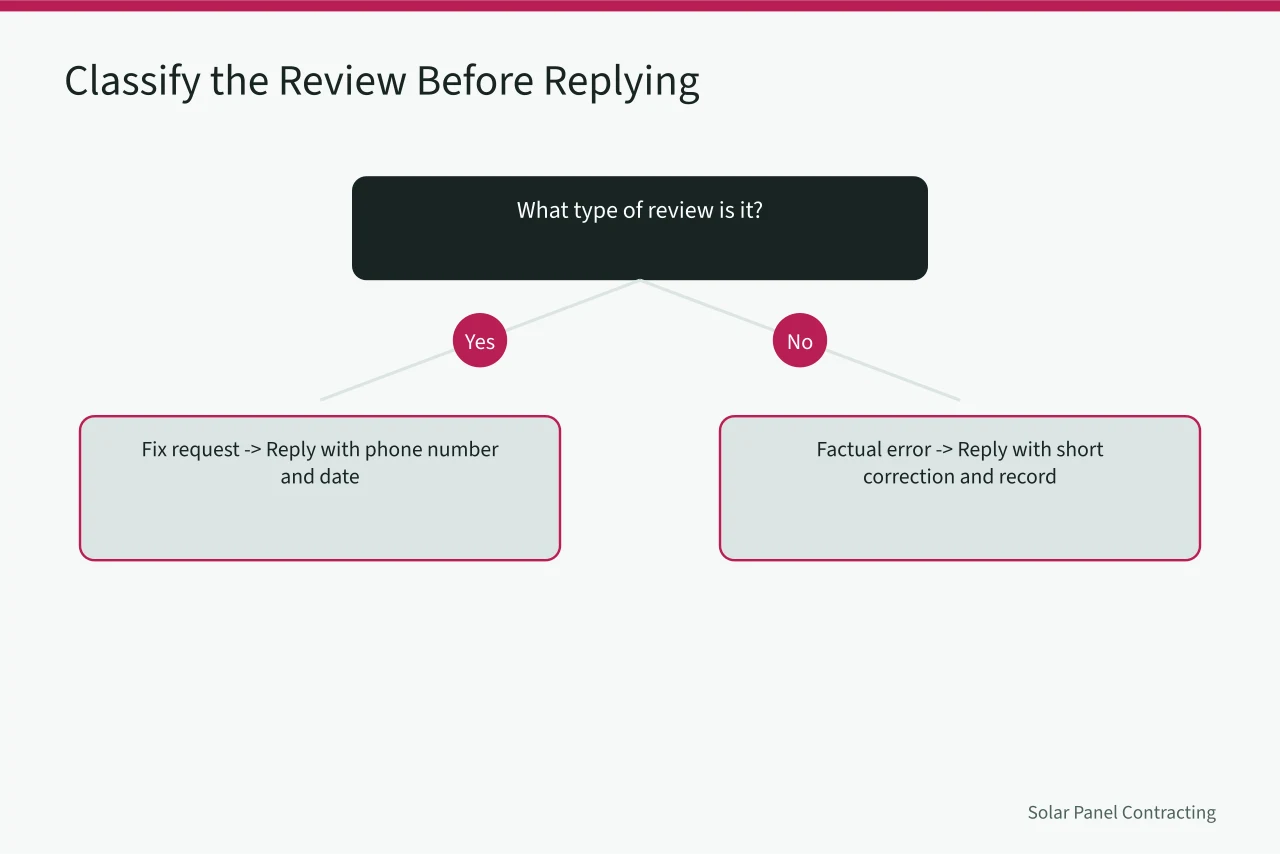
Abuse, meaning profanity or a review from someone who was never a customer, gets reported to Google for removal and no public reply.
A reply that names a customer's address, loan balance, or credit status can violate privacy law and your own contract. Keep job specifics out of the public thread.
Reputation management practice treats the reply as content aimed at the next reader, not the current one (online reputation management overview). That framing removes most defensiveness on its own.
How to check each step came out right
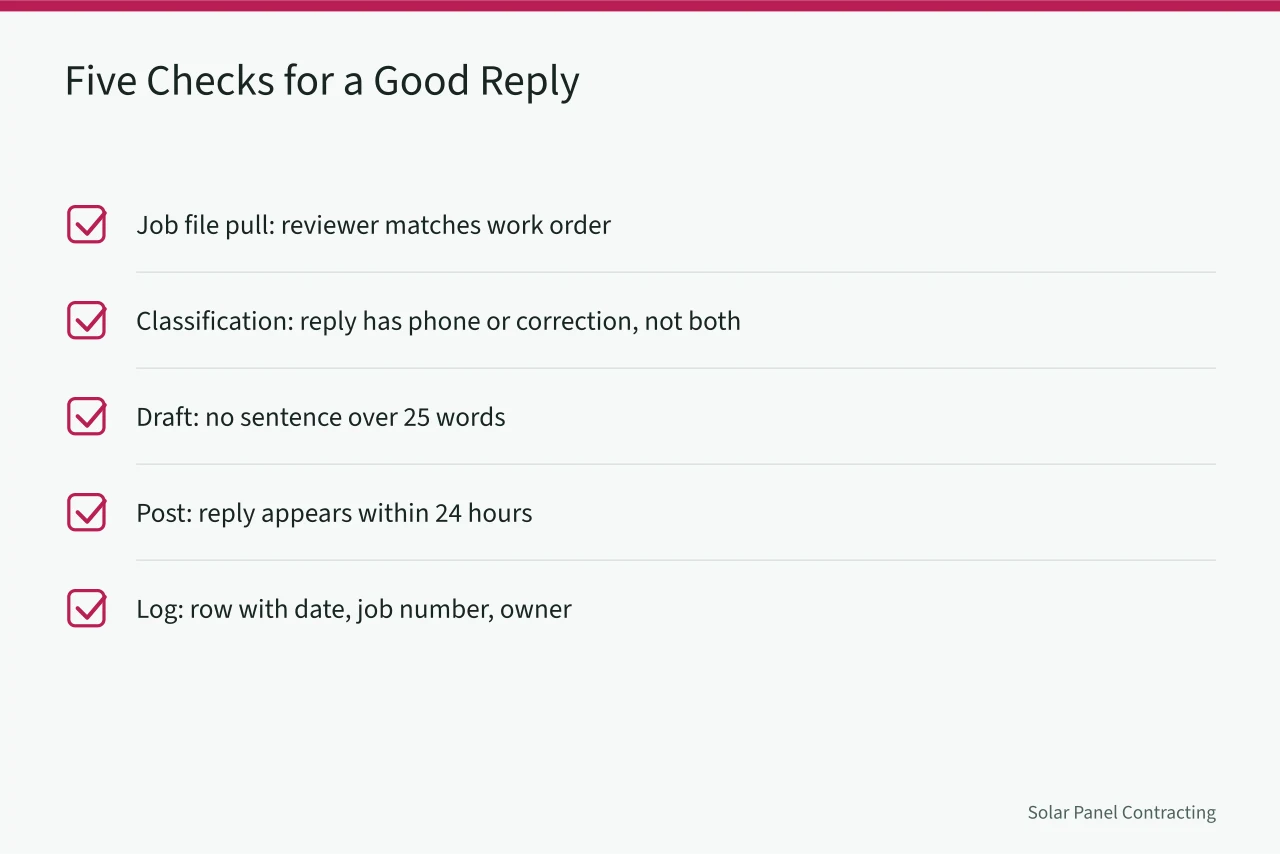
Use visible checks, not feelings.
| Step | Check that it worked |
|---|---|
| Job file pull | Reviewer name matches a work order in your CRM |
| Classification | Reply contains either a phone number or a factual correction, never both |
| Draft | No sentence over 25 words, no mention of money owed |
| Post | Reply appears under the review within 24 hours |
| Log | Row exists with date, job number, and follow-up owner |
A reply that passes all five reads calm to a stranger. That is the only test that matters.
The same discipline applies when you read your own complaint files; reading solar installer complaint handling with a sceptical eye shows how to separate a pattern from a one-off.
What to do when a step goes wrong
- You replied before pulling the job file and got a detail wrong. Post a short correction the same day, then move the thread to email.
- The reviewer is not a customer. Report to Google, do not argue publicly.
- Two employees replied to the same review. Delete the weaker reply and keep the one with the job number.
- The customer demands a refund in the thread. Move to a written settlement offer, never negotiate in public.
Example
A Raleigh installer received a two-star review claiming the crew left conduit unsealed. The owner pulled the job file, found the work order, and replied with a service number and a two-day callback window. The reviewer updated the review to four stars after the visit. The reply was eleven words long.
That is the whole method. Short, factual, and aimed at the next reader.
Reviewing the reviewer before you write
Not every review deserves a reply. A competitor posting from an address outside your service area is a report, not a conversation. A customer with an open warranty claim should get a private call first, because a public reply can complicate the claim.
Warranty language in your contract governs what you can promise in public (warranty law overview). If the reply offers a remedy the contract does not cover, you have created a new obligation.
Volume matters too. A solar company review management routine should aim to answer every review inside one week, not inside one hour. Speed without a job file is how defensive replies get written. Owners who build a steady referral habit see fewer hostile reviews in the first place, as building a solar installer business referral habit explains.
When to stop and hand it to a professional
Hand the matter to a lawyer when a review alleges personal injury, unlicensed electrical work, fraud, or a lien dispute. Hand it to your insurer when the review describes property damage. Hand it to a licensing board liaison when the reviewer has filed a complaint with a state board, because your public reply becomes evidence.
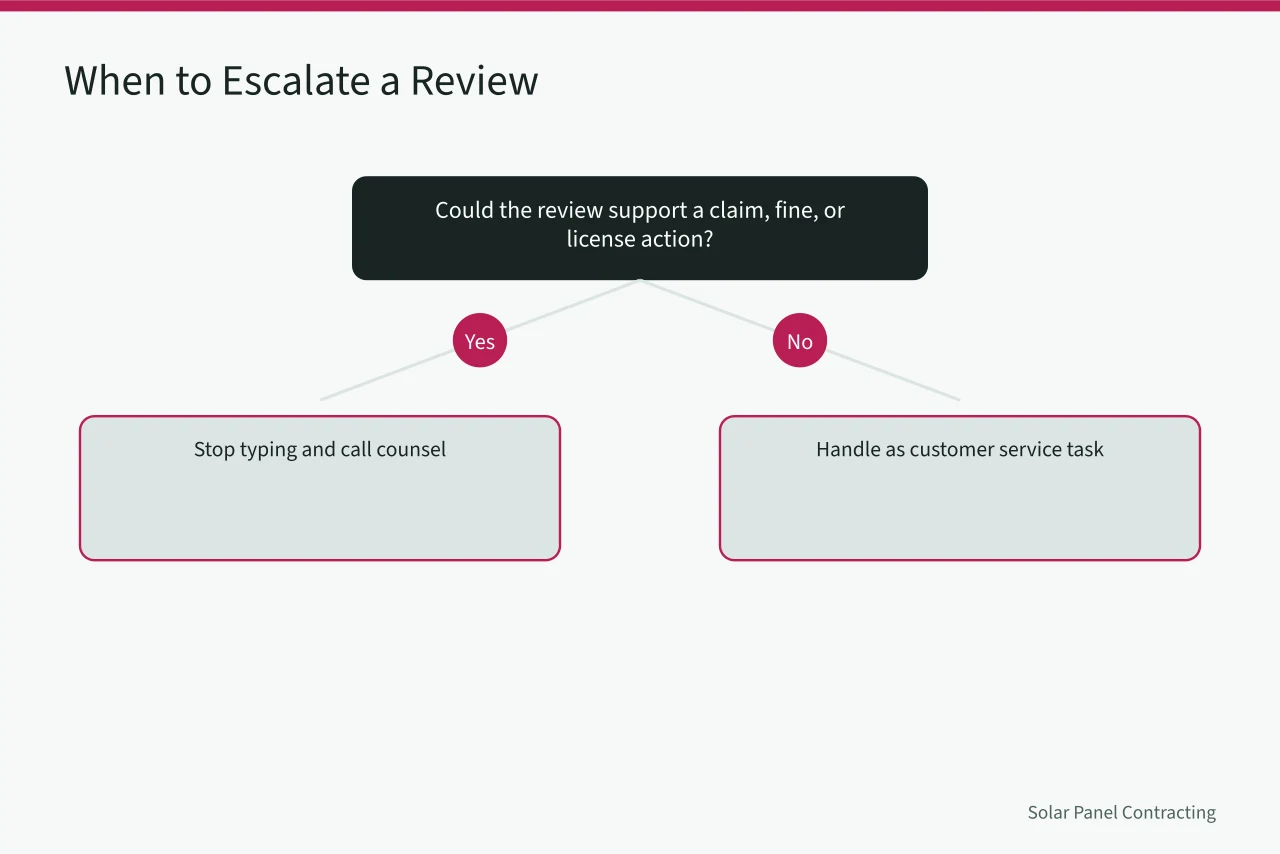
A simple condition covers all four: if the review could support a claim, a fine, or a license action, stop typing and call counsel. Everything else is a customer service task with a keyboard attached.
Common questions
Should I respond to every Google review, positive and negative? No. Reply to negative reviews that describe a fixable problem and to positive reviews that name a crew member. Skip one-line praise and obvious spam. Google Business Profile ranking rewards activity, but a wall of identical thank-you notes reads as automated.
Can I ask a customer to remove a review? You can ask once, politely, after the problem is resolved. You cannot offer money, a discount, or free equipment in exchange for removal. The FTC treats that as a deceptive practice, and Google can suspend the profile.
How long should a reply be? Two to four sentences. Long replies read as arguments. State what you found, what you will do, and how to reach you.
What if the review contains false statements about my license? Reply once with the license number and the issuing state, then stop. If the reviewer repeats the claim, send a written demand and keep a copy. Escalate to counsel if it continues.