Guides
How California utility interconnection queues shape solar customer expectations
PG&E and SCE interconnection queues decide when a California solar system turns on, and that timing sets your cash flow and your customer promises.
What to take away
- Two approvals gate every California job: the building department approves the installation, and PG&E or SCE approves the operation. The second one usually runs longer.
- Neither utility energizes a system on a promise. Both want a complete application and a signed inspection card from the authority having jurisdiction.
- A clean residential review on an open circuit clears in weeks. A main panel upgrade, a battery export setting, or a feeder that needs a study adds months.
- Final payment usually hangs on permission to operate, so queue time is a working capital problem before it is a customer service problem.
- Ranges beat dates in the sales conversation. A customer told six to eight weeks who waited fourteen feels misled even when the install was flawless.
How the PG&E and SCE interconnection queues actually work
Interconnection is the utility's process for letting your array connect to its grid and run. It is separate from your permit, your inspection, and your contract. A finished array can sit on a roof for weeks before anyone may legally turn it on.
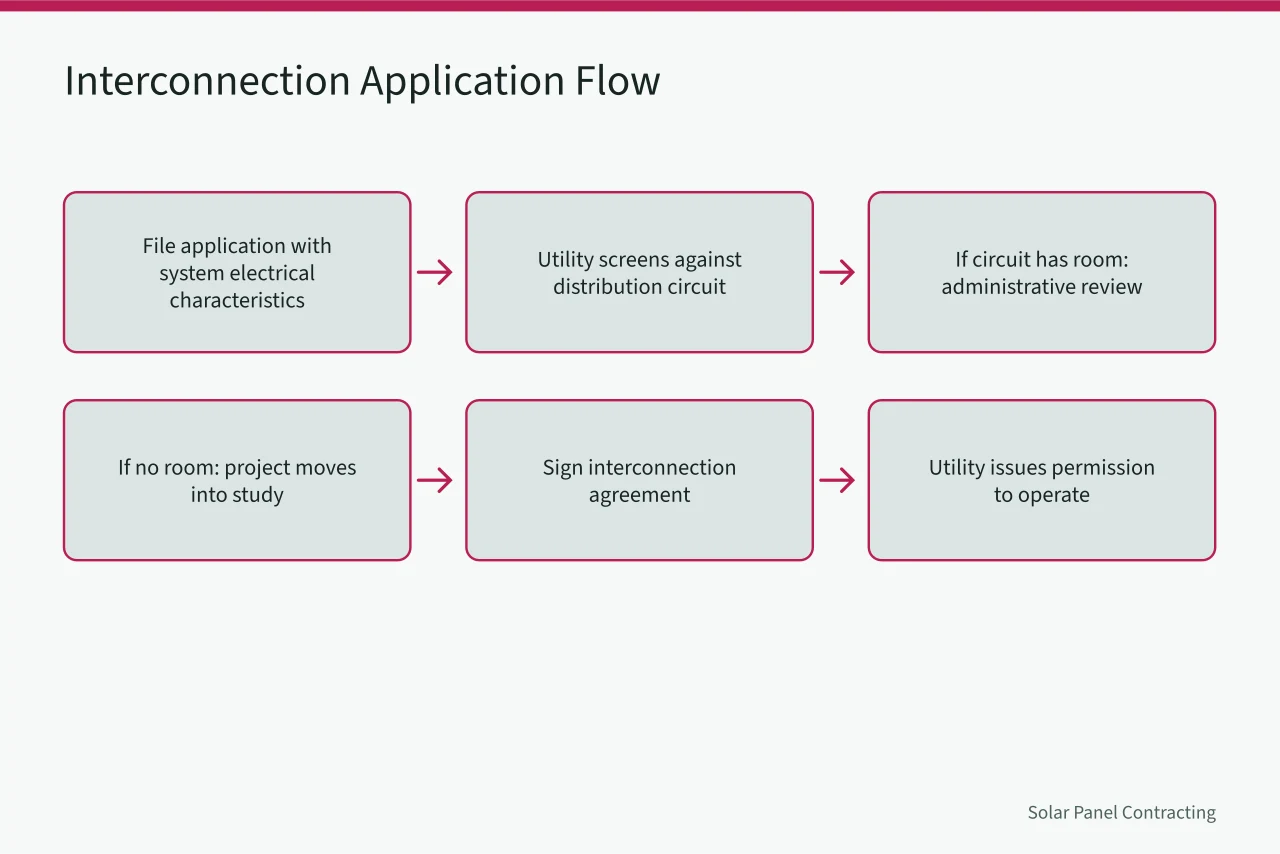
The sequence is similar at both utilities. You file an application describing the system's electrical characteristics. The utility screens it against the distribution circuit. If the circuit has room, the review is administrative. If it does not, the project moves into a study, and studies take time.
PG&E runs residential applications through an online portal tied to the customer's service account. Small systems that pass the screen get a fast review. A main panel upgrade or an export level above what the circuit was built for draws a second look. PG&E also wants a signed interconnection agreement before it issues permission to operate.
SCE works the same way in outline. Applications go through its own portal, the utility reviews the design against the serving circuit, and it issues authorization to operate once the application is approved and the local inspection is cleared. SCE has been explicit that it will not energize a system the authority having jurisdiction has not signed off.
Both utilities treat the queue as first come, first served within a circuit. Your customer's position depends partly on what else is being built nearby. A street where three neighbors go solar in one quarter can move slower than an isolated rural service.
The takeaway for solar panel contracting is that you manage two approvals, not one. Your schedule has to carry both. If you work across several utilities, the differences matter more than the similarities, which is why a service area and utility territory map belongs in your planning, not just your marketing.
What drives the delay ranges you quote
Delay ranges are the most useful number you can hand a customer and the easiest to get wrong. Utilities publish service targets, but actual times move with volume, circuit conditions, and how complete your application is.
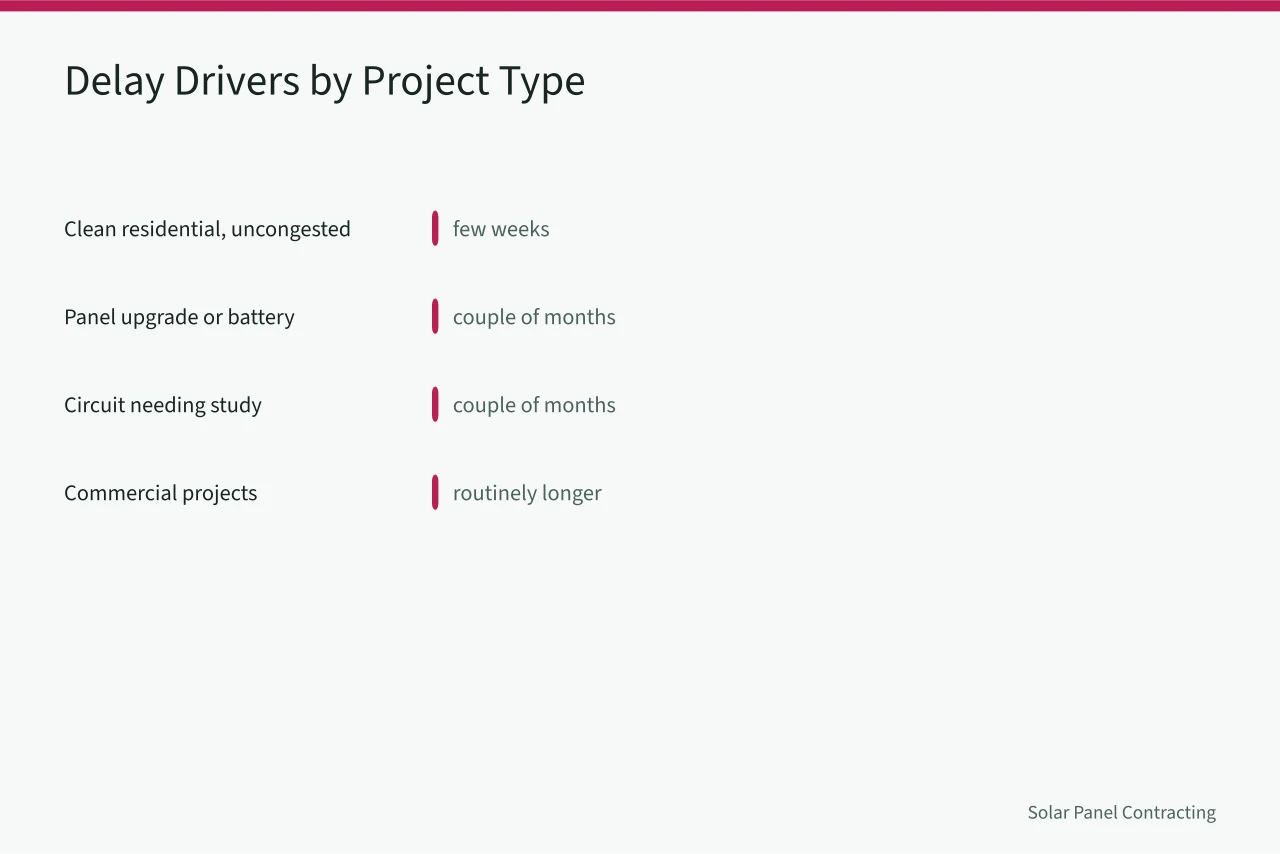
A clean residential application on an uncongested circuit usually clears review in a few weeks. Add a panel upgrade, a battery with a non-export setting, or a circuit that needs a study, and the same project can run into a couple of months. Commercial projects routinely run longer.
Four things drive most of the variance.
- Circuit capacity. A feeder already hosting a lot of distributed generation may need a study before it approves more export.
- Application quality. A missing single-line diagram, wrong inverter data, or a mismatch between application and permit adds review cycles.
- Inspection timing. The utility will not grant permission to operate until the local inspector signs off, so your inspection slot is part of the queue.
- Volume. Application surges, often tied to net metering California policy changes, lengthen everyone's review.
Net metering California rules are the backdrop. When the state changed its net metering structure, applications spiked ahead of the deadline and utilities worked through backlogs. Any future policy change will do the same thing.
Public electricity data is worth watching for context, since interconnection volumes track broader generation trends. The Electricity - U.S. Energy Information Administration (EIA) publishes that data, and it is a reasonable way to sanity check whether a slow quarter is local or statewide.
Grid integration research also shapes how utilities evaluate new connections, and the Infrastructure | NIST maintains work relevant to that. Knowing it exists explains why some reviews are more technical than others.
Regulatory notices can signal changes before they reach your inbox, and the Federal Register :: Environment carries federal energy and environmental notices that occasionally touch distributed generation.
What queue timing does to schedules and cash flow
Most solar contracts pay in stages, and the largest stage usually hangs on permission to operate, not the last roof screw. That single fact is the whole cash flow story.
Build the array in March and the utility grants permission in June, and your labor and material costs land in March while much of your revenue lands in June. Three months of float on every job is a working capital problem that compounds across a backlog.
Model it before you sell it. For each job, list the payment milestones, the expected date of each, and the gap between your largest cost outflow and your largest inflow. Then multiply that gap by the number of jobs you expect to have in flight at once.
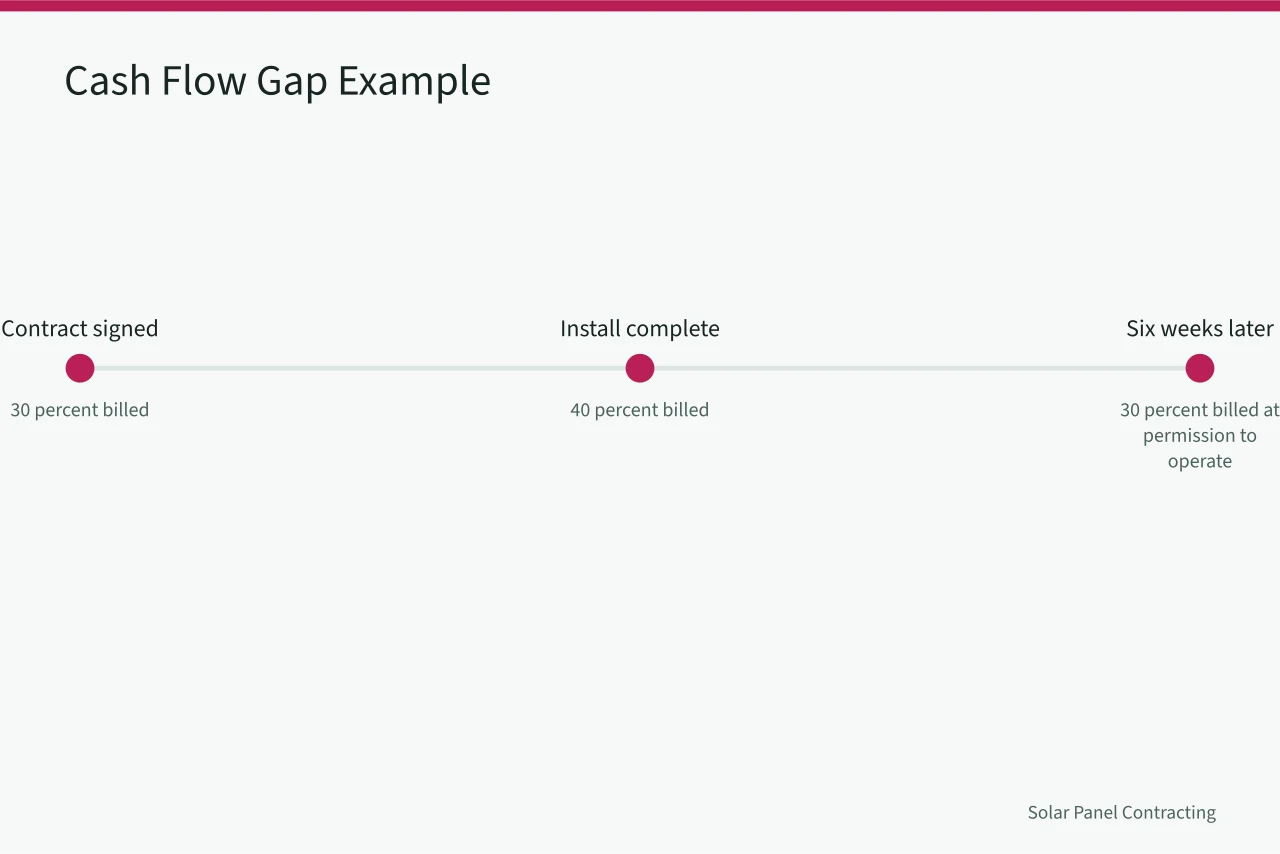
A worked example. Suppose a residential job bills 30 percent at contract, 40 percent at install, and 30 percent at permission to operate. If install happens six weeks before permission to operate, you carry 30 percent of the contract for six weeks. Ten jobs in that state is a real number, not a rounding error.
That is why a disciplined solar installer customer acquisition routine matters more in California than in states where utilities energize faster. You are not just tracking profit. You are tracking how long your money sits in someone else's queue.
A monthly KPI routine should include days from install to permission to operate, average receivable age, and the dollar value of completed but unenergized systems. Those three numbers tell you whether the queue is eating your margin.
Setting customer expectations in the sales conversation
Most complaints about interconnection do not come from the delay. They come from surprise. A customer told six to eight weeks who waited fourteen feels misled even when the work was flawless.
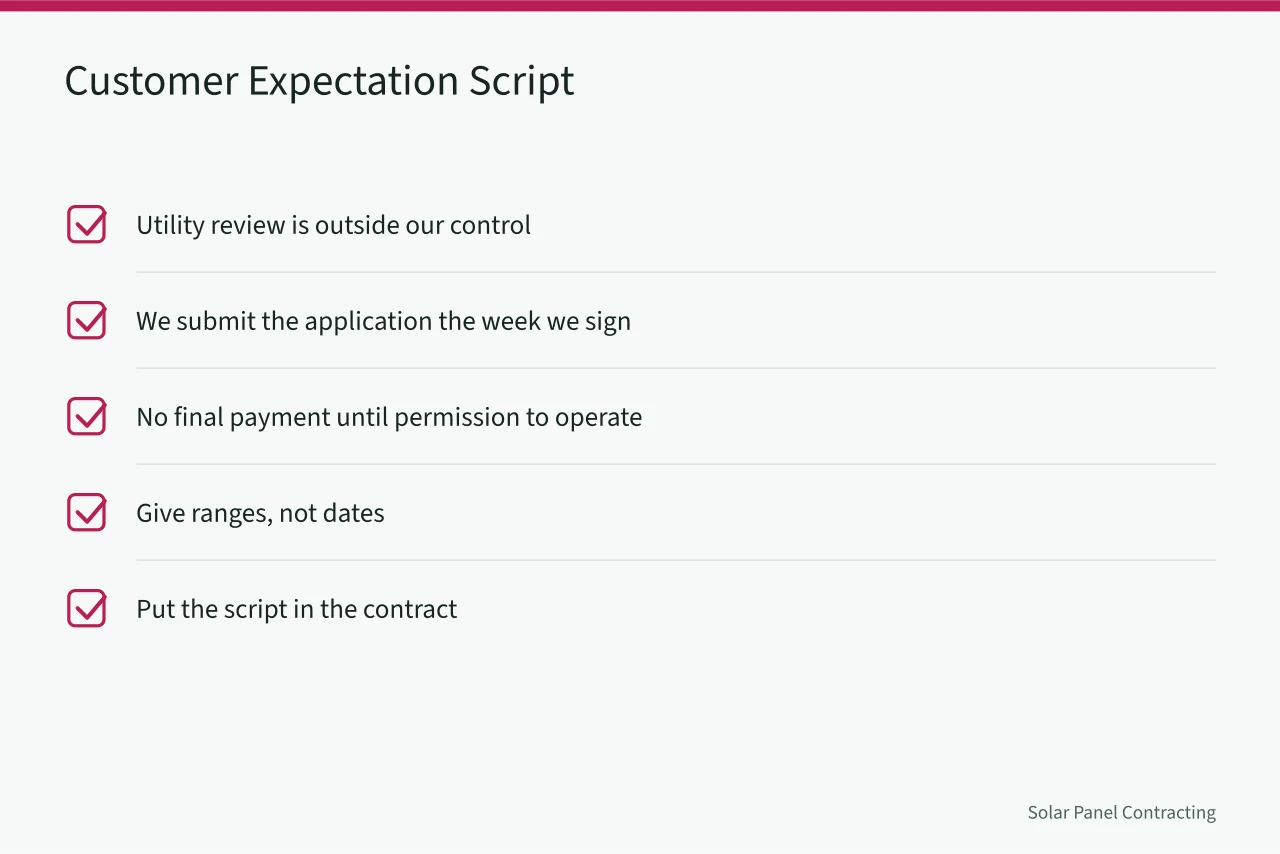
Give ranges, not dates. Say the utility review typically takes a few weeks for a straightforward project, and that projects needing a panel upgrade or a circuit study take longer. Then say you will tell them the moment the utility responds.
Put it in writing. A short expectation script in the contract, covering the utility review, the inspection, and permission to operate, prevents the argument later.
The Homeowner's Guide to Solar | Department of Energy is a useful reference for what customers have already read before they call you, and it sets a baseline you can speak to.
Three sentences that work:
- "The utility reviews the connection after we finish the install, and that review is outside our control."
- "We will submit the application the week we sign, so the clock starts early."
- "You will not owe the final payment until the utility grants permission to operate."
That last sentence is powerful and only safe if your cash flow can carry it. If it cannot, change the milestone, not the promise.
Sales staff should also know what the customer's utility actually requires. A script accurate for PG&E may be wrong for SCE. Build the script by utility, and keep it current. When something does go wrong, a documented complaint handling process keeps a delay from becoming a dispute. Most interconnection complaints are really communication complaints.
Paperwork and NEC-driven inspection steps that gate approval
Nothing moves until the paperwork is complete and the inspection passes. Treat both as part of the interconnection timeline, not as prerequisites you handle separately.
The National Electrical Code, published as NFPA 70 (NEC) Code Development, sets the electrical design and inspection baseline that California jurisdictions adopt and enforce. If your design does not meet the adopted code, the inspector will not sign, and the utility will not energize.
Confirm the adopted edition with your local AHJ, and have a licensed electrician sign the design.
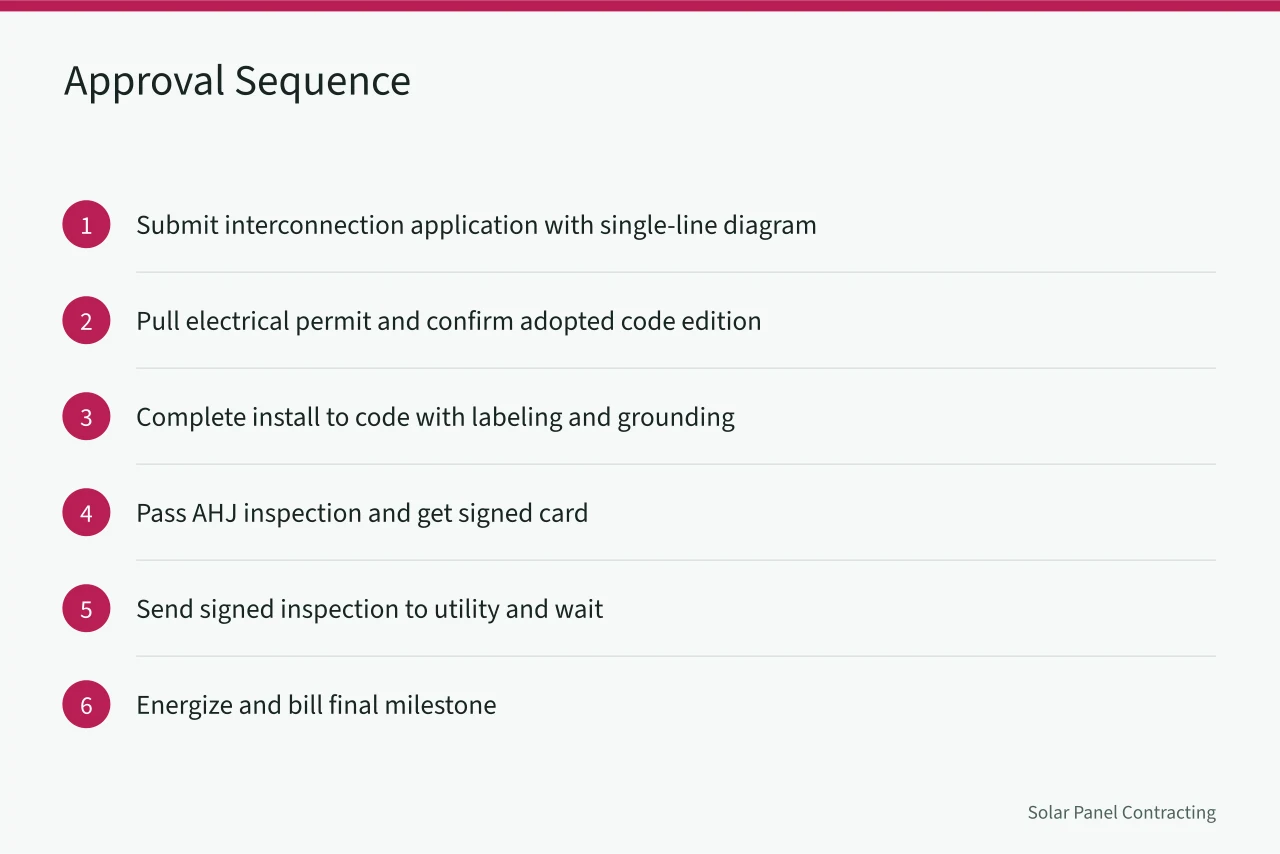
Here is the sequence that gates approval.
- Submit the interconnection application with a complete single-line diagram, equipment datasheets, and inverter settings.
- Pull the electrical permit and confirm the local jurisdiction's adopted code edition.
- Complete the install to code, including labeling, rapid shutdown, and grounding.
- Pass the authority having jurisdiction inspection and get the signed card.
- Send the signed inspection to the utility and wait for permission to operate.
- Only then energize and bill the final milestone.
Use this as a pre-submission checklist.
- Single-line diagram matches the permit set and the application.
- Inverter and battery datasheets attached, with export settings stated.
- Main panel busbar rating and any upgrade documented.
- Rapid shutdown and labeling per the adopted code edition.
- Customer service account number verified against the address.
- Inspection scheduled before the install crew leaves the site.
- Signed inspection card uploaded to the utility portal the same day.
Most rejections come from step one. A diagram that does not match the equipment actually installed sends the application back to the start of the review line.
Managing a backlog when interconnection slips
When the queue slows, you have two problems: the jobs already sold and the jobs you are still selling. Handle them differently.
For sold jobs, communicate on a schedule. A short update every two weeks, even when there is no news, does more than silence followed by an apology. Tell the customer exactly where the application sits.
For new sales, adjust what you promise. If your average install-to-permission time has stretched, your sales script has to stretch with it. Selling a six-week timeline when your last ten jobs averaged twelve is how you manufacture complaints.
Operationally, sequence crews so you are not finishing twenty systems in one month and energizing none of them. Spacing installs smooths both your labor and your receivables.
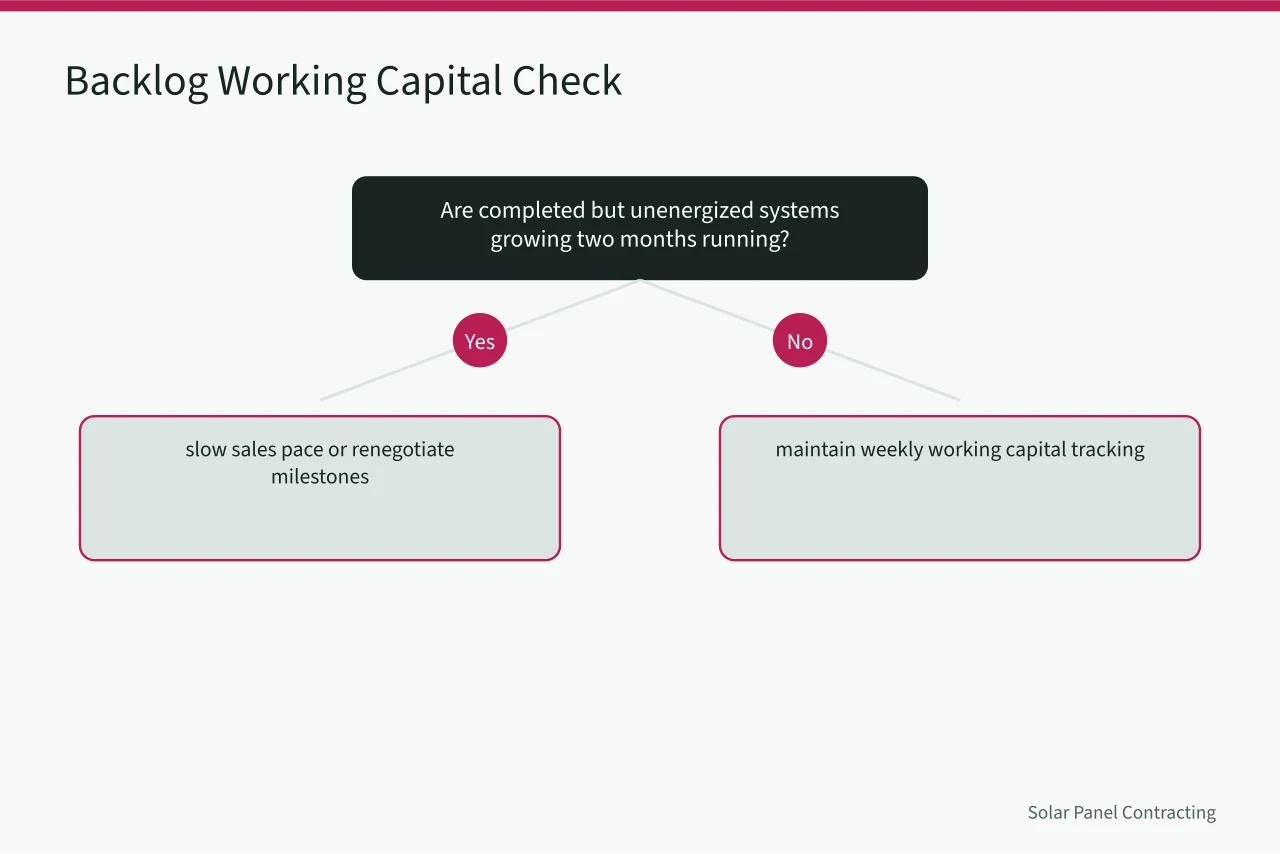
Watch working capital weekly, not monthly, during a backlog. Completed but unenergized systems are the number to track. If it grows two months running, slow your sales pace or renegotiate milestones before it becomes a payroll problem.
If you are deciding where to grow next, remember that queue behavior varies by utility territory, and that belongs in your business location strategy alongside labor and permitting costs.
Keep the customer's first bill in mind. Until permission to operate, they pay the utility in full with no solar offset. That is the real cost of a slow queue to them, and it is worth saying out loud.
Common questions
How long does PG&E take to approve a residential interconnection?
A straightforward application on an uncongested circuit usually clears review in a few weeks. Projects with a panel upgrade, a battery export setting, or a circuit study can take considerably longer. PG&E publishes its current service targets, and your application portal shows where the file sits.
Does SCE energize before the local inspection passes?
No. SCE requires the authority having jurisdiction to sign off on the installation before it issues authorization to operate. Build the inspection into your schedule as a hard gate, not a step you chase after the crew leaves.
Can I bill the customer before permission to operate?
That depends on your contract milestones. Many installers hold the final payment until permission to operate, which shifts the cash flow risk onto the business. Have an attorney review the milestone language before you change it.
What is the biggest cause of interconnection delay?
Incomplete or inconsistent applications. A single-line diagram that does not match the installed equipment sends the application back through review, and the project loses its place in line.