Guides
Solar Installer Subcontractor Agreement Canada: Terms to Review
Solar installer subcontractor agreement Canada must clear CRA classification, GST/HST and provincial lien rules. Review these before signing.
What to take away
- CRA decides contractor status from the facts of the working relationship, not from the label on the contract, so a written "subcontractor" heading settles nothing on its own.
- GST/HST registration is the subcontractor's obligation; a hiring firm that pays an unregistered supplier can be assessed for the tax it failed to withhold.
- Provincial lien legislation sets the holdback percentage and the deadline to preserve a lien, and those numbers differ by province.
- A clearance certificate or statutory declaration at final payment is the cheapest protection against a subcontractor's unpaid suppliers and workers.
Who has jurisdiction over the agreement
Three layers of rules apply at once, and they do not overlap neatly.
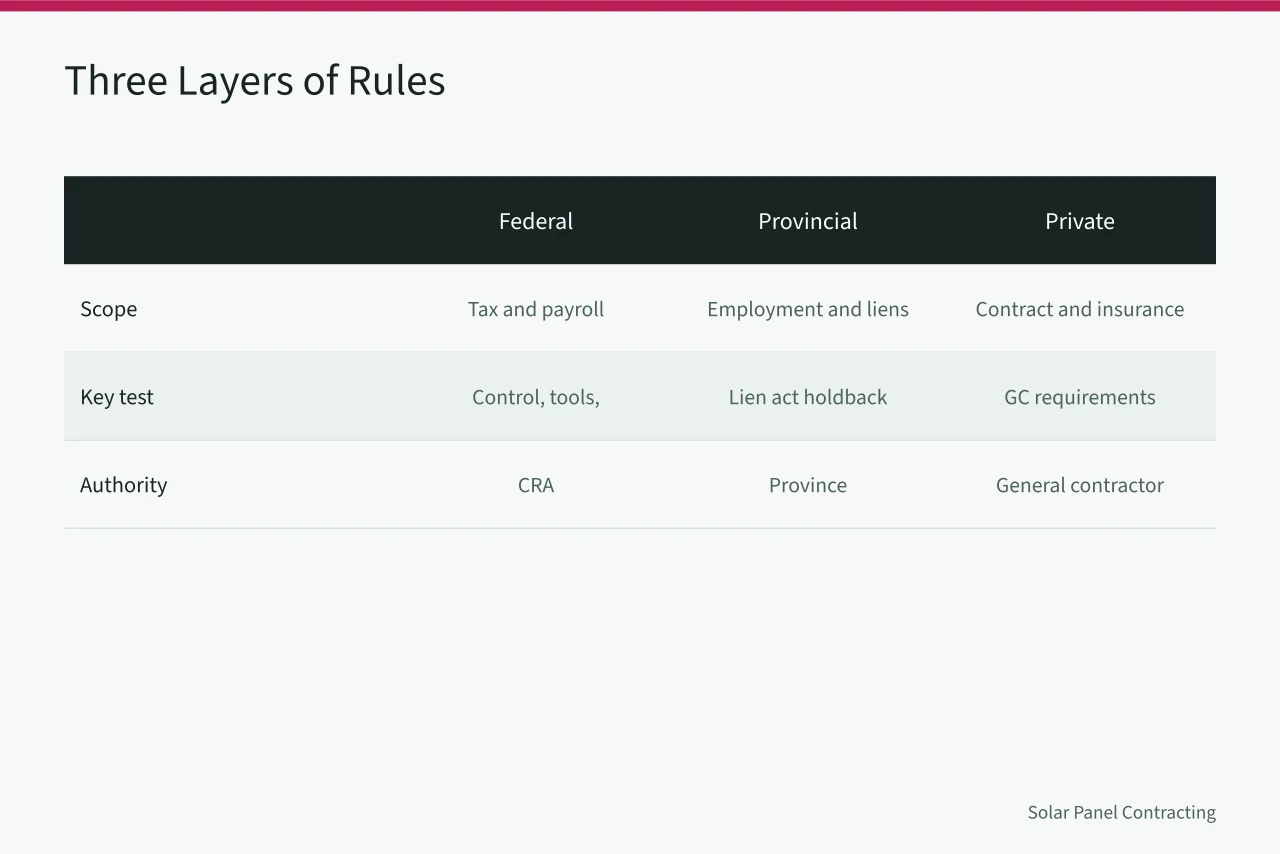
The federal layer is tax and payroll. The Canada Revenue Agency publishes the tests it uses to decide whether a worker is an employee or a self-employed contractor. Those tests turn on control, ownership of tools, chance of profit and risk of loss.
Read the agency's own payroll guidance before you draft a classification clause. A clause that contradicts the working reality will not hold.
The provincial layer covers employment standards, workplace safety insurance and construction liens. Each province runs its own regime, and the lien act in force where the panels go up governs the holdback.
The private layer is the contract itself plus any insurance and bonding requirements the general contractor imposes. Federal labour standards set a floor for some terms, and the Government of Canada's labour standards page explains which employees those cover.
What triggers a written agreement
A handshake is common on small residential jobs and it is a mistake once money, equipment or a second crew is involved.
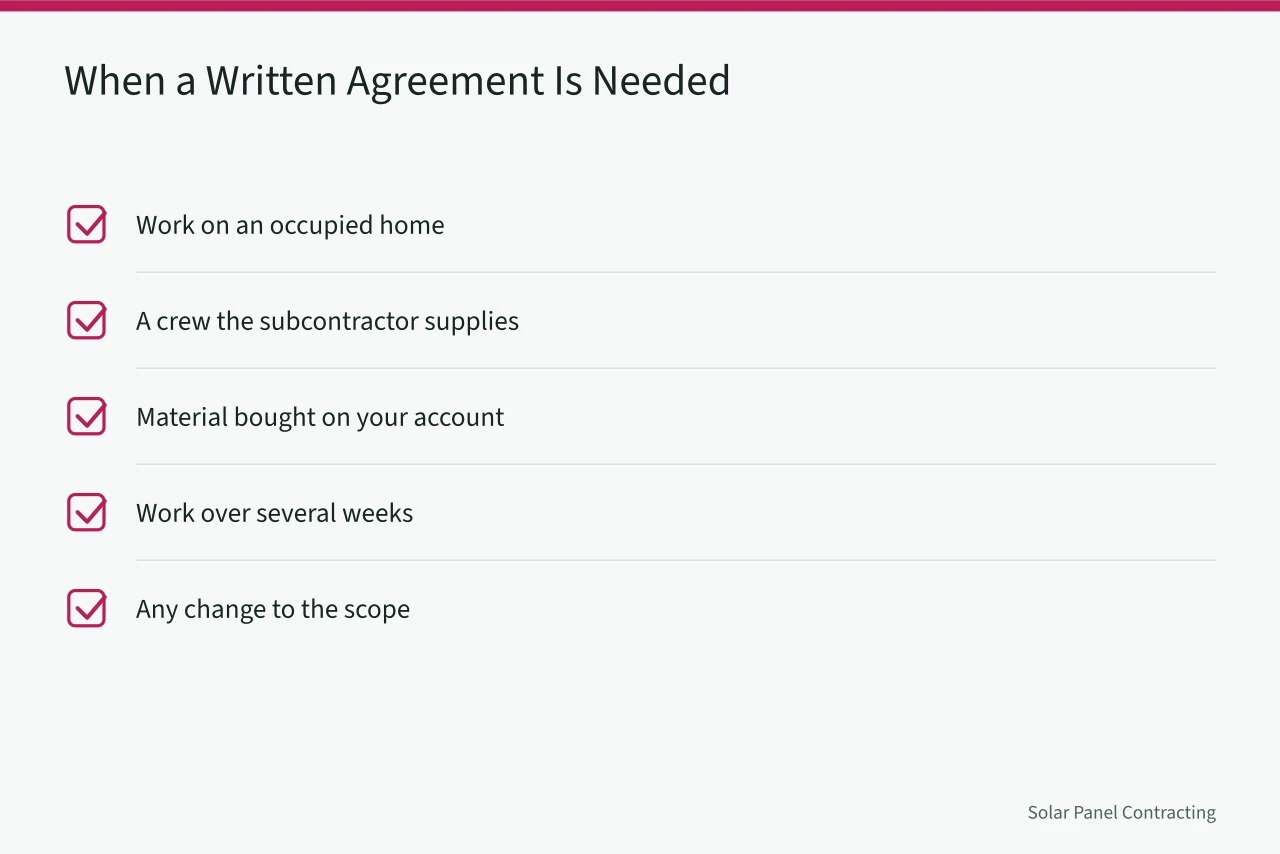
| Trigger | Why the agreement matters |
|---|---|
| Work on an occupied home | Liability, damage and cleanup terms need a named party |
| A crew the subcontractor supplies | Classification and WSIB or provincial coverage questions follow |
| Material bought on your account | Lien exposure shifts to your property |
| Work over several weeks | Holdback release dates need to be fixed in writing |
| Any change to the scope | Change orders need a signature trail |
The scope change is the one owners underestimate. A verbal addition to a roof array is a dispute waiting to happen, and the general concept behind a change order is that the price, schedule and responsibility all move together in one signed document.
Clauses that decide who carries the risk
Start with classification. The agreement should describe the work, the tools, the hours and the method of payment in a way that matches how the crew actually operates. A fixed price per installation supports contractor status. An hourly rate with set shifts and your equipment pushes the other way.
Then GST/HST. The subcontractor must be registered and must quote a valid business number on every invoice. If the supplier is not registered, the hiring firm can be held liable for the tax.
Insurance and coverage come next. Ask for a certificate naming you as additional insured, and confirm the provincial workers' coverage account is in good standing.
Finally, payment terms. The holdback percentage and the release date should be written into the agreement, not left to the lien act's default. The subcontractor relationship in construction law is well documented, and a written agreement is what separates a clean one from a costly one.
A subcontractor agreement that copies a United States template will get the tax, the holdback and the coverage wrong in three places at once.
Documents to collect before the first day
- Signed agreement with scope, price and schedule attached
- GST/HST registration number verified
- Certificate of insurance naming your company
- Provincial workers' coverage clearance letter
- List of workers who will be on site, with their own status confirmed
What happens if you skip the paperwork
The concrete consequence is a tax assessment. If CRA rules that a worker was an employee, the hiring firm owes the unremitted Canada Pension Plan contributions, Employment Insurance premiums, interest and penalties, and the liability can reach back several years.
A second consequence is a lien against the property. An unpaid supplier or worker can register a lien, and the homeowner will hold you responsible for clearing it. That is why a statutory declaration or clearance certificate at final payment is standard practice on Canadian jobs.
Common questions
Is a subcontractor agreement the same as a 1099 arrangement in Canada? No. The 1099 form is an American filing. In Canada the equivalent question is whether CRA treats the worker as an employee or a self-employed contractor, and the answer comes from the working relationship rather than a form.
Does the subcontractor charge GST/HST on the invoice? Yes, if the subcontractor is registered and the supply is taxable. The hiring firm should confirm the registration number before the first payment.
How long does a holdback stay in place? It depends on the province. Each lien act sets its own percentage and its own release period, so check the statute for the province where the work is done.
Can a contract clause override CRA's classification? No. A written clause is evidence, not a decision. CRA looks at control, tools, financial risk and integration into your business.